
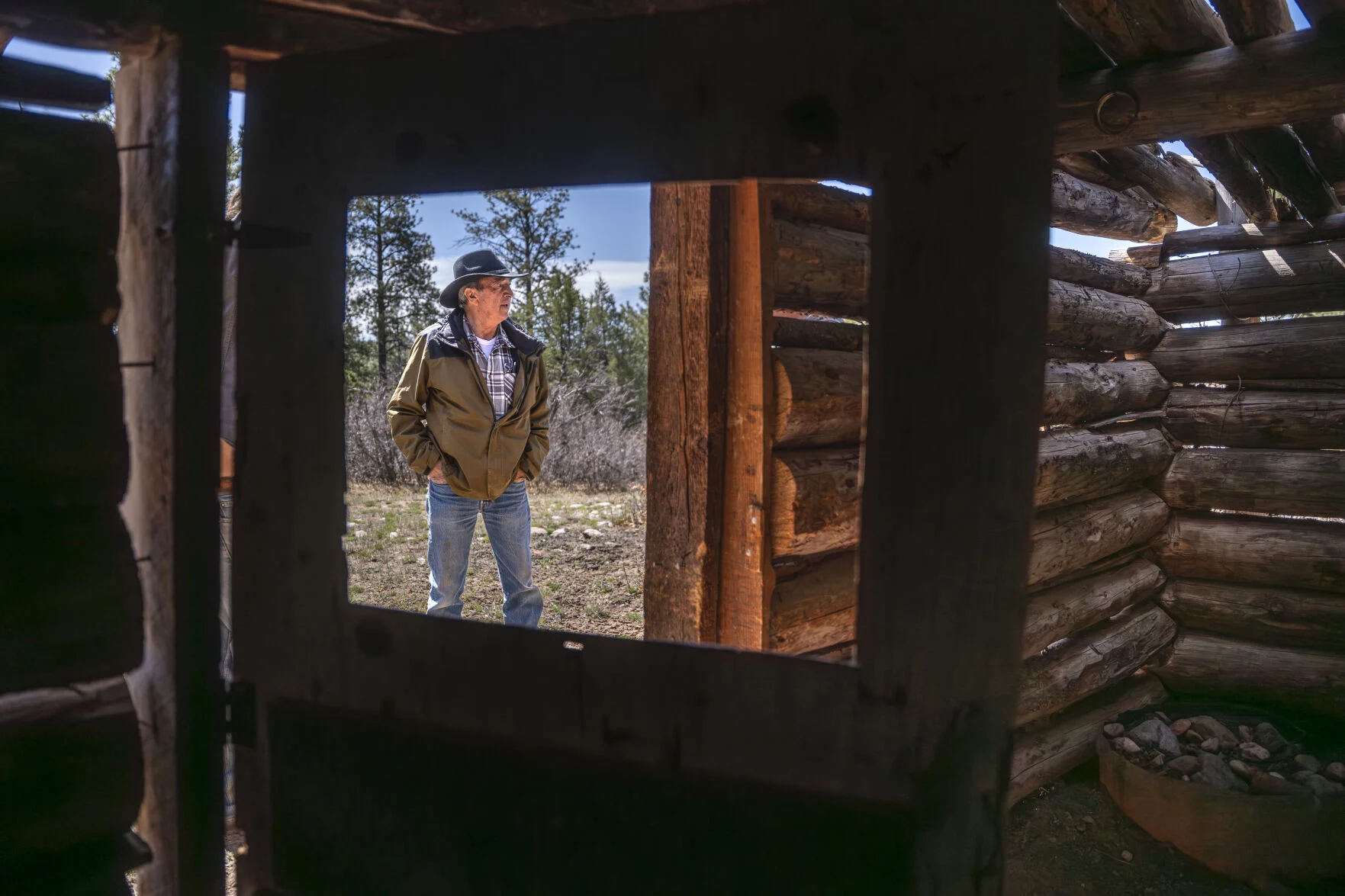
CANJILON — As he piloted his Toyota pickup down the familiar, winding Forest Service roads, Moises Morales spoke of generations of conflict between local ranchers and federal government employees who control grazing and timber permits.
He served six months behind bars long ago for his role in the 1967 raid on the Tierra Amarilla courthouse by land grant activists. Now, Morales is in the midst of another major fight: Exploratory drilling for uranium is proposed on the lush federal land where his family has run cattle for generations, near the streams central to the welfare of his rural village of Canjilon.
“We have to do whatever we have to do to stop it,” said Morales, 79, chairman of the Rio Arriba County Commission. “If we don’t, we’re done — the kids, the next generation. Think about the sickness this thing will bring.”
A proposal from a Canadian mining company to conduct exploratory drilling in the Carson National Forest north of Abiquiú has seeded swift outrage in the region, with opponents citing potential contamination to the Rio Chama watershed — which would not only affect local residents like Morales but could have impacts far downstream for both farmers and municipalities, including Santa Fe, that draw water supplies the Rio Chama carries to the Rio Grande.
In late April, during a packed meeting in Tierra Amarilla, the Rio Arriba County Commission passed a resolution objecting to the drilling proposal in front of an animated crowd. Residents have maintained uranium mining would have a devastating impact in a rural region where many make a living through ranching and agriculture, living off the land and relying on private water wells.

New Mexico’s congressional delegates have been outspoken in their condemnation of the plans, backing up a chorus of local voices — residents who fear they won’t be heard by decision-makers in Washington, D.C.
Last week, Morales floated the idea of barring mining company trucks from using county roads to access the Carson National Forest as he decried diminished grazing permits from the Forest Service in recent decades. He said these forests were once common lands stripped from land grant heirs in violation of the Treaty of Guadalupe Hidalgo generations ago in the early 1900s.
“I will not let them use county roads,” Morales said. “I will fight that.”
Drilling for uranium occurred north of Canjilon decades ago, he added.
Proposal under review
The decision is in the federal government’s hands. Gamma Resources Ltd. has applied for a permit through the U.S. Forest Service to do exploratory drilling for uranium in what it is calling its Mesa Arc project.
The company is advancing the project with a planned “10- to 12-hole 6,500-ft drill program” designed to look into “historical holes” and test “step-out targets,” according to the company’s website.
Carson National Forest spokesperson Zach Behrens said in a statement the agency is currently reviewing the exploration proposal to determine if it is “complete enough” for the Forest Service to consider. Once the proposal is completed, Behrens wrote, the agency would then determine the level of analysis needed to green-light the proposal under the National Environmental Policy Act.
Behrens said federal law distinguishes between exploration and mining.
“If a proposal for mining were submitted, it would trigger its own separate and rigorous regulatory review and environmental analysis,” the statement read.
Gamma Resources Ltd. did not respond to questions emailed last week.

Exploratory drilling for uranium is different from sustained, industrial-style uranium mining in that the former involves drilling holes in the earth to take rock samples and get a sense of underground mineral deposits. Although, such drilling is generally an indication a company would want to open mining operations in an area, provided sufficient mineral deposits are found.
On its website, Gamma Resources says historic drilling in the Carson National Forest discovered 2.9 million pounds of triuranium octoxide — known as U3O8 and a compound of uranium. “The project is centered on a four-mile uranium-mineralized trend with multiple deposits and areas of high-grade potential,” the website states.
‘Look at Church Rock’
On a recent day, Morales drove his pickup to a primitive cabin built by his grandfather in the 1930s deep in the forest for when the family went to work a particular pasture.
He and Max Martinez, another rancher in the Canjilon area, spoke animatedly through the lush canyons when passing a cattle watering tank, switching at times between Spanish and English.
“Right now, you can get on the ground and roll in it. If you need to take a bath in the Yeso Tank, you can take a bath in the Yeso Tank,” Martinez said, referring to a fishing hole in the forest near Canjilon. “But what’s going to happen in 30 years [if] the uranium has contaminated everything? Do you feel safe going out there and killing a deer and maybe eating it?”
“Look at Church Rock. Look at what they’ve done over there,” Martinez added, referring to a large uranium mill spill, considered one of the biggest releases of radioactive material in U.S. history, that occurred at a mill near Gallup in 1979.
Uranium mining legacy
Once a major industry, uranium mining slowed to a halt in New Mexico in the 1990s, but as the price and demand for uranium increases, the industry could be poised to make a comeback.
The legacy of uranium mining in New Mexico, particularly in the Grants and Laguna Pueblo areas from the 1950s until the 1990s, has prompted grave concerns.
Separate from the Carson National Forest proposal, a company is aiming to do exploratory mining in the Mount Taylor area near Grants.
After a peak in the 1980s, domestic uranium production plummeted as prices decreased. In the last quarter of 2025, however, production was on the rise, according to the U.S. Energy Information Administration. Seven facilities in Wyoming, Texas, Utah and Nebraska produced the entire supply.
U.S. Sens. Ben Ray Luján and Martin Heinrich, as well as U.S. Rep. Teresa Leger Fernández, sent a letter to Carson National Forest Supervisor James Duran expressing their objections to the Gamma Resources proposal. They plan to introduce federal legislation withdrawing the Chama watershed from “mineral entry.”
They also want the Forest Service to commit to a full environmental impact statement before any action is taken.
“The communities of the Chama Valley — acequia farmers, tribal members, ranchers, and rural families — have tended this watershed for generations,” the letter from the delegates states. “The Forest Service has both the authority and the responsibility to ensure that decisions affecting their water, their land, and their future are made with the care, science, and respect those communities deserve.”
‘Everything goes downhill’
Jicarilla Apache Nation President Adrian Notsinneh drew hearty applause April 23 during a County Commission meeting when he expressed solidarity with commissioners on opposition to the mining proposal.
“We need to stand up and prevent this,” Notsinneh told the commissioners. “Water is life.”

The scene was intended to be an unequivocal message for those in Washington: This rural county, larger than the state of Connecticut with some 40,000 residents, is prepared to fight back.
Parked in front of the Canjilon post office one day last week, before taking a trailer of cattle to the vet, Andres Garcia said uranium mining near Canjilon would have grave impacts not just for ranchers here but for everyone downstream.
The village, home to about 200 people, is about 80 miles north of Santa Fe.
“It’s not just Northern New Mexico that would be contaminated,” Garcia said. “It’s all the way down. You’re talking about Albuquerque, Santa Fe, Española — all the way down. Everything goes downhill. It’s not just our livestock here. It’s livestock all the way down.”
Morales said Tuesday about 100 people attended a meeting in the community that day convened by Sen. Lujan — another strong showing of opposition.
“Not one single mining company can say they can contain that material, where the community hasn’t gotten contaminated — the water, the soils, the cattle,” Martinez said. “We use cattle on those allotments. Where they are going to be drilling the exploratory hills, it’s grazing operations.”
Staff writer Alaina Mencinger contributed to this report.
Article Source: Santa Fe New Mexican