
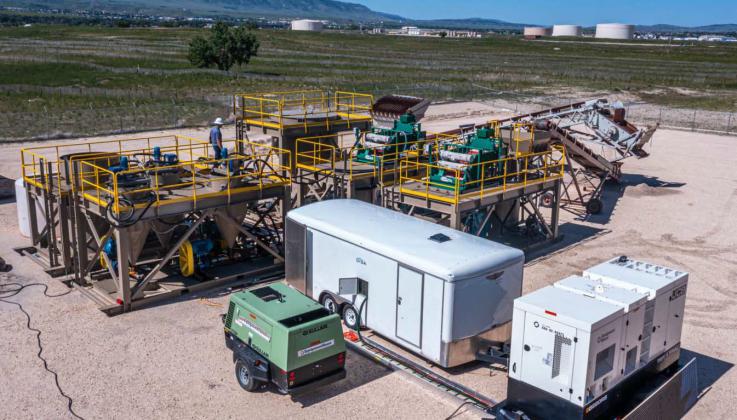
GRANTS, N.M. – Approximately 6,000 cubic yards of abandoned uranium mine waste will be excavated from four areas of the Old Church Rock Mine site on the Navajo Nation in a timecritical removal action approved by the U.S. Environmental Protection Agency as part of a settlement agreement with Nu-Fuels, Inc., a Laramide Resources Ltd. subsidiary. The Church Rock location will provide a testbed for the second phase of a treatment technology known as High-Pressure Slurry Ablation, or HPSA. DISA Technologies Inc., which owns the patent, received its Source Materials License Sept. 30 from the U.S. Nuclear Regulatory Commission to use ablation to remediate mine waste at abandoned and inactive mine sites. The Church Rock site was included previously in a HPSA study funded by U.S. EPA and finalized in 2023.
“This license represents a turning point in how our nation confronts legacy uranium contamination,” Greyson Buckingham, DISA CEO, president and co-founder, said in a followup to the NRC announcement. “For decades, AUM sites have been viewed as a burden too complex and costly to clean up. Today, we have a clear, regulated pathway to do it faster, safer, and at lower cost – while recycling valuable resources that support our nation’s energy future.”
‘Safer and Sooner’ “Addressing legacy uranium mine sites is a longstanding priority for the Navajo Nation,” according to Stephen Etsitty, executive director of the Navajo Nation Environmental Protection Agency.
The Old Church Rock Mine, through its various owners, operated as a conventional underground uranium mine from around 1957 to 1982, producing more than 293,000 tons of ore. Radiological surveys in 2006-2007 showed gamma rates approximately 50 times background for the area.
The mine is one of 523 testaments to the Cold War scattered across the reservation. Cleanup funding is available for about 220 of those mines. That leaves more than 50% orphaned, with no responsible party identified, no funding dedicated for their reclamation, and nobody left to sue, Etsitty said.
Former Navajo Nation President Joe Shirley Jr. signed the Diné Natural Resources Protection Act into law on April 29, 2005, after it overwhelmingly passed the 20th Council. The purpose of the law is to ensure that no further damage to the culture, society, and economy of the Navajo Nation occurs because of uranium mining or processing “until all adverse economic, environmental and human health effects from past uranium mining and processing have been eliminated or substantially reduced to the satisfaction of the Navajo Nation Council.”
“This (Church Rock) project is an important step forward to advance a set of cleanup solutions that we feel, and President (Buu) Nygren feels, are safer, effective and timelier,” Etsitty said. “We’re calling this new strategic approach ‘Safer and Sooner.’” Permanent removal
The Nygren administration wants permanent removal of the radioactive piles, not relocation to another spot on the reservation or bordering Navajo land, which historically has been the remedy employed by federal regulators.
In 2011, for example, approximately 30,000 cubic yards of radiumcontaminated soil from a transloading area at the Skyline Mine were transported from the desert floor in Monument Valley to the top of Oljato Mesa via a gondola and capped for “interim storage” at a cost of $7 million. U.S. EPA did not identify a permanent remedy.
HPSA’s strong performance in the 2023 pilot study, which used a 5-ton per hour unit, supported advancing to phase two and a 10-ton per hour unit, Etsitty said, adding that DISA is now working on 50- and 100-ton per hour units for future scalability.
“The Phase 2 Verification Study will allow us to continue evaluating this High-Pressure Slurry Ablation treatment technology at a larger field-scale level. We’re looking to actually do real removal actions – permanent removal actions – instead of just moving material from one location to another and capping it in place,” he said.
Resource or waste?
In the HPSA process, abandoned uranium mine waste is crushed and mixed with water to create a slurry which is then pumped through opposing injection nozzles that are contained within a steel collision cell. The highpressure nozzles create a high impact zone that separates uranium and other minerals from the host sand.
The process generates two types of material: “fines concentrates” containing licensable quantities of source material that will be packaged and sent offsite for disposal or further processing, and “coarse material” which could be used for backfill or cover material if it meets or exceeds background radiation levels. DISA expects the process to achieve a 60-90% reduction in uranium and radium-226 concentrations.
“We’ve had discussions with Energy Fuels for the fines concentrates,” Etsitty said. “There is the potential for this resource recovery to provide a potential revenue source. We’re not there yet with Energy Fuels, but if there’s any revenue we can realize from this resource recovery, we need to put that back to help reduce the cost of these actions. Every year of delay to get things cleaned up, the cost of construction continues to go up. And with this war happening, all of these fuel costs only add and escalate the price of doing this work.”
“We think that if we don’t find a way to keep the costs as low as possible we’re just going to end up with cap-in-place everywhere,” Etsitty said. “That ends up always being the lowest-cost option.”
Host site at Ambrosia Lake?
Navajo envisions taking the coarse material that doesn’t meet background levels to a site at Ambrosia Lake, owned by BHP, an Australian multinational mining and metals company.
“The Navajo Nation supports disposing of High-Pressure Slurry Ablation- treated uranium waste at Ambrosia Lake because the area’s favorable geology helps prevent groundwater contamination,” Daniel Moquin, principal attorney for the Navajo Nation Department of Justice’s Natural Resources Unit, said.
“The lack of the Navajo population near the proposed site is also important. This contrasts favorably with the U.S. EPA’s selection of a site near Thoreau, which is within the Rio San José Basin and too close to a substantial human population, including many Navajo Nation members,” Moquin said.
U.S. EPA has proposed removing 1.1 million cubic yards of untreated radioactive waste materials from the Quivira Mine near Church Rock, trucking it to the solid waste landfill just outside the Navajo community of Thoreau and burying it atop an artesian aquifer. Navajo EPA wants the waste taken farther than a mile or two from the Nation’s boundary.
BHP has expressed willingness to collaborate on developing a repository. Liz Ruedig of BHP spoke of the possibility during a November meeting of the Eastern Navajo Land Commission at Baca Chapter. “We believe that there is a lot of potential at the site,” she said, not only because of the reclamation status, but because BHP owns 14,000 acres in the area and could accept all of the waste from Navajo’s 523 abandoned uranium mines.
Weighing the benefits
The site’s proximity to the reservation would reduce transportation costs and degree of logistical complexity of moving waste following the ablation process, Ruedig said, adding that there is no threat to groundwater because historical mining activities reduced the amount of groundwater in the area.
Massive layers of Mancos shale would encapsulate any discharge and prevent contaminants from being transferred offsite. There are existing roads and a railroad nearby, no perennial streams or surface water bodies, and no nearby residences. “All of these factors make the Ambrosia Lake site a suitable location for a waste repository,” Ruedig said.
A recent conference presented by the Clean Energy Association of New Mexico focused on fueling the U.S. nuclear renaissance. “At this conference it was illustrated, if you have $100 and you spend $5 of it but then the $95 you put in a can and you just bury it and forget about it – that’s basically what the Quivira-Thoreau remedy is,” Etsitty said.
“We’ve asked EPA repeatedly, ‘Take off your statutory blinders and think as a trustee – what’s best for us? Is it best that we just take all this untreated waste material and pay the landfill authority to receive it to the tune of over $100 million? And if the price of uranium remains high, what if they decide to start shipping it out somewhere they can turn it over? Once it gets on the landfill, it’s off of the Nation, technically, and it’s out of our jurisdiction.”
Source Article by By Kathy Helms Special To Cibola Citizen