MASE
Posts by MASE Admin:
Press Release: July 13 Uranium Spill Commemoration
FOR IMMEDIATE RELEASE June 18, 2019
Contact: Edith Hood, Red Water Pond Road Community Association 505.905.8051 home, 505.713-4085 cell
Susan Gordon, Multicultural Alliance for a Safe Environment, coordinator 505.577.8438 sgordon@swuraniumimpacts.org contact for photos or graphics
Red Water Pond Road Community: 40 Years Since North East Church Rock Uranium Tailings Spill That Was Never Investigated Nor Cleaned Up
- Uranium Tailings Spill Commemoration, Saturday, July 13, 7 am to 3 pm 12 miles North of Red Rock State Park on State Highway 566 near Church Rock, NM
- Nuclear Nation Film Showing, Sunday, July 14, 12 pm to 4 pm The El Morro Theater, Gallup
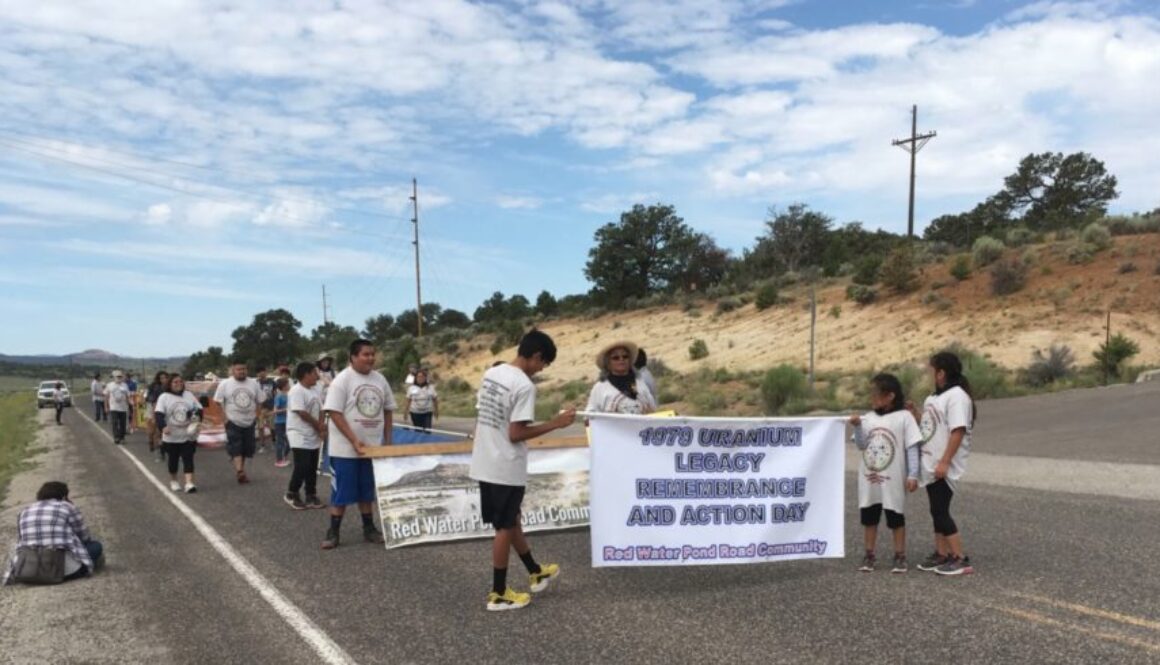
The Red Water Pond Road Community on Navajo Nation will be hosting their 40th annual commemoration of the 1979 Uranium Tailings Spill that is the largest uranium tailings spill in the United States.
On July 16, 1979, an earthen dam that held liquid uranium waste broke, releasing 1,000 tons of solid radioactive mill waste and more than 90 million gallons of acidic and radioactive liquids into the Rio Puerco. The contaminants flowed downstream through Gallup, NM and across nine Navajo chapters and into Arizona. Several days after the spill, United Nuclear Corporation sent a handful of people out with shovels and buckets in an attempt to remediate the mess. To this day there has been no reclamation, no study to see how far the contamination went and its impacts on local water systems and people’s health. United Nuclear Corporation has not been held accountable for the spill.
The North East Church Rock community are concerned about the uranium contamination legacy that has poisoned Mother Earth, including our sacred waters, land, and livestock. This gathering will provide a venue to discuss and educate everyone about the impacts of uranium mining and milling and about the ongoing work to remove uranium contaminated soil from the surrounding areas to protect our families and environment.
There will be a 7 am walk to the spill site to offer healing prayers. Following the walk people will gather under the shaded Arbor for food, community education, speeches, and a silent auction.
www.swuraniumimpacts.org
###
NM has already done its share for the nuclear age
Published March 23, 2019 Albuquerque Journal North
New Mexico is poised to become the Nuclear Waste Dump State for the United States. Nuclear waste from nuclear weapons and waste from commercial nuclear power reactors are all heading to our state if we don’t fight back.
There are efforts by the Energy Department to magically change the long-standing classifications of high-level nuclear waste in order to find cheaper ways to address legacy waste. The Waste Isolation Pilot Plant (WIPP) has worked to gain approval to change the way they measure the amount of waste allowed so they can bring even more transuranic waste to the facility. There are attempts to bring additional contaminants to WIPP that are outside of the original agreements made with the state.
And now we face a new threat with the proposed Consolidated Interim Storage (CIS) site being planned for Eddy and Lea Counties to become the holding facility for high level nuclear waste from reactor sites across the United States for up to 120 years.
Currently the Nuclear Waste Policy Act (NWPA) does not allow the private storage or ownership of high-level nuclear waste from commercial reactors. Unfortunately there is an effort to amend the NWPC to allow CIS of commercial waste until a permanent repository is established.
The state of New Mexico has not conducted any serious environmental review of the project proposed by the Holtec Corporation. Some items raising red flags are listed below:
- Holtec has no plan for repairing leaking canisters on-site or along the transport routes. They told the Nuclear Regulatory Commission (NRC) that they would return all leaking canisters back to the sender.
- Transport by rail, barge, or highway across 38 states could begin without any uniform plans for accidents along the way.
- There is no plan to inspect or replace storage canisters that are damaged at the reactor sites or subjected to corrosive elements in the atmosphere or ground beneath them and it may not be safe to try.
- No usable technology currently exists to monitor the spent fuel canisters once they have been emplaced in storage containers.
- A privately-owned and operated enterprise cannot guarantee that there will be no safety lapses or releases over an accumulated licensing period of 120 years, or even during the first 20 years in above-ground storage.
Alternative remedies include storing the existing high level nuclear waste in sturdier thick-walled steel canisters that can be safely inspected for damage and repackaged and keep them at the reactor sites until a permanent repository is built.
While checking on the lifespan of Holtec’s storage canisters, we found out that neither Holtec nor the NRC is willing to look at cask integrity beyond a 20-year licensing period. This is frightening news considering that untreated spent nuclear fuel must be isolated from air, water, and humans for hundreds of thousands of years.
Damaged thin-walled canisters are already in place at nuclear reactor sites such as San Onofre in California, placing nearby residents and Pacific coastal communities at risk, not to mention accidental releases to ocean waters. Risking the possibility of more damage while removing them from their current storage site is unnecessary, and transporting these damaged containers to New Mexico magnifies the risks of accidental releases exponentially.
If cracked and leaking nuclear waste storage canisters are props for a bad dream, then the dream of safely storing high level nuclear waste forever in containers that can’t be inspected or replaced is a nightmare beyond proportion.
Don’t Waste New Mexico. We’ve already done our share for the nuclear age. Quit producing more high-level nuclear waste until a permanent repository for this dangerous and long-lived waste is designated. States and communities selected to host the waste must give their consent before any of this hazardous material is moved from the site that produced it.
Signed:
Susan Gordon, Multicultural Alliance for a Safe Environment
Linda Evers, Post 71 Uranium Workers Committee
Candace Head-Dylla, Bluewater Valley Downstream Alliance
Edith Hood, Red Water Pond Road Community Association
Petuuche Gilbert, Laguna Acoma Coalition for a Safe Environment
Larry King, Eastern Navajo Diné Against Uranium Mining
Kids’ documentaries good for everyone involved
Gallup Independent Editorial – Dec 13, 2018
The uranium mining legacy of the region has had devastating effects on those who worked in uranium mines and those who live near the mines. Today, those who were exposed so long ago are seeing their children and grandchildren learn about how uranium affects humans. It is incredibly important for schools and families to educate children on the dark history of uranium mining in our area.
In Grants, community members sat down for an afternoon of education on the area’s history of uranium mining at the Grants Public Library Friday. Children and parents attended the event to understand their past.
During the event, elementary school students from St. Joseph Mission School shared their documentary-style videos on the subject. At least 10 St. Joseph’s students participated in the Multicultural Alliance for a Safe Environment’s Video Contest. They worked alone and in groups and researched their subject matter intensely. Not only were the acquiring new skills, their video projects were also part of a service learning initiative.
The students, some of whom live near uranium mines, interviewed their family members in their documentaries. The sixth-grade students conducted independent research and were not afraid to include themselves and their families in their videos. Almost all of the students interviewed their grandparents and other senior family members. For many, this may have been a sensitive subject, but it is important that the students were able to have this critical conversation with their relatives – many of whom probably never had their thoughts on their experience recorded. Students Raiden Martinez and Jimmy Nunez are from Laguna Pueblo and live near Jackpile Mine. Their documentary on uranium mining garnered them fourth place in the contest.
Student Merrick Kohn, whose documentary placed first, interviewed his grandmother who talked about her experience working in an office above a uranium mine.
Although she did not enter the mine, she, too, suffered side effects from having been exposed to uranium. In the video she explained how employees – miners and non-miners alike – discovered that their health was still adversely affected regardless of whether or not they entered the mine.
Second place winners Elijah Dah and Stevie Nunez interviewed St. Joseph Mission School Principal Antonio Trujillo. In that documentary, Trujillo gave a brief overview of his own post-1971 experience with the uranium mining industry.
Trujillo said he was surprised that the students showed great interest in the project and he wants to gear the students toward similar projects in the future. We think that’s a great idea because this issue is a worldwide problem that has had negative impacts on the environment and hundreds of millions of people and it is not addressed enough.
The Multicultural Alliance for a Safe Environment’s Video Contest awarded each winning contestant a share in prize money.
However, we hope that students will look beyond the value of the prize money and instead look forward to developing their newly-acquired skills. Interviewing people, conducting research and filmmaking is a form of storytelling and it is an integral part of human history. It is absolutely critical that storytellers – no matter what medium they choose – be encouraged to develop their skills because everyone has a story to tell.
In this space only does the opinion of the Gallup Independent Editorial Board appear.
Film festival hopes to raise awareness of uranium mining’s impact
By Dana Martinez December 10, 2018
Cibola County Bureau cibola2@gallupindependent.com
GRANTS — The Multicultural Alliance for a Safe Environment hosted a video contest Friday and tied it to the annual Uranium Film Festival. Residents were treated to be the first to see the films of local students. The main goal behind the event was to spread awareness of the impact of the uranium industry on families.
The contest was held in two parts. The first part was a viewing and results of elementary student videos at the Grants Public Library. All of the winning entries were from students at St. Joseph Mission School in San Fidel.
In the evening the review of high school student video submissions and results were seen in the New Mexico State University-Grants auditorium. In first place was a Grants High School Class, represented by Josh Sanchez, and in second place was Emily Ramirez.
Ramirez was interviewed after her video. The audience asked how she was able to get sweeping overhead shots of the Grants Mining Museum. She replied that she used her father’s drone. Another audience member asked if she had ever considered the impact of uranium on the area before. She replied that with her household being in an affected area they have become familiar with radon testing, but that she hadn’t thought about it beyond that.
Organizer and MASE associate Candace Head-Dylla said she was happy to see the students take such an interest in the subject. The awards ceremony concluded the film festival.
Film festival director Norbert G. Suchanek, of Brazil, said filmmaker Shri Prakash of Ranchi, India, was awarded “The International Uranium Film Festival Lifetime Achievement Award” for fighting the uranium industry for more than 20 years with his camera and for giving the voiceless uranium victims, who are the indigenous Adivasi people of Jadugoda, Indian, a powerful voice.
Filmmaker Brittany Prater of Ames, Iowa, received “The Young Director Award” for her feature-length documentary, “Uranium Derby,” which is about how she looked into her hometown’s highly secretive involvement in the Manhattan Project during the 1940s. Prater uncovered the historical role of Ames, Iowa, in the production of materials for the first atomic bomb through the portrayal of archival footage featuring two important involved scientists of the time, Dr. Harley Wilhelm and Dr. Frank Spedding.
‘Dooda Leetso’
Peaches, who received “The Young Indigenous Filmmaker Award” for her short documentary, “Dooda (No) Leetso (Uranium) The Legacy of Navajo Nation Uranium Mining,” said the award was her first one.
Dooda Leetso was produced by her company, PaperRocketProductions, which she co-founded. Peaches said she submitted Dooda Leetso to the international film festival at the invitation of Anna Marie Rondon, executive director of New Mexico Social Justice and Equity Institute.
“I’m so glad I did because I got to meet some amazing people who are doing wonderful work,” Peaches said.
She said she received her first formal filmmaking training when she was about 16- or 17-years-old and a participant in the “Outta Your Backpack Media project,” which was one of numerous endeavors by activist artist, musician, songwriter and organizer Klee Benally of Flagstaff. Peaches emphasized that Outta Your Backpack enhanced the filmmaking of her and her network of friends.
“We were on a fast track in making films and Outta Your Backpack was a great opportunity made available to us,” she remembered.
Peaches said that PaperRocketProductions has started working on “Protect,” which is a film that focuses on fossil fuels and indigenous communities directly impacted by it and their reactions to it.
She encouraged youth and young adults to become involved in film festivals by attending them, which she hoped would motivate them to take action in their communities.
Peaches added, “Young people should always have a seat at the table to have their voices heard because many of them feel like issues involving uranium and fossil fuels are not their issues or is an issue that they don’t need to worry about.”
Recycle
The Uranium Film Festival trophy is a piece of art produced by Brazilian waste-material-artist Getúlio Damado, who lives and works in the famous artist quarter Santa Teresa in Rio de Janeiro where the first International Uranium Film Festival was held in May 2011.
Damado uses old watches in the making of the awards to remember the first atomic bomb dropped over Hiroshima. Watches in Hiroshima stopped exactly at 8:15 in the morning when the A-bomb exploded on Aug. 6, 1945.
Nuclear filmmakers sometimes risk their careers or even their lives to do what they have to do and so the International Uranium Film Festival provides the filmmakers with a global audience and honors them and their work with awards “Radioactivity is invisible, has no smell no taste,” Suchanek said.
“It’s a huge challenge to film because it’s something that you cannot see, but something that still can hurt or even kill you.”
He noted, “In addition, nuclear programs and their consequences are often hidden or concealed by industry and governments. This complicates the work of investigative filmmakers. That’s why we founded the uranium fi lm festival to honor and reward these filmmakers and their work.”
International Uranium Film Festival presented filmmaker Deidra Peaches of Flagstaff, Arizona, with The Young Indigenous Filmmaker Award.
Photo courtesy International Uranium Film Festival
Kids’ videos offer new view of uranium mining’s legacy
By Dana Martinez December 8, 2018
Cibola County Bureau cibola2@gallupindependent.com
GRANTS — Community members sat down for an afternoon of education on the area’s history of uranium mining at the Grants Public Library Friday.
While that is not an uncommon occurrence for Cibola County, the day’s teachers were unique, elementary school students from St. Joseph Mission School shared their documentary style videos on the subject.
At least 10 St. Joseph’s students participated in the Multicultural Alliance for a Safe Environment’s Video Contest. They worked alone and in groups and researched their subject matter intensely. Their video projects were part of a service learning initiative.
Students show interest
Principal Antonio Trujillo said they showed more interest in the subject than they did in their usual reading and math work. Trujillo said the students applied all their skills into research and learning about the issue. He said, “I was really surprised. They really got involved with the idea that they are part of something bigger than themselves and that our area is ground zero for a worldwide dialog.”
The sixth-grade students researched on their own and added a personally relevant angle by interviewing family members who participated in uranium mining in the past, of which almost all the students interviewed their grandparents and other senior family members.
Hits close to home
The video project hit close to home for the students, both literally and figuratively. In fourth place was a video from Raiden Martinez and Jimmy Nunez. The two actually live near Jackpile Mine in Laguna Pueblo.
In second place was Elijah Dah and Stevie Nunez, who interviewed their principal. Trujillo gave a brief overview of his own post-1971 experience with the uranium mining industry.
The only quartet group came in third place. Fabian Chereposy, Damien Baca, Carmella Chosa, Johnathan Victorino and Joaquin Candelaria each researched a specific branch of information on uranium and mining techniques.
‘Fun, but frustrating’
In first place was Merrick Kohn. He interviewed his grandmother who talked about her experience working in an office above a uranium mine.
In the video, she explained the path of how employees other than actual miners discovered that there were still ill effects on employees health regardless of entering the actual mine.
Kohn said that the project was fun but very frustrating. Because of technical difficulties he had to edit his project three times.
Each winning contestant received a share of prize money. The third-place group said that they planned to put their sum toward a school trip happening later this year to Notre Dame University, in South Bend, Indiana
Filmmaker lends advice
Also present was a filmmaker and activist from India, Shri Prakash. The audience screened his film, “NABIKEI.” The film delves into the history of uranium mining in the Southwest and focuses on the past and present effects for Native American communities. It also details India’s hardships with the same industry.
The crowd started a brief discussion after Shri Prakash’s film and talked about their hopes for their new budding filmmakers. Shri Prakash started the discussion by comparing the United States efforts to have standards for health, safety and the environment.
A new hope
Carletta Garcia said a few words to the group. One of the school students is a relative. She said, “I have a new hope for future environmentalists.”
That hope is also shared with Trujillo, who said that they want to keep the kids geared toward more similar projects. In the future, Trujillo hopes to have the kids participate in a project wherein they learn about scientific testing of water around mines.
Organizer of the contest, Candace Head-Dylla, is the Community Liason for the Bluewater Valley Downstream Alliance. She said that this is the first video contest that the group has put on. The afternoon was dedicated to the elementary students.
“We’re trying to get the youth interested in the topic and issues. We hope that they can understand the issues and legacy left,” she said.
She added that this was also good for them to hear from a professional like Shriprekash. He noted that he “sees a lot of hope” in the students eyes over their project.
The evening portion was hosted at New Mexico State University-Grants for the high school student entries. It was in combination with an International Film Festival.
Uranium Workers’ Day Feb 15th
PRESS ADVISORY January 18, 2019
Contact: Susan Gordon, Coordinator, Multicultural Alliance for a Safe Environment 505-577-8438 sgordon@swuraniumimpacts.or
Former uranium workers and impacted community members will travel to the Round House to raise concerns about the continuing historic uranium mining faced by many New Mexicans
* Uranium Workers’ Day at New Mexico Legislature is Friday, February 15, 2019
The Multicultural Alliance for a Safe Environment will be hosting the Uranium Workers’ Day at the New Mexico State Legislature, in Santa Fe, on Friday, February 15th. Starting at 12 pm there will be a press conference in the Rotunda with former uranium miners and people from the impacted communities.
Speakers at the 12 pm event on February 15 include:
Linda Evers with Post “71 Uranium Workers Committee. Ms. Evers lives in Milan and has been working for decades to gain fair compensation for uranium workers who are not covered under the current version of the Radiation Exposure Compensation Act.
Larry King volunteers with the Eastern Navajo Diné Against Uranium Mining. He was working for United Nuclear Corporation when the largest uranium tailings spill in the US breached an earthen dam in Churchrock in July 1979 spilling millions of gallons of acidic, radioactive tailings solution.
Anna Benally lives in the Red Water Pond Road Community on Navajo Nation. Anna and her family live between two massive uranium tailings piles that continue to contaminate her community.
Visit www.swuraniumimpacts.org for more information.
Contact Susan Gordon for interviews with uranium workers.
###
Japanese, Navajo share views when it comes to their livestock
By Marley Shebala, Dec 3, 2018
Diné Bureau navajo1@gallupindependent.com
WINDOW ROCK, Ariz. – Japanese cattle farmers may live more than 5,680 miles from the Navajo Nation, but they are connected to the Diné people by their fierce love for their livestock.
In the film, “Nuclear Cat tle,” a middle-age Japanese couple recall with a flood of tears the day that they were forced to drive past their cattle and flee for their lives from their cattle farm and home that they built because of the nuclear disaster at the Fukushima Daiichi Nuclear Power Plant.
The husband, who was speaking Japanese, said, “When we were leaving, I couldn’t stop crying. I told them (the cows) I was sorry.”
On March 11, 2011, a major earthquake and tsunami caused Japan’s worst nuclear accident, which involved the disabling of the power supply and cooling of three-Fukushima Daiichi nuclear reactors that melted three nuclear cores in the first three days, forced the evacuation of about 160,000 people, and the death of about 19,000 residents living along the northeast coast of Japan.
‘Nuclear Cattle’
“Nuclear Cattle,” focused on how the deadly aftermath of the disaster impacted cattle, including those owned by the Japanese couple and other Japanese farmers.
There are massive numbers of carcasses of cows that were left tied to stalls in barns. The few cows that are still alive are emaciated and lying on the ground slowly dying. But then the film shows herds of cattle wandering around evacuated residential areas and towns.
The Japanese couple, who have returned to their cattle farm, which is still contaminated by radiation, look at their surviving cattle and remember the day the Japanese government ordered all the cattle farmers to kill their cows that survived. The husband says, “I feel alive when I come home.”
The wife of another Japanese couple that has also returned to their contaminated farm and home to save their cattle, says her husband told her he would not mind if he dies at home with his cattle.
Surviving cattle
A worker on another cattle farm, which became a haven for surviving cows and is called Farm of Hope, says he returned to his work station without the owners because he could not allow the cows that survived the disaster to die from starvation and dehydration.
He also says that even through the Japanese government tells the farmers that their cows are financially worthless, he knows that there is a reason the cows survived and it must be found.
A Japanese professor from a nearby university identified that reason and it was for scientific research so other parts of the world impacted by nuclear contamination will know how it hurts large domesticated animals. But the Japanese government refuses to fund the research and continues to refuse financial support.
Herve Courtois, an International Uranium Film Festival commissioner from France, who watched Nuclear Cattle, which has English subtitles, said the Japanese government refuses to fund the research on their people’s cattle because the government supports the corporations operating the nuclear power plants.
Dana Eldridge attends the International Uranium Film Festival at the Navajo Nation Muse um in Window Rock, Arizona, Thursday. Alma E. Hernandez/Independent
Government revenues
Courtois said the nuclear plants generate revenues for the government, which has also pushed the government to hire a public relations firm to spin lies after lies to their people about the safety of nuclear energy.
He said the government reported to their people that the cattle farmers and other residential areas were being successfully decontaminated by scraping off the surface of the land, bagging the earth and depositing at one of extremely dangerous contaminated cattle farms, which is surrounded by lush green forests and within view of the Fukushima Daiichi nuclear power plants operated by Tokyo Electric Power Company.
But, Courtois said, the government and T.E.P.Co. withhold information about how the radiation has seeped lower into the earth and how they cannot scrape the top soil from the forest areas, which means that when it rains, the runoff re-contaminates the surface.
“Nuclear Cattle” was one of several films shown for free at the Navajo Nation Museum as part of the 2018 International Uranium Film Festival, which started Thursday and ends Saturday night. But if you missed the film festival at the museum, you have a chance to attend the one-day festival at the Native American Cultural Center at Northern Arizona University in Flagstaff, Arizona, Sunday.
The festival will also travel to Grants, Albuquerque, Santa Fe and Tucson, Arizona.
Information: uraniumfilmfestival.org
Thelma Whiskers talks about the White Mesa Mill that has affected her life after a screening of “Half Life: The Story of America’s Last Uranium Mine,” during the International Uranium Film Festival at the Navajo Nation Museum in Window Rock, Arizona, Thursday. Alma E. Hernandez/Independent
Film festival highlights uranium’s impact on tribal lands
Noel Lyn Smith, Farmington Daily Times Published Nov. 30, 2018
Traveling festival makes 3-day stop in Window Rock
(Photo: Noel Lyn Smith/The Daily Times)
WINDOW ROCK, Ariz. — The International Uranium Film Festival began its three-day run at the Navajo Nation Museum here on Thursday.
The film festival was founded in 2010 in Rio de Janeiro with the goal of informing audiences about the impact of uranium mining and nuclear activities on communities and the environment.
It visited Window Rock in 2013 and will hold screenings this month in Albuquerque, Grants and Santa Fe, and in Flagstaff and Tucson, both in Arizona.
Anna Rondon is the executive director for New Mexico Social Justice and the Equity Institute, a nonprofit organization that deals with environmental health disparities. She helped organize the festival’s visit to the Southwest.
Navajo Nation Vice President and President-elect Jonathan Nez, left, talks about the legacy of uranium mining on the reservation while Vice President-elect Myron Lizer listens during the International Uranium Film Festival on Thursday at the Navajo Nation Museum in Window Rock, Ariz. (Photo: Noel Lyn Smith/The Daily Times)
“It’s a festival of films. Films of education. We are not celebrating uranium. Let me make that clear, it’s a festival of how we can fight and survive beyond the nuclear deprivation of our homelands,” Rondon said.
Navajo Nation Vice President and President-elect Jonathan Nez said the festival provides the opportunity to show films that featue the Native American perspective and demonstrate a universal concern about uranium mining on health and the environment.
“It’s not a Navajo issue. It’s clear across the country, all around the world,” Nez said.
He commended the work of the film festival founders, Norbert Suchanek and Márcia Gomes de Oliveira, for providing an outlet for people to understand the circumstances of uranium on communities.
International Uranium Film Festival founders and directors Norbert Suchanek and Márcia Gomes de Oliveira address the audience at the start of the event on Thursday at the Navajo Nation Museum in Window Rock, Ariz. (Photo: Noel Lyn Smith/The Daily Times)
With more than 500 abandoned uranium mines on the Navajo Nation, the need continues to address clean-up activities and to hold the federal government and companies accountable for mining, he said.
“How do we come together and express our discontent? That’s what we are here to do through this film festival,” Nez said.
Approximately 40 people attended the first session at 3 p.m., which showed five documentaries.
The film “Half Life: The Story of America’s Last Uranium Mill,” focuses on the White Mesa uranium mill, located 2 miles north of the Ute Mountain Ute Tribe’s White Mesa community in Utah.
An audience watches the documentary “Dii’go Tó Baahaane’: Four Stories About Water” at the International Uranium Film Festival on Thursday at the Navajo Nation Museum in Window Rock, Ariz. (Photo: Noel Lyn Smith/The Daily Times)
Thelma Whiskers was one of three tribal members who spoke about the mill site after the screening. Whiskers said she has expressed her opposition to the site for several years because of its risk to public health and the land.
She added the documentaries she watched on Thursday opened her eyes to uranium’s effect on tribes.
“No matter what tribe we are, we are all brothers and sisters,” Whiskers said.
The festival resumed at the museum today. It concludes Saturday with screenings at 10 a.m., 2 p.m., 3 p.m. and 5:30 p.m., and an awards ceremony at 7 p.m.
Noel Lyn Smith covers the Navajo Nation for The Daily Times. She can be reached at 505-564-4636 or by email at nsmith@daily-times.com.
International Uranium Film Festival returns to Navajo Nation
Farmington Daily Times by Noel Lyn Smith, Nov. 26, 2018
FARMINGTON — Documentaries that share stories about uranium mining and its legacy on Native American communities will be shown when the International Uranium Film Festival returns this week to Window Rock, Arizona.
The free film festival starts Thursday at the Navajo Nation Museum and will feature film screenings over three days.
The film festival was founded in 2010 in Rio de Janeiro with the goal of providing education about the impact of uranium mining and nuclear activities on communities and the environment.
The festival previously visited Window Rock in 2013, and this year’s stop is part of a Southwest tour that includes screenings in December in Albuquerque, Grants and Santa Fe, and in Flagstaff and Tucson, both in Arizona.
“The International Uranium Film Festival has been operating every year. They do one or two presentations in different countries, and it seemed like a good time to come back to the U.S. Southwest,” said Susan Gordon, coordinator for the environmental group Multicultural Alliance for a Safe Environment.
The group partnered with New Mexico Social Justice and the Equity Institute, a nonprofit organization that deals with environmental health disparities, to bring the festival to the area.
One of the documentaries that centers on the Navajo Nation is “Tale of a Toxic Nation,” which focuses on the Red Water Pond Road community in Church Rock near Gallup.
Gordon said the 13-minute documentary tells the story about the community’s uranium mining legacy and how residents continue to advocate for federal agencies to conduct cleanup activities.
“I think it’s empowering for them to be able to see their story and know it’s going out much further than they were used to,” she said.
Other documentaries share information about the consequences of uranium mining on members of the Ute Mountain Ute, Acoma, Laguna and Lakota tribes.
There are also films about nuclear activity occurring at the international level, including one about the 2011 nuclear accident at the Fukushima Daiichi plant in northern Japan, and about activity happening in the U.S., such as the proposed nuclear waste repository at Yucca Mountain in Nevada.
Norbert Suchanek, general director for the film festival, said audience members gain firsthand information about the risks of uranium, nuclear power, nuclear waste and radioactivity, as well as knowledge for addressing those issues.
Suchanek added that since these types of film are not regularly shown in theaters, the festival provides a “rare opportunity.”
“That’s a totally different experience than to watch the films on your computer or TV. Plus, the audience will meet the filmmakers, too, and discuss the films and issues with them,” he said.
The festival opens at 3 p.m. Thursday, followed by screenings at 5:30 p.m. and 7 p.m.
Navajo Nation Vice President and President-elect Jonathan Nez will be the guest speaker when the event starts Thursday.
On Friday, screenings are planned for 10 a.m., 3 p.m., 5 p.m. and 7:30 p.m. Showings on Saturday will be at 10 a.m., 2 p.m., 3 p.m. and 5:30 p.m.
There will be question-and-answer sessions with filmmakers and festival organizers following select screenings.
For more information about the festival or to review its program, visit the International Uranium Film Festival website at uraniumfilmfestival.org.
Noel Lyn Smith covers the Navajo Nation for The Daily Times. She can be reached at 505-564-4636 or by email at nsmith@daily-times.com.