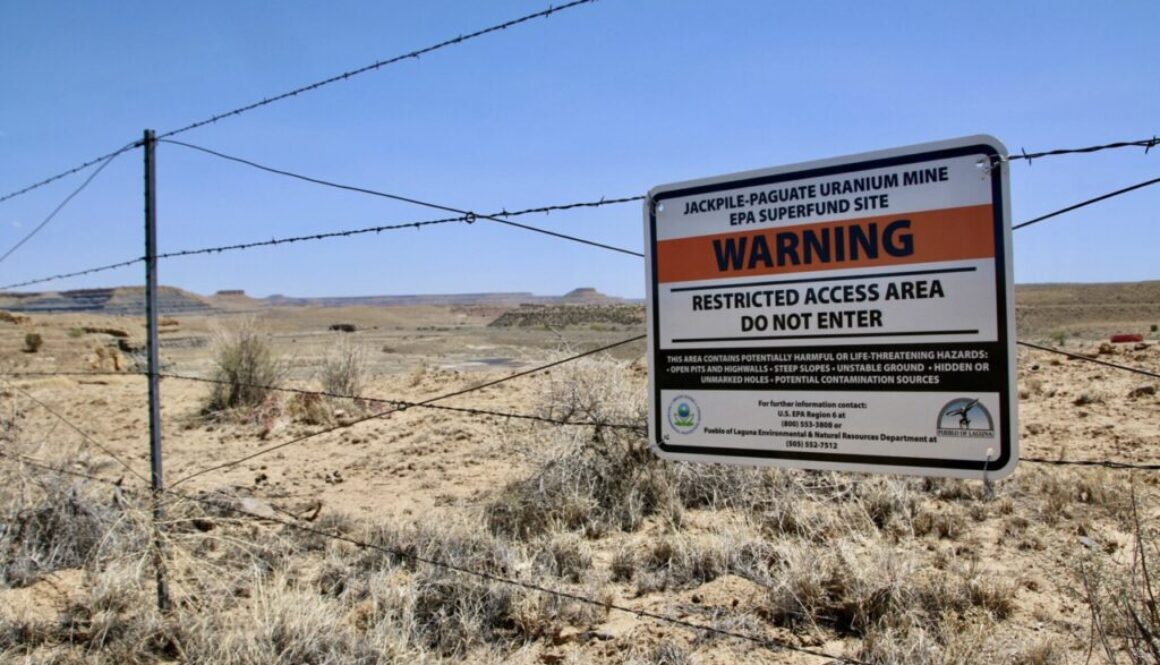
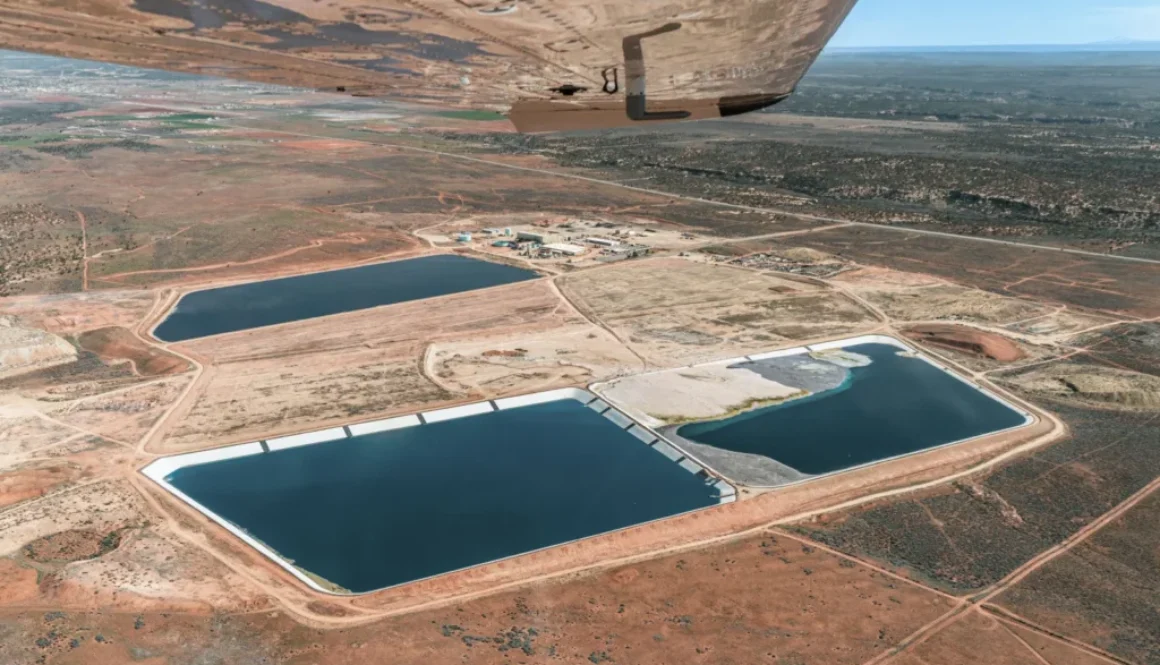
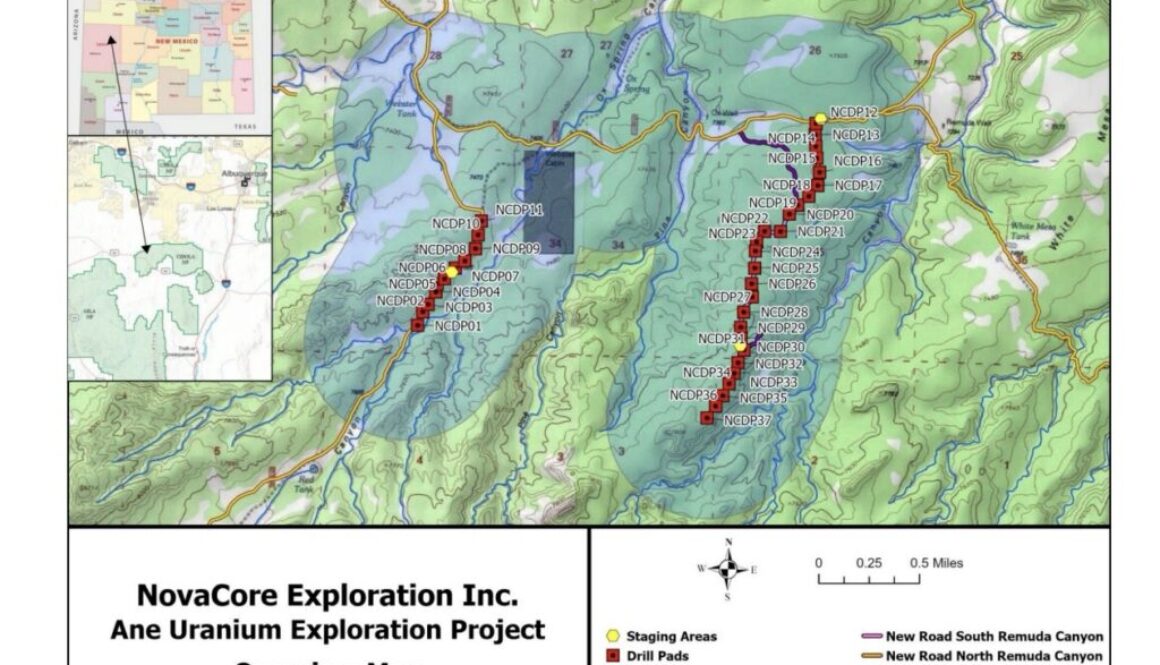
GRANTS, N.M. – Approximately 6,000 cubic yards of abandoned uranium mine waste will be excavated from four areas of the Old Church Rock Mine site on the Navajo Nation in a timecritical removal action approved by the U.S. Environmental Protection Agency as part of a settlement agreement with Nu-Fuels, Inc., a Laramide Resources Ltd. subsidiary. The Church Rock location will provide a testbed for the second phase of a treatment technology known as High-Pressure Slurry Ablation, or HPSA. DISA Technologies Inc., which owns the patent, received its Source Materials License Sept. 30 from the U.S. Nuclear Regulatory Commission to use ablation to remediate mine waste at abandoned and inactive mine sites. The Church Rock site was included previously in a HPSA study funded by U.S. EPA and finalized in 2023.
“This license represents a turning point in how our nation confronts legacy uranium contamination,” Greyson Buckingham, DISA CEO, president and co-founder, said in a followup to the NRC announcement. “For decades, AUM sites have been viewed as a burden too complex and costly to clean up. Today, we have a clear, regulated pathway to do it faster, safer, and at lower cost – while recycling valuable resources that support our nation’s energy future.”
‘Safer and Sooner’ “Addressing legacy uranium mine sites is a longstanding priority for the Navajo Nation,” according to Stephen Etsitty, executive director of the Navajo Nation Environmental Protection Agency.
The Old Church Rock Mine, through its various owners, operated as a conventional underground uranium mine from around 1957 to 1982, producing more than 293,000 tons of ore. Radiological surveys in 2006-2007 showed gamma rates approximately 50 times background for the area.
The mine is one of 523 testaments to the Cold War scattered across the reservation. Cleanup funding is available for about 220 of those mines. That leaves more than 50% orphaned, with no responsible party identified, no funding dedicated for their reclamation, and nobody left to sue, Etsitty said.
Former Navajo Nation President Joe Shirley Jr. signed the Diné Natural Resources Protection Act into law on April 29, 2005, after it overwhelmingly passed the 20th Council. The purpose of the law is to ensure that no further damage to the culture, society, and economy of the Navajo Nation occurs because of uranium mining or processing “until all adverse economic, environmental and human health effects from past uranium mining and processing have been eliminated or substantially reduced to the satisfaction of the Navajo Nation Council.”
“This (Church Rock) project is an important step forward to advance a set of cleanup solutions that we feel, and President (Buu) Nygren feels, are safer, effective and timelier,” Etsitty said. “We’re calling this new strategic approach ‘Safer and Sooner.’” Permanent removal
The Nygren administration wants permanent removal of the radioactive piles, not relocation to another spot on the reservation or bordering Navajo land, which historically has been the remedy employed by federal regulators.
In 2011, for example, approximately 30,000 cubic yards of radiumcontaminated soil from a transloading area at the Skyline Mine were transported from the desert floor in Monument Valley to the top of Oljato Mesa via a gondola and capped for “interim storage” at a cost of $7 million. U.S. EPA did not identify a permanent remedy.
HPSA’s strong performance in the 2023 pilot study, which used a 5-ton per hour unit, supported advancing to phase two and a 10-ton per hour unit, Etsitty said, adding that DISA is now working on 50- and 100-ton per hour units for future scalability.
“The Phase 2 Verification Study will allow us to continue evaluating this High-Pressure Slurry Ablation treatment technology at a larger field-scale level. We’re looking to actually do real removal actions – permanent removal actions – instead of just moving material from one location to another and capping it in place,” he said.
Resource or waste?
In the HPSA process, abandoned uranium mine waste is crushed and mixed with water to create a slurry which is then pumped through opposing injection nozzles that are contained within a steel collision cell. The highpressure nozzles create a high impact zone that separates uranium and other minerals from the host sand.
The process generates two types of material: “fines concentrates” containing licensable quantities of source material that will be packaged and sent offsite for disposal or further processing, and “coarse material” which could be used for backfill or cover material if it meets or exceeds background radiation levels. DISA expects the process to achieve a 60-90% reduction in uranium and radium-226 concentrations.
“We’ve had discussions with Energy Fuels for the fines concentrates,” Etsitty said. “There is the potential for this resource recovery to provide a potential revenue source. We’re not there yet with Energy Fuels, but if there’s any revenue we can realize from this resource recovery, we need to put that back to help reduce the cost of these actions. Every year of delay to get things cleaned up, the cost of construction continues to go up. And with this war happening, all of these fuel costs only add and escalate the price of doing this work.”
“We think that if we don’t find a way to keep the costs as low as possible we’re just going to end up with cap-in-place everywhere,” Etsitty said. “That ends up always being the lowest-cost option.”
Host site at Ambrosia Lake?
Navajo envisions taking the coarse material that doesn’t meet background levels to a site at Ambrosia Lake, owned by BHP, an Australian multinational mining and metals company.
“The Navajo Nation supports disposing of High-Pressure Slurry Ablation- treated uranium waste at Ambrosia Lake because the area’s favorable geology helps prevent groundwater contamination,” Daniel Moquin, principal attorney for the Navajo Nation Department of Justice’s Natural Resources Unit, said.
“The lack of the Navajo population near the proposed site is also important. This contrasts favorably with the U.S. EPA’s selection of a site near Thoreau, which is within the Rio San José Basin and too close to a substantial human population, including many Navajo Nation members,” Moquin said.
U.S. EPA has proposed removing 1.1 million cubic yards of untreated radioactive waste materials from the Quivira Mine near Church Rock, trucking it to the solid waste landfill just outside the Navajo community of Thoreau and burying it atop an artesian aquifer. Navajo EPA wants the waste taken farther than a mile or two from the Nation’s boundary.
BHP has expressed willingness to collaborate on developing a repository. Liz Ruedig of BHP spoke of the possibility during a November meeting of the Eastern Navajo Land Commission at Baca Chapter. “We believe that there is a lot of potential at the site,” she said, not only because of the reclamation status, but because BHP owns 14,000 acres in the area and could accept all of the waste from Navajo’s 523 abandoned uranium mines.
Weighing the benefits
The site’s proximity to the reservation would reduce transportation costs and degree of logistical complexity of moving waste following the ablation process, Ruedig said, adding that there is no threat to groundwater because historical mining activities reduced the amount of groundwater in the area.
Massive layers of Mancos shale would encapsulate any discharge and prevent contaminants from being transferred offsite. There are existing roads and a railroad nearby, no perennial streams or surface water bodies, and no nearby residences. “All of these factors make the Ambrosia Lake site a suitable location for a waste repository,” Ruedig said.
A recent conference presented by the Clean Energy Association of New Mexico focused on fueling the U.S. nuclear renaissance. “At this conference it was illustrated, if you have $100 and you spend $5 of it but then the $95 you put in a can and you just bury it and forget about it – that’s basically what the Quivira-Thoreau remedy is,” Etsitty said.
“We’ve asked EPA repeatedly, ‘Take off your statutory blinders and think as a trustee – what’s best for us? Is it best that we just take all this untreated waste material and pay the landfill authority to receive it to the tune of over $100 million? And if the price of uranium remains high, what if they decide to start shipping it out somewhere they can turn it over? Once it gets on the landfill, it’s off of the Nation, technically, and it’s out of our jurisdiction.”
New Mexico knows the promises and the consequences of extractive industries. Across the state, communities are still living with the legacy of past mining — from contaminated water to lasting health impacts that have stretched across generations.
As new mining proposals emerge across New Mexico’s rural and Tribal communities, and national debates intensify around minerals used in energy technologies, the question facing our state is not simply whether mining will happen, but how decisions will be made and whose voices matter.
That question became more urgent earlier this year when federal actions attempted to roll back environmental justice initiatives that aim to address disproportionate environmental harms faced by communities of color, Tribal nations and rural communities.
In response, attorneys general from multiple states, including New Mexico, issued guidance affirming that environmental justice efforts remain lawful and essential to protecting communities.
Community organizations across New Mexico — including the NM Mining Watch coalition — called on Attorney General Raúl Torrez to join the multi-state guidance.
For communities across New Mexico — particularly those that have experienced the impacts of mining firsthand — this clarification matters.
Environmental justice is not a new concept here. Communities in uranium mining regions have spent decades confronting contamination, health impacts and the legacy of abandoned mines. Many rural and Indigenous communities continue to live with the consequences of decisions made without their full participation. As the guidance notes, environmental justice has roots in broader civil rights movements, and federal law continues to protect against environmental discrimination.
Environmental justice initiatives help ensure these experiences are considered when new projects are proposed, including how pollution, water use and health risks affect impacted communities.
In practice, environmental justice means ensuring decisions about pollution, water use and development account for the people and communities closest to those impacts.
As interest in mining increases across the West — from uranium to copper — these protections are especially important for New Mexicans. Pressure to expand mining should not come at the cost of weakening safeguards that protect communities and our air, land and water.
The multi-state guidance reaffirms that states retain authority to protect public health, consider cumulative environmental impacts that disproportionally affect New Mexicans, and ensure communities have a meaningful voice in decisions that affect them.
That principle is especially relevant in New Mexico, where water is scarce and many communities already face environmental challenges linked to historic mining.
Protecting water, community health and access to decision-making are essential components of responsible governance.
The recent action by the New Mexico attorney general demonstrates that states play an important role in upholding environmental justice even when federal policies shift.
As pressure to expand mining grows, people across New Mexico deserve choices grounded in the realities people experience every day from extractive industries.
Environmental justice helps ensure those realities are part of the conversation.
New Mexico Mining Watch is a coalition of organizations working to ensure that mining decisions protect water, community health and the rights of communities most affected by extraction by bringing together community voices, technical expertise and policy engagement opportunities. Members work with communities across New Mexico, from uranium mining regions in the northwest to copper mining communities in the west, bringing together community voices, technical expertise, and policy engagement opportunities.
New Mexico’s path forward must be guided by more than economics. An environmental justice focus will help us to chart that path.
U.S. Sen. Ben Ray Luján wrote a letter to the editor published on the Washington Post’s websiteSunday calling for changes to the 1872 Mining Law.
The New Mexico Democrat pushed back on some points made by Wyoming Republican Sen. Cynthia Lummis in an April op-ed and criticized President Donald Trump’s policies promoting mining on public lands.
“I know what bad mining policy looks like,” Luján wrote. “The Trump administration reversed protections for New Mexico’s Upper Pecos watershed, leaving 165,000 acres open to hardrock mining over the unanimous objection of communities and tribal nations still cleaning up a mine that closed in 1939. The administration is now fast-tracking uranium exploration in the Chama watershed, which supplies drinking water across northern New Mexico and still bears the scars of its uranium mining history.”
“The real permitting problem is not too much process but an outdated system that breeds conflict and mistrust,” Luján continued, going on to plug the Mining Waste, Fraud, and Abuse Prevention Act he introduced a year ago. The bill, whose co-sponsors include his New Mexico colleague Sen. Martin Heinrich, has yet to move forward in Congress.
“Lummis wants certainty for industry,” Luján wrote. “New Mexicans want certainty that their water will be drinkable. Both are possible — but not without an honest diagnosis.”
In other news, U.S. Rep. Gabe Vasquez wrote to Defense Secretary Pete Hegseth late last week asking him to issue an order barring service members and department employees from placing national security-related bets on prediction market platforms. The letter, which Vasquez penned with a handful of other lawmakers, “comes in response to troubling reports of service members illegally using prediction markets to leverage insider government information to place bets and profit on classified U.S. military action in places like Iran and Venezuela,” Vasquez’s office wrote in a news release.
“The pattern of likely government insiders or military personnel using classified, military information to place bets on these contacts risks the lives of our servicemembers and compromises operations,” the lawmakers wrote. “Indeed, the perverse incentives inherent in conflict-related contracts could prompt leaders to prioritize personal profit over mission success.”
CANJILON — As he piloted his Toyota pickup down the familiar, winding Forest Service roads, Moises Morales spoke of generations of conflict between local ranchers and federal government employees who control grazing and timber permits.
He served six months behind bars long ago for his role in the 1967 raid on the Tierra Amarilla courthouse by land grant activists. Now, Morales is in the midst of another major fight: Exploratory drilling for uranium is proposed on the lush federal land where his family has run cattle for generations, near the streams central to the welfare of his rural village of Canjilon.
“We have to do whatever we have to do to stop it,” said Morales, 79, chairman of the Rio Arriba County Commission. “If we don’t, we’re done — the kids, the next generation. Think about the sickness this thing will bring.”
A proposal from a Canadian mining company to conduct exploratory drilling in the Carson National Forest north of Abiquiú has seeded swift outrage in the region, with opponents citing potential contamination to the Rio Chama watershed — which would not only affect local residents like Morales but could have impacts far downstream for both farmers and municipalities, including Santa Fe, that draw water supplies the Rio Chama carries to the Rio Grande.
In late April, during a packed meeting in Tierra Amarilla, the Rio Arriba County Commission passed a resolution objecting to the drilling proposal in front of an animated crowd. Residents have maintained uranium mining would have a devastating impact in a rural region where many make a living through ranching and agriculture, living off the land and relying on private water wells.
Canjilon, a small ranching community of roughly 200 people, is pushing back against plans for uranium mining in the area.Nathan Burton/The New Mexican
New Mexico’s congressional delegates have been outspoken in their condemnation of the plans, backing up a chorus of local voices — residents who fear they won’t be heard by decision-makers in Washington, D.C.
Last week, Morales floated the idea of barring mining company trucks from using county roads to access the Carson National Forest as he decried diminished grazing permits from the Forest Service in recent decades. He said these forests were once common lands stripped from land grant heirs in violation of the Treaty of Guadalupe Hidalgo generations ago in the early 1900s.
“I will not let them use county roads,” Morales said. “I will fight that.”
Drilling for uranium occurred north of Canjilon decades ago, he added.
Proposal under review
The decision is in the federal government’s hands. Gamma Resources Ltd. has applied for a permit through the U.S. Forest Service to do exploratory drilling for uranium in what it is calling its Mesa Arc project.
The company is advancing the project with a planned “10- to 12-hole 6,500-ft drill program” designed to look into “historical holes” and test “step-out targets,” according to the company’s website.
Carson National Forest spokesperson Zach Behrens said in a statement the agency is currently reviewing the exploration proposal to determine if it is “complete enough” for the Forest Service to consider. Once the proposal is completed, Behrens wrote, the agency would then determine the level of analysis needed to green-light the proposal under the National Environmental Policy Act.
Behrens said federal law distinguishes between exploration and mining.
“If a proposal for mining were submitted, it would trigger its own separate and rigorous regulatory review and environmental analysis,” the statement read.
Gamma Resources Ltd. did not respond to questions emailed last week.
Max Martinez, a ninth-generation cattle rancher and farmer, is shown last month in Canjilon. “Our children, those are the real treasures we are trying to protect. This is one of the last pristine parts of New Mexico,” said Martinez who opposes plans for uranium mining in the area.Nathan Burton/The New Mexican
Exploratory drilling for uranium is different from sustained, industrial-style uranium mining in that the former involves drilling holes in the earth to take rock samples and get a sense of underground mineral deposits. Although, such drilling is generally an indication a company would want to open mining operations in an area, provided sufficient mineral deposits are found.
On its website, Gamma Resources says historic drilling in the Carson National Forest discovered 2.9 million pounds of triuranium octoxide — known as U3O8 and a compound of uranium. “The project is centered on a four-mile uranium-mineralized trend with multiple deposits and areas of high-grade potential,” the website states.
‘Look at Church Rock’
On a recent day, Morales drove his pickup to a primitive cabin built by his grandfather in the 1930s deep in the forest for when the family went to work a particular pasture.
He and Max Martinez, another rancher in the Canjilon area, spoke animatedly through the lush canyons when passing a cattle watering tank, switching at times between Spanish and English.
“Right now, you can get on the ground and roll in it. If you need to take a bath in the Yeso Tank, you can take a bath in the Yeso Tank,” Martinez said, referring to a fishing hole in the forest near Canjilon. “But what’s going to happen in 30 years [if] the uranium has contaminated everything? Do you feel safe going out there and killing a deer and maybe eating it?”
“Look at Church Rock. Look at what they’ve done over there,” Martinez added, referring to a large uranium mill spill, considered one of the biggest releases of radioactive material in U.S. history, that occurred at a mill near Gallup in 1979.
Uranium mining legacy
Once a major industry, uranium mining slowed to a halt in New Mexico in the 1990s, but as the price and demand for uranium increases, the industry could be poised to make a comeback.
The legacy of uranium mining in New Mexico, particularly in the Grants and Laguna Pueblo areas from the 1950s until the 1990s, has prompted grave concerns.
Separate from the Carson National Forest proposal, a company is aiming to do exploratory mining in the Mount Taylor area near Grants.
After a peak in the 1980s, domestic uranium production plummeted as prices decreased. In the last quarter of 2025, however, production was on the rise, according to the U.S. Energy Information Administration. Seven facilities in Wyoming, Texas, Utah and Nebraska produced the entire supply.
U.S. Sens. Ben Ray Luján and Martin Heinrich, as well as U.S. Rep. Teresa Leger Fernández, sent a letter to Carson National Forest Supervisor James Duran expressing their objections to the Gamma Resources proposal. They plan to introduce federal legislation withdrawing the Chama watershed from “mineral entry.”
They also want the Forest Service to commit to a full environmental impact statement before any action is taken.
“The communities of the Chama Valley — acequia farmers, tribal members, ranchers, and rural families — have tended this watershed for generations,” the letter from the delegates states. “The Forest Service has both the authority and the responsibility to ensure that decisions affecting their water, their land, and their future are made with the care, science, and respect those communities deserve.”
‘Everything goes downhill’
Jicarilla Apache Nation President Adrian Notsinneh drew hearty applause April 23 during a County Commission meeting when he expressed solidarity with commissioners on opposition to the mining proposal.
“We need to stand up and prevent this,” Notsinneh told the commissioners. “Water is life.”
Moises Morales checks on cattle grazing near the small community of Canjilon last month.Nathan Burton/The New Mexican
The scene was intended to be an unequivocal message for those in Washington: This rural county, larger than the state of Connecticut with some 40,000 residents, is prepared to fight back.
Parked in front of the Canjilon post office one day last week, before taking a trailer of cattle to the vet, Andres Garcia said uranium mining near Canjilon would have grave impacts not just for ranchers here but for everyone downstream.
The village, home to about 200 people, is about 80 miles north of Santa Fe.
“It’s not just Northern New Mexico that would be contaminated,” Garcia said. “It’s all the way down. You’re talking about Albuquerque, Santa Fe, Española — all the way down. Everything goes downhill. It’s not just our livestock here. It’s livestock all the way down.”
Morales said Tuesday about 100 people attended a meeting in the community that day convened by Sen. Lujan — another strong showing of opposition.
“Not one single mining company can say they can contain that material, where the community hasn’t gotten contaminated — the water, the soils, the cattle,” Martinez said. “We use cattle on those allotments. Where they are going to be drilling the exploratory hills, it’s grazing operations.”
Staff writer Alaina Mencinger contributed to this report. Article Source: Santa Fe New Mexican
A dark storm cloud of ignorant financial speculation hovers above the Navajo Nation, the largest indigenous reservation in the country, rich in mineral resources, livestock, farms and sacred landmarks. It stretches across parts of northern Arizona and New Mexico, and southern Utah. Some young billionaires and wannabes, with minds full of fungible narratives about new riches in data centers and small modular (nuclear) reactors, have begun to speculate on resuming uranium mining on the Colorado Plateau. Mountain-state members of Congress authored a successful bill to make buying Russian uranium ready processed for power-plant use illegal (except when no other source is available – which is most of the time), the moribund uranium-futures market has begun to rise, and the mining press has begun to write about a uranium boom. A mine near the rim of the Grand Canyon started up in December 2023, despite local protests, particularly by the Havasupai tribe living directly below the mine. It had already contaminated one aquifer in an earlier incarnation. Four more mines on the Colorado Plateau are in various stages of permitting. Diné activists have begun protests against these mines. A mill that processes uranium to power-plant specifications is operating in southern Utah and faces continual opposition from one of the Ute tribes living nearby, protesting against air and water pollution.
A battle is shaping up on the Colorado Plateau between its Native inhabitants and capitalist natural resource plunderers. The government and the speculators will pose the question in terms of property rights. But Diné activists, with more than adequate data, pose the issue in terms of their health, the health of miners who died of cancers and lung disease, and even of unborn children exposed to radioactive waste around abandoned uranium-mine tailings.
During World War II, the Manhattan Project at Los Alamos, New Mexico, developed the atomic bomb, using uranium in part from the tailings of vanadium mines on the Navajo Reservation. From the late 1940s to the late 1980s, during the Cold War, the federal government played an unusually filthy role in the affairs of Native tribes living on the Plateau, mainly Diné. It used its property rights to tribal land “held in trust” to facilitate the opening of hundreds of practically unregulated mines on the reservations, its National Security authority to be the sole buyer of uranium, and even invoked National Security to prevent the Surgeon General from notifying miners, mainly Diné and Hopi, of the health risks from working in uranium mines. When rates of lung and kidney diseases and cancer began to soar among retired miners, the federal government, with few exceptions, ignored the growing health crisis among the miners, many of whom had been code talkers during WWII. “National Security” became a vehicle for the federal government to open the reservation for the plundering of as much uranium as it desired.
Stewart Udall, JFK’s Secretary of the Interior, was an exception, however, who spent years after he left government representing victims of atomic bomb tests downwind and ailing miners and working on legislation which at long length became the Radiation Exposure Compensation Act in 1990, providing (with some serious flaws) compensation to miners and downwind victims of radiation exposure from nuclear bomb tests.
Udall commented on the behavior of the Atomic Energy Commission in his book, The Myths of August:
When AEC officials embraced the idea that their efforts would be discredited and disrupted if they admitted that radiation might cause cancers or that their activities were exposing innocent bystanders to excessive doses of radiation, they were entering a moral wasteland. All subsequent decision-making was perverted by that twisted reasoning. It fostered a conviction that it was more important to protect the tests than to protect civilians. And it spawned a policy that the impact of radiation on human health and all ‘harmful’ facts about radiation ‘accents’ had to be concealed from the American people.
RECA was allowed by Congress to expire in 2024 but was reauthorized in 2025, with yet another sunset provision. Evidently, Republicans focused on the political horror of imported Russian uranium decided to repress all knowledge of the domestic consequences of uranium mining, but later relented at least on behalf of the downwinder communities.
Despite whatever the rhetoric of the moment has been, the government’s de facto policy about health damage from uranium mining in Indian Country has been to try to wait out and not compensate as many of the sick and dying as possible. In the case of the Diné, the sickness of contemporary American “narrative” is on full display, making icons of WWII Navajo code talkers but ignoring completely what happened to so many of them who took jobs in uranium mines after the war.
Alongside RECA, years of frustrating effort by Diné and supporters at last led to government surveys of abandoned mines and plans to remove radioactive waste, which, until warned, people were still using as material to build houses and fences. The problem with the achievement of these goals has been money. The only safe way to detoxify the Native lands on the Colorado Plateau is to remove the mine waste. But that has proved to be very expensive, in most cases more expensive than the finance caps the feds have placed on the enabling legislation. And there remains the problem of where to safely store material that is radioactive for hundreds of thousands of years.
Editors for the American Indian Republic described the living situation on the reservation in October 2017 in harsh terms:
Despite many of these efforts to reconcile the damaging effects of uranium mining on the Navajo Nation reservation, pollution from the uranium has made it unsafe for many people to live on the reservation long term. While many of the abandoned mines shut down years ago, mounds of toxic waste are still piled atop the dirt as the radioactive dust has become a primary issue for many local Tribal residents, with the continued struggle to restore their sacred land and to remove the contaminated material still underway.
Areas affected by Abandoned Uranium Mines. Map: GAO.
The American Indian Movement opposed relocation programs for Natives with the 1969-occupation of Alcatraz Island, the former federal penitentiary in San Francisco Bay, and with subsequent Lakota uprisings and political agitation on other reservations during the 1960s and 70s. Minneapolis-based AIM continues to deliver cultural, historical and practical education to its members.
At the 1992 World Uranium Hearing in Salzburg, Diné activist Phil Harrison Jr. described the situation:
My father, when he died two years ago, was only 43 years old. It was very, very hard for me to see him die a painful death. He weighed only 90 pounds when he left us. I have never witnessed anything like the way he died. And I watched my mother suffer. My mother had to pick up the responsibilities of raising us. . . . Hundreds have died now of similar patterns, mostly from lung cancer and respiratory problems. The first 16 miners who died, their average age was only 43 years. . . Today, we still have to look for solutions and continue to explore options of how we have to deal with this, providing proper health services and cleaning up of leftover tailings and abandoned uranium mines. There are over 1,200 mines abandoned right now. The radioactive waste is still very hot and ranges 50 to 100 times over the natural background. The abandoned mines are still hot and pose health risks by emitting radon gases. One of these mines that leak water, the livestock feed on it. 26 years after the mining has stopped, we are left with the waste, the sickness and sometimes no alternatives to restore what was the original. The genocide will never be forgotten. . . . Yes, compensation is available, but money will not make up for the loss of our loved ones. The radioactive waste they say is safe, why can’t they be placed in their own backyard?”
Chairman of the Diné Uranium Remediation Advisory Commission, Perry Charley, created a program some years ago to educate the Diné about the dangers of uranium in their own language, including a glossary of scientific and mining terms in Navajo. One of DURAC’s most recently selected commissioners, Leona Morgan, brings 20 years of activism with her, including the Haul No! campaign against trucking uranium ore for 300 miles from an Energy Fuels Inc. mine through the reservation to an EFI processing mill in southern Utah. Haul No! was founded by Klee Benally, a Diné and European artist, musician, writer and activist who was also active in campaigns to preserve the San Francisco Peaks, one of the four mountains sacred to the Navajos. Other Haul No! The co-founders were Morgan and Sarana Riggs, a Chiricahua and Diné cultural and environmental educator.
The Navajos have a tradition for celebrating a baby’s first laugh. When, at around three months, a child lets out its first “real giggle,” the witness of the event is tasked with holding a party to celebrate.
For four years, Anna Rondon, executive director of Gallup-based New Mexico Social Justice Equity Institute, was the co-principal investigator for the Navajo Department of Health in the ongoing Navajo Birth Cohort Study, part of a federal study of 55,000 children nationwide, which has found heavy metals in newborn Diné babies’ systems.
Dr. Tommy Rock, professor in the Earth Sciences Department of Northern Arizona University, has spent his life studying environmental damage on indigenous lands and advocating for change. He is particularly knowledgeable and eloquent on the subject of toxic dust on the Colorado Plateau.
Doug Brugge and Aaron Datesman’s book, Dirty Secrets of Nuclear Power in an Era of Climate Change, deals with radioactive waste from nuclear power plants, generally stored on site. The study looks at the danger of low-level radioactive leaking, some of it constant, from nuclear power plants. Datesman’s thesis is that the unacknowledged dangers of constant or frequent radioactive exposure would apply equally to radioactive mine waste on the reservation, which people pass by frequently, even daily, for going to and from school, or to work, or herding livestock.
Nevertheless, a new technological “solution” has been proposed and federally permitted to remediate toxic wastes from abandoned uranium mines throughout the Colorado Plateau and the Sonoran Desert. It is called High Pressure Slurry Ablation, a proprietary technology of Casper, Wyoming-based DISA Tech.
DISA Tech CEO Greyson Buckingham described the process for Cowboy State Daily:
Imagine like a tennis ball being covered in mud and you’re shooting these tennis balls at each other. What happens when they hit? The mud breaks off, but the tennis balls stay intact. And that’s what we’re doing, effectively just shooting millions of particles at a time at each other.
In a DISA Tech press release announcing the Nuclear Regulatory Commission’s decision to grant his company a unique license to mine AUM tailings from Gallup to Spokane, Buckingham said:
This license represents a turning point in how our nation confronts legacy uranium contamination.For decades, AUM sites have been viewed as a burden too complex and costly to clean up. Today, we have a clear, regulated pathway to do it faster, safer, and at lower cost—while recycling valuable resources that support our nation’s energy future. We’re deeply grateful to Chairman Wright, the NRC Commissioners, the bipartisan leadership of Senators Lummis and Kelly, Navajo Nation leadership, and other key stakeholders for helping make this vision a reality.
A key figure Buckingham failed to acknowledge was DISA’s lead lawyer, Washington DC-based, Pillsbury Law partner, Jeff Merrifield, a former presidential appointee to the Nuclear Regulatory Commission. Celebrating the license, a unique permit granted by the NRC, Merrifield said:
This is the kind of American innovation that unites environmental remediation, national security, and economic revitalization. It’s proof that when agencies work together, technology can turn legacy problems into lasting progress.
About that time, Merrifield was made a member of the board of directors of DISA Tech.
Meanwhile, in this developing struggle, Morgan told Source New Mexico that ongoing, indecisive state and federal cleanup efforts are “better late than never,” but emphasized that the state should approach cleanup in a culturally sensitive manner and establish permanent monitoring.
Additional funds would unlock further cleanups, New Mexico Environment Department Uranium Mine Reclamation Coordinator Miori Harms told Source NM, noting that the U.S. Environmental Protection Agency
technically has the jurisdiction, but they tend to prioritize their sites, and these are the smaller ones that fall out the bottom. But they certainly present physical safety hazards and environmental hazards that we don’t want in our state.
New Mexico state Senator Jeff Steinborn said it was “incumbent” on the federal government to pitch in further: “It’s great that we’re appropriating money ($20 million) to clean up some sites and help people out. But it’s a much bigger cost than what our state can afford.”
However, if local, state, and federal decision makers, convinced by political and economic rather than scientific studies of the effectiveness of DISA’s technology, then governments, beginning with the Navajo Nation itself, are expected to argue that it will be safe to mine uranium again on the assumption that DISA’s miracle technology will reduce or possibly eliminate the costs of cleanup.
Such a deal!
This “ablated” highly radioactive material, gathered outside abandoned uranium mines and concentrated by the HPSA process, will be trucked, despite a Navajo law against it, through the reservation to the mill in southern Utah. The precedent for breaking this law was established in 2025 when the Arizona governor paused transport of EFI ore to assist negotiations between Energy Fuels Inc’s Pinyon Plain mine and the Navajo Nation. The deal the tribe and the company reached provided that the company would truck “as much as 10,000 tons of uranium-bearing cleanup materials from abandoned uranium mines within the Nation,” and — entering the twilight world of discretionary funds– “make further contributions to support the Nation’s transportation safety programs, education, the environment, public health and welfare, and local economic development on the Navajo Nation relating to uranium matters.”
A new agreement with DISA Tech, facilitated by the Director of the Navajo Nation Environmental Protection Agency Steven Etsitty, will probably piggyback on the Pinyon Pine mine deal.
DISA Tech informed Cowboy State Daily in 2025:
The US Nuclear Regulatory Commission (NRC) accepted DISA ‘s application for a license to use its technology to remediate waste at abandoned mine sites in April, when the regulator set a schedule for a detailed technical review and developed and deployed a clear, first-of-its-kind regulatory framework which saw the licensing approval process completed in six months – much quicker than the 18-24 months it might have taken previously.
It is the first of its kind because the Nuclear Regulatory Commission somehow cut out the federal Environmental Protection Agency from the process after EPA tests of the ablation process in 2022 concluded: “HPSA treatment did not achieve site-specific Navajo residential cleanup goals for uranium or for Ra-226 for waste processed at any of the three sites …” In any event, there would have been no way to produce a meaningful environmental impact statement according to NEPA requirements for a set of projects proposed across the length and breadth of the Colorado Plateau and the Sonoran Desert.
The federal government has never attempted to determine the costs for cleaning up the radioactive contamination on the Navajo Reservation caused by 40 years of uranium mining, although partial estimates exist. The government’s interest in DISA Tech’s water-spray gadget is because it is a lot cheaper than any cleanup estimates and it appears to do the job.
The United States government granted the Native tribes aboriginal title to tribal ancestral lands, property rights of occupation and use, subordinated to the federal government’s ultimate ownership of the underlying soil. The Navajo Tribal Council was created in the 1920s to sign oil leases negotiated by the federal government. Traditionally, tribal organization was very diffuse, reflected today in the 110 chapters of local government. So, Native people can occupy and use their native lands according to treaties until such time the federal government decides to exploit the land’s natural resources, like uranium, rare earth metals, coal, and oil.
Blasting near Black Mesa, Navajo Nation land. Photo: Jeffrey St. Clair.
Another bad-faith assumption behind the HPSA process is that uranium mining will be safe now because today we have environmental law and regulation. But this project violates the National Environmental Protection Act in numerous ways, detailed in comment letters to the NRC, yet on it goes, practically speaking, exempted from NEPA.
Eric Jantz, staff attorney for New Mexico Environmental Law Center, commented on the DISA license application to the Nuclear Regulatory Agency, writing:
In its speculative scenario where it assumes DISA’s hypothetical HPSA operations will perform flawlessly. NRC fails to consider the only actual data available that indicates HPSA waste (coarse fraction) will, in many cases, leach contaminants into the ground and groundwater. By any standard, the NRC failed to take the required “hard look” at HPSA…The TetraTech Report, which is the sole data source for the NRC’s analyses, indicates that ablation byproduct material, i.e., the coarse fraction left behind after ablation, would have uranium and radium concentrations high enough to make areas where the coarse fraction remains unsuitable for residential or agricultural use in most cases…Additionally, NRC fails to consider impacts of climate change on water availability. Had NRC done so, it would have found that water scarcity will increase dramatically in arid Southwest regions, including New Mexico, and a FONSI (Finding of No Significant Impact–ed) would be inappropriate…Given increasing water scarcity in New Mexico and around the Southwest and DISA’s proposed water usage, NRC cannot justify a finding of no significant impact, even on a generic level.
Speculative thinking on uranium recently achieved absurd arrogance in the New Mexico state Legislature when Sen. Anthony “Ant” Thornton, former executive director of Sandia National Laboratories, tried to get nuclear relisted as renewable energy, which would circumvent a state law requiring half the energy for utilities to be renewable by 2050 to achieve the state’s requirement for clean air and water. Opponents, who stopped the bill in committee, argued that the waste from the small modular reactors proposed to be scattered throughout New Mexico would remain on their sites. The politicians didn’t want their districts to have to deal with the problems the Diné face.
A nuclear advocacy organization, Clean Energy Associates of New Mexico, sponsored a conference at the Pritzker-owned Hyatt Regency Tamaya resort on the Santa Ana Pueblo, 30 miles north of Albuquerque, starting on April 20th. The event title, “Nuclear New Mexico: Fueling the US Nuclear Renaissance,” indicates clearly that more than 40 presenters from nuclear energy companies and local, state, and federal government officials were talking about uranium mining in New Mexico. Lately, there have been frequent reports of mine permit applications on the edges of the Navajo Nation. Stephen Etsitty, director of the Navajo EPA, spoke on the first day. DISA’s Buckingham presented his company’s project during the conference. A sizable group of demonstrators against a “nuclear renaissance” was on site in protest.
More from the Cowboy State Daily puff piece on DISA Tech:
This (NRC) license represents a turning point in how our nation confronts legacy uranium contamination,” said Greyson Buckingham, DISA’s CEO, President, and Co-Founder. “For decades, AUM sites have been viewed as a burden too complex and costly to clean up. Today, we have a clear, regulated pathway to do it faster, safer, and at lower cost—while recycling valuable resources that support our nation’s energy future. We’re deeply grateful to Chairman Wright, the NRC Commissioners, the bipartisan leadership of Senators Lummis and Kelly, Navajo Nation leadership, and other key stakeholders for helping make this vision a reality…Investors include Halliburton Labs and Valor Equity Partners…
This unique license to process uranium-mine wastes from Gallup to Spokane without further environmental review took many business, educational, social, and political connections. Former Vice President Dick Cheney was CEO of Halliburton before going to the White House. Cheney grew up in Casper, Wyoming and called it home during his decade in Congress. Casper is the headquarters for DISA Tech. Sen. John Barrasso, author of the Senate bill to ban the purchase of Russian uranium for power plants, also lives in Casper. Barrasso was a student at Georgetown University, where he received a BS and an MD. DISA’s cofounder, Greyson Buckingham, also received a BA and MA in American government from Georgetown. DISA’s attorney and board member, Jeff Merrifield, received his law degree from Georgetown. Antonio Gracias, founder and CEO of Valor Private Equity Partners, which manages $17.5 billion in assets for more than 360 companies and funds, received a master’s degree from the Georgetown School of Foreign Service before going to law school at the University of Chicago, where he was a classmate of Liz Cheney. Gracias joined Chicago high society and became a trustee of UC and of the Aspen Institute. Gracias has raised $30 million for DISA from Valor headquarters in Chicago.
As a result of early investments, Elon Musk put Gracias on the board of Tesla and later on the board of SpaceX. At Trump’s Department of Government Efficiency, Musk put Gracias on the team investigating the Social Security Administration and later in charge of the task force on immigration. Gracias was encouraged to retire from DOGE when American Federation of Teachers’ president Randi Weingarten complained that he and his executives weren’t adequately managing AFT’s $1.8 billion investment and other pension funds because of their work with DOGE.
“For decades, tribal and rural communities in Arizona, and particularly on the Navajo Nation, have lived with the health and environmental consequences of abandoned uranium mines,” said Arizona Senator Mark Kelly. “This license is a meaningful step toward finally addressing legacy uranium contamination in a way that protects public health, strengthens our energy security, and delivers results for the communities most affected. I’m thankful to Senator Lummis, who has been a partner in advancing this work, the Navajo Nation, and to Chairman Wright and Commissioners Marzano and Crowell at the NRC for taking this important step.”
The senator is listening to money, not to his own constituents directly affected by AUM radioactive wastes. They say, in whatever public forum they meet, most often in their local chapter meetings, that they want the waste to be removed, not partially remediated. The senator’s job to get the policy and funding to make that happen instead of talking about “meaningful steps” at ceremonies of political corruption. What about the steps of the children who tend sheep on contaminated land?
Aerial view of uranium mill on Navajo Nation land near Shiprock, New Mexico. Photo: Department of Energy.
“The extensive contamination remaining today is an ongoing breach of trust and a breach of specific treaty commitments,” wrote law professor Nadine Padilla in her Colorado Law Review article, “Abandoned Mines; Abandoned Treaties: The Federal Government’s Failure to Remediate Abandoned Uranium Mines on the Navajo Nation.” Padilla brilliantly documents the violations of law and ethics surrounding this issue. She concludes,
In a time of national need, the United States relied on and benefited from the uranium mined on Navajo lands. The Navajo people bore the burden of this extensive mining and continue to bear the burden as the reservation remains saddled with hundreds of abandoned mines that leach contaminants throughout the soil, water, and air. The extensive contamination remaining today is an ongoing breach of trust and a breach of specific treaty commitments…the federal government must take action and provide a full and fair remedy for impacted Navajo communities. The United States must honor its treaty commitments and trust obligations by providing the Navajo people a permanent home for their prosperity and happiness—as expressly agreed to in the Navajo treaties.
People who believe in the philosophy of Moving Fast and Breaking Things are attempting once again to bulldoze people who believe in Áádóó naʹ nileʹ díʹ éí dooda, that delicate matters and things of importance must not be approached recklessly. It is a conflict between people with no respect for elders vs. people with great respect for elders, despite the large loss of elders to diseases arising from uranium mining and abandoned mine waste.
Setting aside Amory Lovins’s observation a decade ago that “Nuclear prices only go up. Renewable energy prices come down,” DISA Tech’s HPSA project may be bad economics and violates environmental regulation, but it also encourages financial speculation in uranium mining in the Intermountain Region. The performance by the boys from Georgetown U. was A #1, elite, plutocratic political/economic corruption. Barrasso is a doctor; Gracias’s entire family, both parents and three siblings, are in medicine. Reason enough for their AMA contempt for an ancient culture whose entire religion is based on the healing of individuals. What could the Diné know about their own health and environment that Dr. Barrasso and Mr. Gracias would listen to when they are betting millions and their reputations on the resumption of uranium mining?
The financial speculators are guided by plutocratic, ecomodernist think tanks. The Diné are defending what remains habitable of their homeland. Their guides include: the collective memory of a terrible history of exploitation, illness and premature death; their remaining elders; a few brave activists and intelligent, educated tribal members who must often oppose their own tribal council; and medicine men and women concerned with the physical, mental and spiritual health of their tribe. The Diné understand that energy from the dangerous, toxic business of uranium mining produces nuclear bombs, technology and cancer, and ask if the gamble is worth the health of their children.
Is the distribution of more nuclear power-plant waste worth the health of anyone’s children?
Regretfully, the limitless demand for more electricity resembles a Breccia-pipe uranium mine on the Plateau. Look down deep enough into it and you see old Leetso, uranium, the Yellow Monster of the Diné, grinning back at you and hoarsely whispering, “National Security.”
Bill Hatch lives in the Central Valley in California. He is a member of the Revolutionary Poets Brigade of San Francisco. He can be reached at: billhatch@hotmail.com.
New Mexico has been at the forefront of nuclear colonialism since its inception during World War II. As a result, generations of families have faced long-term effects from nuclear contamination that remain long after companies leave.
From the Trinity Downwinders who recently received a semblance of justice through the reauthorized Radiation Exposure and Compensation Act in 2025 to communities still fighting for the cleanup of abandoned uranium mines and the 1979 Churchrock Mill Tailings spill, the largest radioactive disaster in North America, New Mexicans are too familiar with the struggle for remediation and reconciliation.
Regardless, the Clean Energy Association of New Mexico (CLEAN) is hosting a conference titled Nuclear in New Mexico: Fueling the U.S. Nuclear Renaissance from April 20-22 on Tamayameh homelands (Santa Ana Pueblo). This conference seeks to convince stakeholders that uranium and nuclear production are clean and safe, but New Mexicans know better.
Adverse impacts from the nuclear industry’s radioactive contamination include generational cancer clusters, health problems, and lack of access to clean water and sacred sites. “The deterioration of our health — particularly all forms of cancer — and negative environmental impacts to Mother Earth with virtually no reclamation of abandoned mines or comprehensive health studies in our communities have left our people with no other choice than to oppose any form of nuclear development,” says Manuel Pino of Acoma Pueblo with the Laguna Acoma Coalition For A Safe Environment.
Currently, Grants Energy (whose project director is also on the board of CLEAN) is encroaching on the traditional cultural property of Mount Taylor and scarce water resources. Nuclear facilities like Los Alamos National Laboratory and the Waste Isolation Pilot Plant are already facing scrutiny from the New Mexico Environment Department for their failures to clean up and safely store legacy waste.
The conference paints over the dirty history of the nuclear fuel chain ushering in a new age of “nuclear renaissance” and spreading fallacies that new practices are safe for communities and the environment. CLEAN claims that in situ leaching is eco-friendly and safer than conventional mining, yet they will deliberately contaminate the aquifer in order to mine. The nuclear energy industry also falsely claims that nuclear production is clean energy. The industry conveniently omits the greenhouse gas emissions involved in the mining, milling, enriching, fuel fabrication, storage of waste and transport from its carbon equation. These narratives put profit over the health of people, land and water.
“Wellness is our birthright in our sacred space on Mother Earth. We are grounded in connection to place. It is our responsibility to feed her, protect her, and always to give love and thanks for each day we walk, play, work to give her life,” says Kathy Wan Povi Sanchez of Tewa Women United. “If ever there were a time thoughtful people needed to come together, and with collective brilliance and generosity of spirit, determine what direction to take, this growing crisis is that time. We believe that together we can envision and strategize a path through current threats.”
CLEAN and co-conspirator New Mexico Nuclear Alliance claim to be different from the old industry; they want to have “cultural exchanges” and work with community. Yet, their high conference fees exclude many. Why propose creating more waste before dealing with that which is prolific already? In a time when environmental laws are under threat, it is important that we do not allow industry to take advantage of our land and our communities.
At 8 a.m.Monday, at the corner of Tamaya Boulevard and U.S. 550, let’s stand together against industry-backed mining and demand local control to decide what is best for ourselves.
Alhelí Caton-Garcia is working with anti-nuclear allies across New Mexico and more broadly to fight for a future free from nuclear harm.
Bernalillo NE Corner of Hwy 550 & Tamaya Blvd (Both days)
Why This Matters
New Mexico is being targeted for new uranium and nuclear projects backed by billionaires, big tech, nuclear lobbyists, and government entities. In 2025, the New Mexico Nuclear Alliance was established to push a pro-nuclear energy agenda.
Working in tandem, the Clean Energy Association of NM (CleanNM), an industry outfit, also formed to push its pro-uranium agenda. CleanNM presents itself as “good stewards of the environment,” respecting “community engagement” and “cultural traditions,” while its member company, Grants Energy, proposes in situ leach uranium mining on Sacred Mt. Taylor, claiming it is “safe” and “eco-friendly.”
CleanNM will host a 3-day industry conference at the Tamaya Resort on Indigenous lands April 20–22, 2026, with outrageous entry fees that make it inaccessible to the community.
Uranium and nukes have hurt too many people and places in the world. Let’s rally to inform and protect our people, our global family, and future generations from forever radioactive destruction.
Bring banners & signs!
Learn how to protect yourself and your community from the harms of the nuclear industry and its actors.
A Vancouver-based uranium company is seeking federal approval to conduct exploratory uranium drilling within the Carson National Forest in northern New Mexico, according to U.S. Forest Service officials.
Gamma Resources Ltd. issued a notice of intent late last month to the Carson National Forest, proposing to drill up to 12 exploratory boreholes up to 500 feet deep near Canjilon, N.M., forest spokesperson Zach Behrens told Source NM on Wednesday. Canjilon is about 20 miles north of Ghost Ranch in Abiquíu, common landscapes in famed artist Georgia O’Keefe’s paintings.
If the Forest Service approves the Gamma exploratory project, the company will also build temporary drill pads, carve roughly 800 feet of new roads to drill sites and do other “short-term staging” for a roughly 30-day operation, Behrens said.
Gamma Resources did not respond to a Source NM’s email and phone call Wednesday seeking comment. However, on its website, the company states it hopes to extract uranium from a four-mile stretch of uranium-rich deposits in the Chama Basin as part of what it has dubbed the “Mesa Arc Project.”
The company also published an investor presentation dated March 2026 that notes New Mexico’s “historical deposits remain idle due to past market conditions, representing low-hanging fruit for resource growth.” In addition to the “Mesa Arc Project,” the company is also seeking investors for another development it dubbed the “Green River Project” in Southwest Utah.
According to the company, “historic work” has identified nearly 3 million pounds of triuranium octoxide, commonly known as “yellowcake” uranium, in the area it seeks to drill.
Ultimately, the company seeks to drill between 10 and 12 6,500-feet holes to extract uranium, and it anticipates beginning drilling as early as next month, subject to Forest Service approvals. Last week, the company announced it had hired an environmental consulting firm to conduct a resource survey in the area and to ensure the company meets federal cultural resource protection regulations.
“Management believes the Company is uniquely positioned to benefit from the unprecedented policy and market tailwinds reshaping the U.S. nuclear landscape,” Gamma officials wrote in a news release March 16.
Behrens, however, noted that the Forest Service has only begun its review of the Gamma’s “notice of intent” filed with the agency on Feb. 23. The review will determine whether the uranium exploration would cause “significant surface disturbance” and therefore require a full environmental review under the federal National Environmental Policy Act review.
If a NEPA review is necessary, the Forest Service would begin a scoping report, consulting local governments, conservation districts, acequias, grazing permittees and the public at large “to identify environmental, cultural, and socioeconomic considerations,” Behrens said in an email Wednesday.
“The Forest Service is committed to a transparent, science‑based process as required under federal minerals and NEPA regulations,” he wrote.
The proposal marks the latest sign of renewed interest in uranium mining in New Mexico amid a spike in uranium prices and President Donald Trump’s push to expand domestic energy production.
Early in Trump’s second term, the Cibola National Forest deemed two long-dormant uranium mines near Mount Taylor as “priority projects,” and a federal permitting council has sought to fast-track the mine’s federal approvals. Companies behind both mines have since made steady progress on both state and federal permitting applications.
Moises Morales, a Rio Arriba County commissioner who lives in Canjilon, told Source NM on Tuesday that he learned about the proposal last month during a meeting with Forest Service officials. He said he is adamantly opposed to the project and is already mobilizing opposition.
“We’re against it,” he said. “We’ve seen a lot of bad things happening in the Navajo Nation, how they lost their animals and all those people got sick with cancer. I don’t want to see that anymore.”
In addition to being a commissioner, Morales is a longtime advocate for land grant heirs in the area who lost their land to the federal Forest Service and private interests when New Mexico became part of the United States more than a century ago. He said new uranium mining on the former land grant would constitute the latest federal abuse of land it stole from rightful owners.
“You can go back to the beginning of time, and the same thing they did to our grandparents they’re doing to us right now,” he said.
New proposal is extraction not remediation, warns the Navajo group, Dooda Disa
More than 500 abandoned uranium mines (AUMs) contaminate the Navajo Nation, and genuine cleanup is urgently needed. But cleanup must be grounded in strict environmental oversight, transparency, and full community consultation. A proposal now being advanced by Navajo Nation EPA (NNEPA) Executive Director Stephen Etsitty, in partnership with DISA Technologies, is being marketed as AUM remediation when DISA’s High-Pressure Slurry Ablation (HPSA) system does not clean up Navajo land—it extracts uranium for commercial sale while leaving radioactive waste behind.
Etsitty told the Albuquerque Journal he was “really excited” that the process could “accelerate the cleanup” and said “the Navajo Nation is investing roughly $3 million” in a commercial-scale test —all of which is misleading. Even calling HPSA “remediation” is whitewashing, because the technology is strictly a uranium-extraction process.
On January 6, 2025, he introduced Resolution ENAC-12-2025-049 at the Eastern Navajo Agency Council (6) that asks the Navajo Nation to enter into a commercial partnership with DISA in order to apply for DOE critical-minerals grants—an extraction initiative, not a cleanup program. It provides no site information, no environmental safeguards, and no cost details, yet seeks approval for a commercial partnership structured around uranium extraction rather than cleanup.
Map of Navajo Nation chapters. Wikimedia Commons.
The Truth About DISA and HPSA
In 2023, the EPA commissioned Tetra Tech to test HPSA on waste from three Navajo AUM sites: Old Church Rock Mine (OCRM), Quivira Church Rock-1, and the Cove Transfer Station (CTS-2). Over two weeks, small batches of contaminated waste were run through a pilot-scale HPSA unit. The system blasts rock with high-pressure water to create slurry, then separates it into a coarse fraction and a fines fraction. The fines—about 17% of the material—contain 80–95% of the uranium and radium that DISA intends to ship to the White Mesa Mill and sell to Energy Fuels. The coarse fraction is waste that remains radioactive and may be left onsite, buried, or sent to a disposal site that does not exist.
The results are unequivocal: HPSA did not meet Navajo Nation residential cleanup standards because the coarse waste rock left behind is still too radioactive. At each site, the process removed 80–95% of the uranium and concentrated it into the fines fraction (1), but the remaining coarse material still fails cleanup standards. At OCRM, rock that began at 940 mg/kg uranium—milligrams of uranium per kilogram of soil—was reduced only to 47 mg/kg, still far above the Navajo residential cleanup standard of 3.2 mg/kg. The report notes that meeting Navajo standards would require 99.7% uranium removal, which HPSA never achieved. The study shows that HPSA concentrates uranium for extraction but does not produce coarse waste rock clean enough to meet Navajo residential standards. It documents uranium extraction, not cleanup.
Environmental Review, Licensing, and the FONSI
After the field tests, DISA quickly sought federal licensing. On March 28, 2025, the company applied to the Nuclear Regulatory Commission (NRC) for a multi-site “service provider” license. NRC issued a Draft Environmental Assessment (EA) and Finding of No Significant Impact (FONSI) on August 5, 2025, opened a brief comment period, and finalized both documents by September 25, 2025.
This speed was possible only because Trump-era changes to the National Environmental Policy Act (NEPA) weakened requirements for thorough environmental review. NRC’s FONSI rests on assumptions—not Navajo-specific data—about water use, dust, trucking, and waste left onsite. HPSA has never been tested at commercial scale. NRC ultimately granted DISA a multi-state, non–site-specific generic license requiring only a pilot program and a Pre-Mobilization Notification (PMN) before work at any site. If the assumptions in the FONSI are not met, the PMN could trigger a full Environmental Impact Statement (EIS), but this is unlikely given the current administration’s broad weakening of environmental oversight.
Water Use, Energy, Waste, and Trucks
The Tetra Tech study relied on municipal water from Gallup because no Navajo source was available. A scaled-up 50-ton-per-hour HPSA system would use about 200,000 gallons of water per month; a 100-ton-per-hour system, roughly 384,000 gallons—requiring two to four water trucks per day. Each operating campaign ends with 32,000–54,000 gallons of contaminated process water that must be disposed of or transported to another AUM site.
For every 100 tons processed, HPSA generates about 17 tons of fines—the uranium-rich concentrate DISA intends to ship to White Mesa—and roughly 83 tons of coarse waste rock, which remains on the land or must be hauled to a disposal site that does not exist.
Energy demand is also heavy. A 100-TPH system requires two 500-kilowatt diesel generators running continuously, ensuring constant deliveries of diesel fuel and the need for onsite fuel storage—none of which were meaningfully evaluated in the EA, FONSI, or license.
In practice, the project would rely on three continuous streams of truck traffic: water trucks, diesel fuel trucks, and haul trucks carrying uranium-laden fines through Navajo lands to the White Mesa Mill in Utah—transport that is prohibited under the Diné Natural Resources Protection Act of 2005.
Infographic courtesy of Dooda Disa.
Who Profits—and Who Bears the Risk
Under federal law, all Navajo trust land is held by the United States, which controls the mineral rights. Once uranium is extracted from AUM waste, it becomes “source material” that DISA—not the Navajo Nation—may own, transport, and sell under its NRC license. Uranium recovered from high-grade AUM sites could be worth hundreds of millions of dollars—benefiting DISA and Energy Fuels, not the families who have lived with contamination for generations.
Whatever commercial partnership Etsitty envisions with DISA is not clear. DISA needs the partnership to obtain Navajo consent to access sites and conduct business, but what does the Navajo Nation receive in return? Why should the Nation take on the risk while giving up control over Navajo land? The reality is that DISA, a startup with limited funding, cannot even afford to conduct the required pilot itself. That is why Etsitty is asking the Navajo Nation to finance the pilot for $3 million—so DISA can prove its own extraction technology while keeping the uranium and the long-term profits.
What Happens Next—and What Navajo Nation Can Still Do
The question is not whether AUMs should be cleaned up—they must be. The real question is whether DISA should be entrusted with that work. Should the Navajo Nation pay to enter into a commercial partnership with a high-risk company using an unproven technology under the false banner of “cleanup”? All available evidence—the Tetra Tech study, DISA’s own descriptions of HPSA, and NRC’s licensing structure—shows the same thing: this is a mining project, not a cleanup program.
The bottom line is that the Diné Natural Resources Protection Act of 2005 bans uranium mining and processing on Navajo land. Extracting uranium from AUM waste for commercial sale is mining, whether the feedstock is called “ore” or “waste,” and is therefore prohibited.
Dooda Disa is a community-based grassroots group dedicated to providing accurate information, raising awareness, and protecting Navajo lands and communities from renewed uranium extraction disguised as cleanup.
Headline photo:The Window Rock on the Navajo Nation, by Ben FrantzDale/Wikimedia Commons.
At least 350 abandoned uranium mine and mill sites still dot the New Mexico landscape, vestiges of a Cold War-era boom that spurred companies or individuals to dig for ore, predominately along a mineral-rich deposit near Grants.
Often, state officials say, those responsible left without a trace, apart from the environment-polluting and cancer-causing legacy left in their wake.
The $11.1 billion budget Gov. Michelle Lujan Grisham signed into law last week includes an additional $20 million for the state to reclaim abandoned uranium mine sites. It’s the second round of funding the Legislature has approved in recent years to tackle the decades-old problem.
While most of the funding will pay contractors to safely remove hazardous material that is polluting nearby land and water, some will cover costs for a legal team to fan out to county clerks’ offices to dig through microfiche and yellowed articles of incorporation in search of clues for who might be responsible.
New Mexico Environment Department Deputy Cabinet Secretary John Rhoderick told Source NM in a recent interview that the department’s ultimate goal is to force those who dug the mines to reimburse the state for mitigation costs, which could reach as high as $5.3 million per mine, according to a recent estimate. (Source New Mexico Mar. 18, 2026)