By Navajo Times | Sep 19, 2024 | News |
By Donovan Quintero Special to the Times
https://navajotimes.com/reznews/elder-red-water-pond-water-family-members-say-no-to-uranium-mining/
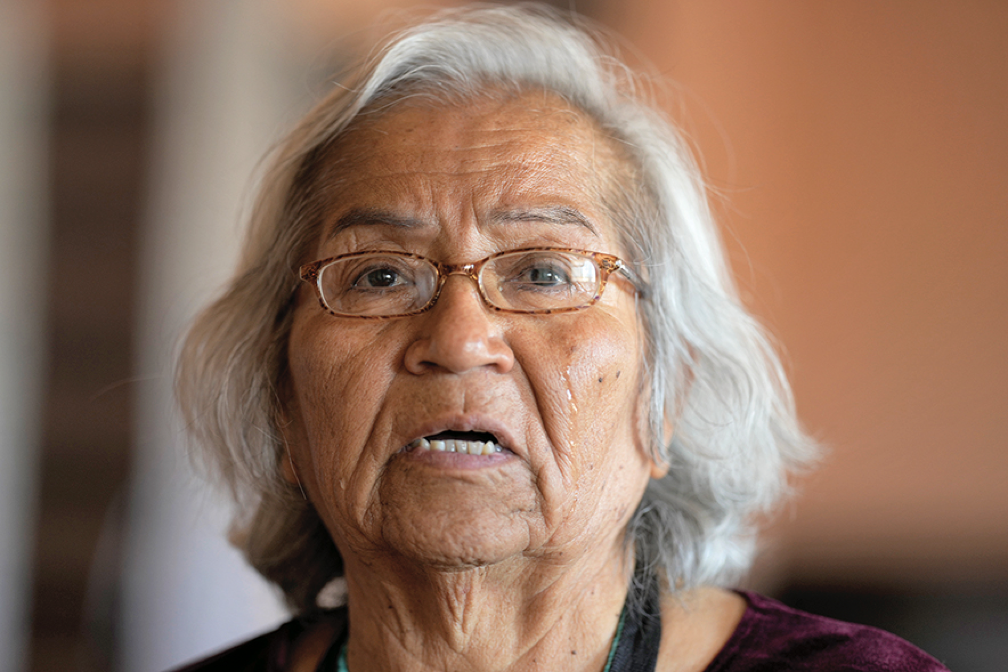
Bertha Nez, 78, from Red Water Pond Road, north of Church Rock, N.M., speaks on Friday about her home and how uranium mining impacted her entire life. Special to the Times | Donovan Quintero
WINDOW ROCK — Bertha Nez grew up herding sheep on pristine lands not yet touched by the uranium boom. Nez was born in a hogan in 1946, near the area now known as Red Water Pond Road, which is north of Church Rock, New Mexico.
For about nine years, Nez remembers living a happy life that consisted of herding sheep, moving to the top of the mesa to their summer camp every summer, collecting medicinal herbs along the hills and hillside, and attending boarding school. Then one day, they heard the sound of trucks.
“We were only kids when it started. Óondáʼniilkáádóó, nléíó chidi ndáájééh, exploration or something. Áko, they go all over the place in the woods,” said Nez. “That’s how it started.”
Before mining companies like United Nuclear Corporation and Kerr-McGee began ripping the lands apart and excavating, Bertha enjoyed the freedom of the seemingly endless eminence she called home: Łichii Dééz Áhí.

Special to the Times | Donovan Quintero
A “No Uranium Mining” sign is placed along U.S. Route 89 near Cameron, Ariz. The sign indicates a stance the Navajo Nation agrees with. There are over 100 abandoned uranium mine claims in the Western AUM Region and centered around the Cameron area.
Nez reminisced about the idyllic summers spent in the forest and plateau, where summer camps and family gatherings were a staple of life.
“We had a summer camp up there. We used to camp up there, we moved up there in winter. That’s what we like. My grandpa went way down the canyon, built a little hogan out there to herd sheep down there,” Nez shared. “So, we went back and forth here, and we liked all the trees and the plants. And there were birds, hummingbirds all around.”
‘Just a mine,’ uranium transported
The commercial exploration, development, and mining of uranium began in 1957, according to the U.S. EPA. Between 1960 and 1962 during its first phase, a total of 77,965 tons of ore was mined from underground mines. The second phase, which spanned from 1963 to 1982, produced an even larger total of 238,286 tons of ore. During this phase, mined ore was transported approximately three miles northeast along State Route 566 to the United Nuclear Corporation uranium mill located at Northeast Church Rock.
“We didn’t know what was going on. ‘It’s just a mine,’ hxá’nóo. We didn’t know what it was,” Nez said.

Special to the Times | Donovan Quintero
Teddy Nez, Bertha Nez’s ex-husband, speaks on Friday about how uranium mining impacted his wife’s family and their homestead at Red Water Pond Road.
Bertha and her family went about their lives which was a steady lifestyle, filled with happy childhood memories of herding sheep, playing on the mesas, and being with family.
However, this nostalgia is now clouded by the harsh reality of contamination that has rendered the land almost uninhabitable and changed their relationship with it.
They had no idea the shady mining practices of Kerr-McGee and United Nuclear Company were creating a disastrous setting that would forever impact all their lives and the place they called home.
When remediation efforts began, Nez said six inches of soil had to be removed from around their homes. Eventually, they began replanting the area with what they were told was native to the area.
“They planted these plants; it grew back all kinds of different flowers. They said it’s native plants, but we never seen some of those plants,” she said. “I was going to walk through the bushes, but I got scared because we have prairie dogs, and we have snakes. You don’t know where you’re walking.”
‘Stillness of everything’
Years of strife followed the contamination, forcing families to relocate multiple times in efforts to seek safety and cleaner living conditions. Nez expressed frustration at being disbelieved about her family’s history and connection to the land. She said they had to prove to officials their roots were in the heart of the contaminated sites left by uranium mining.
“We had to go back to 1936 to prove that our grandparents lived here,” she explained, as they gathered photographs to validate their claims and illustrate the long-standing presence of her family in the area before the contamination.
Despite these challenges, Nez emphasized a strong preference for their current surroundings over the crowded conditions of nearby cities like Gallup. She cherishes the open air, the tranquility brought by rain, and the diverse wildlife that still, albeit sparingly, can be found in their environment.
“I like the stillness of everything,” Nez said, highlighting the significance of preserving this connection to nature.
However, the transformation of their previous home into a contaminated landscape has deprived children of the simple joys that prevailed before.
Nez lamented, pointing to the stark contrast between the vibrant familial activities of the past and the current desolation. The impact of contamination has not only altered the land but also fragmented the communal spirit that once thrived there.
As the uranium boom continued, Nez said they noticed miners living near the mine site.
“There were people ndaalnish kǫ́ǫ́nikǫ́ǫ́, nléí close to the mine they put out their tent, or they sleep in their truck, or put up their shed. So, they live all over the place here. So that’s how it was then,” Nez said.
For years, mining activities did not stop. Miners like her father Jack Hood, who passed away in 2014 due to pulmonary fibrosis, and his brother and sisters lived close to the mine sites. Bertha said her father lived about a thousand feet from his work site.
“They used to just walk over there,” she said. And my brother and my sisters, they used to work there. And they walked over there.”

Special to the Times | Donovan Quintero
A tachee is fenced off to protect it from an ongoing clean-up project where uranium mining has impacted the landscape at Red Water Pond Road.
Mill collapse
One morning in July 1979, an earthen dam at the United Nuclear Corporation uranium processing mill collapsed just a mile downstream from Red Water Pond Road. The breach released approximately 1,100 tons of uranium tailings and 94 million gallons of radioactive wastewater, contaminating an arroyo that the Navajo community relied on for livestock grazing and irrigation.
Nez remembered families living downstream walked through the contaminated spill and reported their legs being burned from the exposure.
“It was about six in the morning when it happened,” she recalled.
She doesn’t say much else about one of the worst nuclear accidents in U.S. history.
Bertha’s ex-husband Teddy Nez, 79, a U.S. Army veteran, said they used to hold NAC ceremonies in front of their home, but it’s been 24 years since they last held one outside their home.
Bertha and her daughter, Jennifer Nez, were in the process of moving once again from their home. Another clean-up of the area requires they move, Jennifer said. Instead of Gallup, they moved to Iyanbito, New Mexico, which is located east of Church Rock, New Mexico.
On Friday they were at the house to pick up their dog and other small items. An overgrowth of wild vegetation like tumbleweed has taken over Bertha’s home landscape. The area where the tipi was erected for NAC ceremonies did not have much vegetation, but it was obvious it had not been used for years.
As part of its remediation efforts, the federal government continues to address the legacy of uranium contamination on the Navajo Nation. They developed a 10-year plan, which is a continuation of two previous five-year plans – 2008-2012 and 2014-2018 – including the Tronox Addendum to the 2014-2018 five-year plan.
Uranium extraction, an increasing demand
Approximately 30 million tons of uranium ore was extracted during mining operations on or near the Navajo Nation from 1944 to 1989. The Federal Atomic Energy Commission was the sole purchaser of uranium until 1966. The Atomic Energy Commission continued to purchase ore until 1970, although sales to the commercial industry began in 1966. Like Bertha’s father and siblings, Navajo people worked at the mines and mills, and often lived and raised their families nearby.
Uranium mining and milling activities no longer occur in the Navajo Nation, but the transport of uranium ore recently began due to an increase in rising demand.
On July 30, Energy Fuels, the largest uranium producer in the United States, commenced mining operations at the Pinyon Plain Mine located south of the Grand Canyon. They reportedly transported an estimated 50 tons of uranium ore through the territory without notifying the Navajo Nation. Tribal police attempted to intercept the transport vehicles but were unable to do so.
Navajo Nation President Buu Nygren expressed concerns over the lack of prior notice, stating his intention to establish roadblocks to halt further shipments until appropriate regulations are established.
President Nygren highlighted existing Navajo laws concerning the transport of radioactive materials, specifically referencing the Navajo Nation Natural Resources Protection Act of 2005 and the 2012 Radioactive and Related Substances Transportation Act. He noted that while these laws exist, the 2012 legislation exempts state and federal highways, which Energy Fuels intends to use for transporting uranium ore. Arizona Attorney General Kris Mayes acknowledged the complexity of the issue, emphasizing that Energy Fuels had committed to providing stakeholders with a two-week notice before transport and ensuring the availability of an emergency plan.
An ‘imminent threat’
To address uranium ore transport across the Navajo Nation, on Aug. 29, an amended Radioactive and Related Substances, Equipment, Vehicles, Persons and Materials Transportation Act of 2012, was signed.
The amended 2012 Act authorizes the Navajo Nation Environmental Protection Agency to put into effect regulations implementing the act since the tribe deemed the transport as an “imminent threat.”
“The interim regulations would expire in one year, during which period the Navajo Nation EPA would engage in public notice and comment on the interim regulations and make public final regulations effective upon approval by the Resources and Development Committee,” the amendment reads.
Under the updated act, companies transporting uranium ore, radioactive waste, or other radioactive products on or across the Navajo Nation or otherwise within Navajo Indian country would be required to agree with the Navajo Nation.
Travel to Washington, D.C.
This Sunday, Bertha’s brother Tony Hood and more than 50 members of the Navajo Nation, Laguna Pueblo, Acoma Pueblo, and Hopi tribe will drive roughly 30 hours by bus from New Mexico to Washington, D.C., to demand House Speaker Mike Johnson allow a vote on legislation that would aid victims of U.S. nuclear tests, uranium mining, and nuclear waste storage.
The RECA bill has been delayed in the House since June despite overwhelming bipartisan support in the Senate which passed it 69-30.
The group, according to a press release from Susan Gordon with the Multicultural Alliance for a Safe Environment, is from New Mexico and Arizona, that includes former uranium workers, veterans, and people who lived downwind of nuclear weapons tests who are suffering from radiation-related illnesses, such as thyroid cancer and lung disease.
The group will depart at 9 a.m. on Sunday following a send-off rally with community members at the National Hispanic Cultural Center in Albuquerque.
While in D.C., Hood and the group will gather on the Capitol lawn Sept. 24-26 to sing, dance, pray, and call for the passage of legislation reauthorizing the Radiation Exposure Compensation Act.
The bill, which would provide health screenings and financial assistance to those sickened by exposure to radiation by the U.S. nuclear weapons program, has sat on Speaker Johnson’s desk since March when it was passed by a bipartisan supermajority in the Senate.
Bertha said she isn’t attending the event in D.C. because she’s been busy preparing for another cleanup to begin. They will lend their support and message, however, they said.
“Łeetso dooda,” said Teddy. “That’s the main thing.”
Bertha added to Teddy’s message and said they are working with young Navajo people in hopes they will continue to say “no” to uranium mining on the reservation.
“Right now, we’re trying to tell other people, the younger people, to watch out, what’s going on in Navajo land, so something like this doesn’t happen again,” said Bertha. “Hopefully the future generation, watch out for their land and the kids, for their future generation.”