

MASE
About MASE
Posts by MASE Admin:

Nuclear Regulatory Commission (NRC) Issues Rare Denial to Uranium Company Seeking to Walk Away from Groundwater Cleanup
Homestake/Barrick Gold Request for “Alternate Concentration Limits” at Grants Reclamation Project Not Accepted by NRC
For Immediate Release: Tuesday, June 27, 2023
Media Contacts:
Eric Jantz, Senior Staff Attorney, New Mexico Environmental Law Center, ejantz@nmelc.org, (505) 980-5239
Susan Gordon, Coordinator, Multicultural Alliance for a Safe Environment (MASE), sgordon@swuraniumimpacts.org, (505) 577-8438
Albuquerque, NM —The Nuclear Regulatory Commission (NRC) recently took the unusual step of denying a License Amendment Request from Homestake Mining Company for Alternative Concentration Limits, which allow corporations to avoid cleaning up contaminated groundwater to pre-operational conditions.
Alternate Concentration Limits were originally intended to be viewed as an exception to the general rule that mills must restore groundwater to pre-operational conditions, but the NRC has regularly approved ACL applications that make it possible for mill operators to walk away from their clean up obligations.
The denial is good news to nearby community residents, who greeted the NRC decision with cautious optimism. Homestake is a subsidiary of Barrick-Gold, a multi-billion-dollar global corporation with the financial means to fully remediate the groundwater plumes seeping from Homestake’s toxic waste piles. Homestake/Barrick-Gold operated a uranium mill and several uranium mines in the Grants Uranium District of New Mexico from the 1950s until 1990.
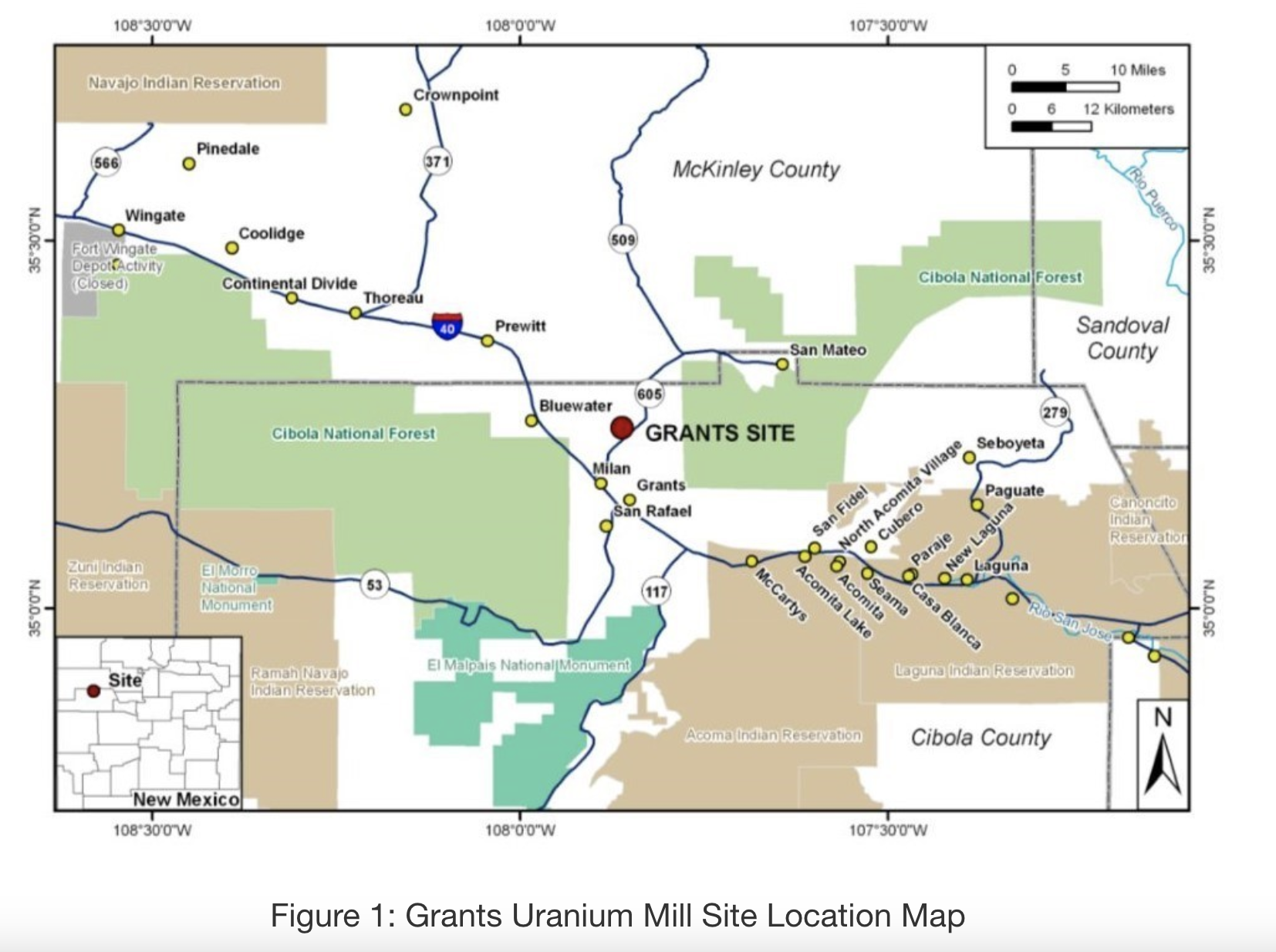
The Homestake Superfund site is located about 5 miles northwest of Grants, NM. Two massive tailings piles totaling 22 million tons cover more than 200 acres. The largest pile is approximately 100 feet high and adjoins San Mateo Creek.
During the NRC public meeting on June 15, 2023, NRC discussed Homestake/Barrick- Gold’s inadequate responses to the ACL application which included: Homestake’s lack of information about the buyout of property and residential homes adjacent to the Superfund site; missing data regarding precipitation, the rate of aquifer recharge, the percolation of water through the waste piles and seepage; and questionable groundwater modeling assumptions.
NRC acknowledges that widespread groundwater contamination across multiple aquifers at the Superfund site may pose a significant risk to future generations if it is left untreated. NRC stated that Homestake’s groundwater modeling may be failing to account for the potential movement of contaminated groundwater offsite. NRC disagrees with Homestake’s conclusion that future remediation efforts will not be beneficial when contaminants continue to be removed under the current groundwater treatment system.
Susan Gordon, Coordinator for the Multicultural Alliance for a Safe Environment, stated, “This should serve as a wake-up call to Homestake/Barrick-Gold. They have been scaring the neighbors with threats that they plan to walk away in two years. Surprisingly, agencies are beginning to do their jobs. Homestake will have to clean up the groundwater to a more protective level and continue to remove uranium from the waters they contaminated in perpetuity.“
Eric Jantz, Senior Staff Attorney with New Mexico Environmental Law Center, responded to the denial: “We applaud the NRC’s decision and hope this is a new era of hard-nosed skepticism of Homestake/Barrick-Gold’s attempt to walk away from their obligation to clean up their mess. We will continue to advocate with the NRC that community health and potable groundwater must be the guiding goals of clean up.”
The Homestake/Barrick-Gold uranium milling operation might be long-defunct, but the radioactive waste piles that remain continue to contaminate several groundwater aquifers, posing an imminent threat to nearby residents and downstream communities.
After promising concerned residents in the 1970s that the site would be cleaned up in ten years, Homestake now contends that further remediation of the site is “technically infeasible.” The company is attempting to buy out neighboring property owners and residences in an attempt to expand site boundaries and exempt the company from continuing its remediation efforts to contain and treat the mobile groundwater contaminant plumes seeping from the toxic waste piles to the current site groundwater quality standards.
Impacted community members want the regulatory agencies to isolate the sources of contamination—seepage from underneath the two unlined tailing piles. Moving the piles to a lined containment location may be the best available technology to isolate the contamination from the surface water and groundwater sources utilized by the surrounding communities for agriculture and municipal water supplies.
NRC’s May 17, 2023 letter (attached) to Homestake denying the ACL request can be accessed on ADAMS under the accession number: ML23119A006 The NRC’s talking points for the June 15, 2023 meeting can be accessed on ADAMS under the accession number: ML23160A024 or this link https://adamswebsearch2.nrc.gov/webSearch2/main.jsp?AccessionNumber=ML23160A
024
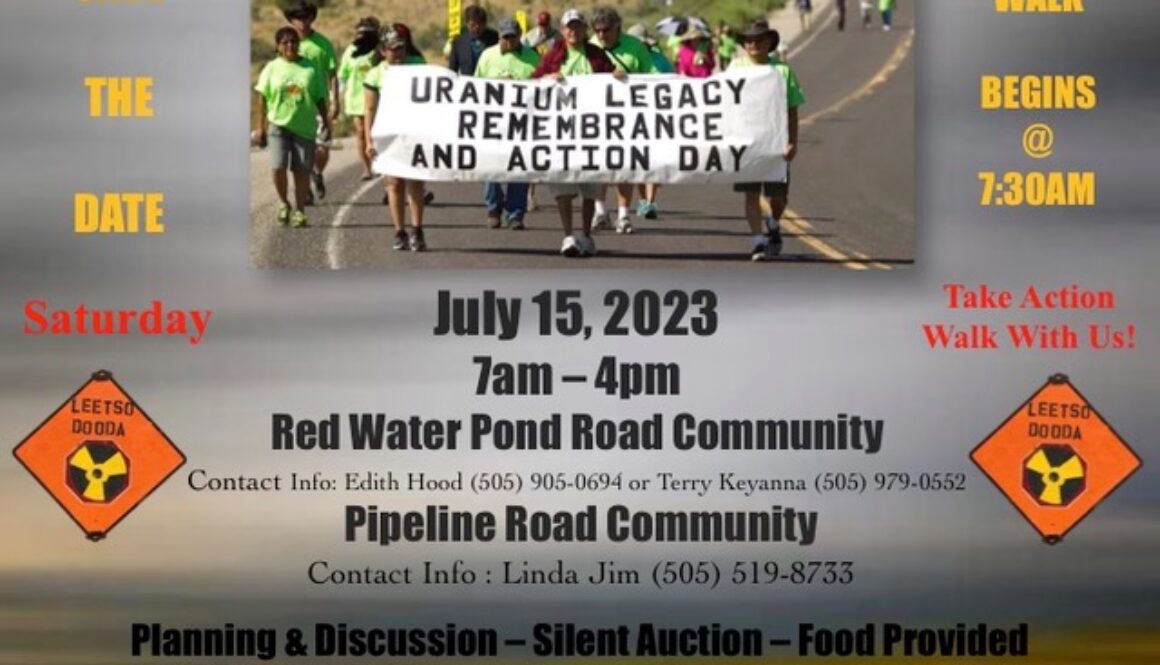
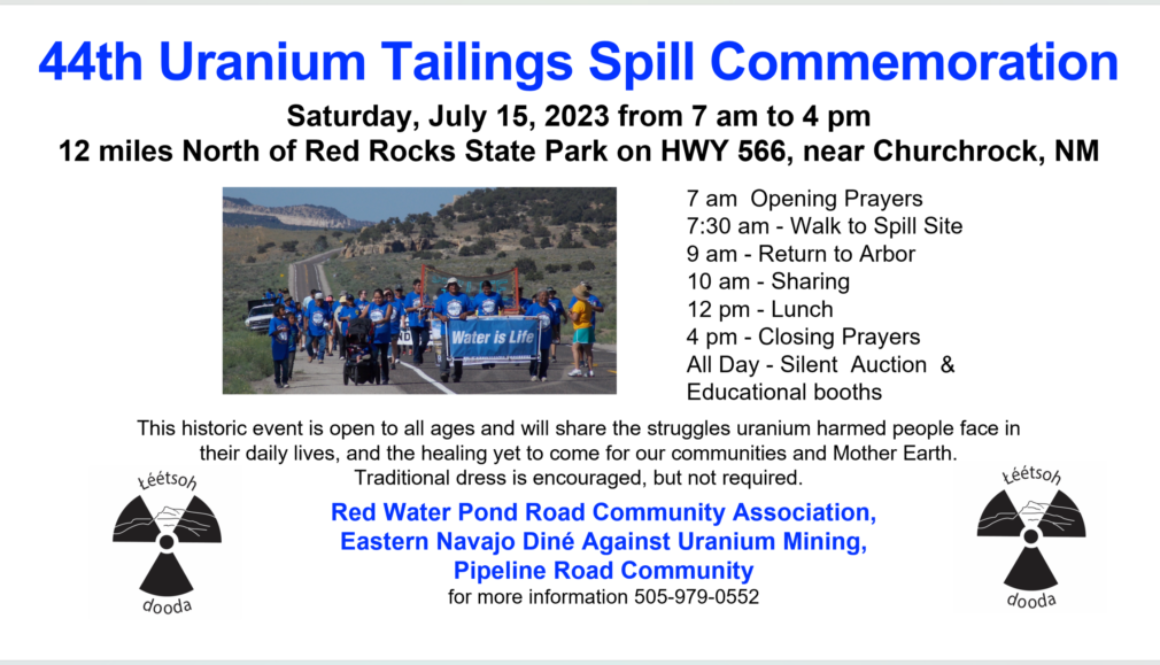
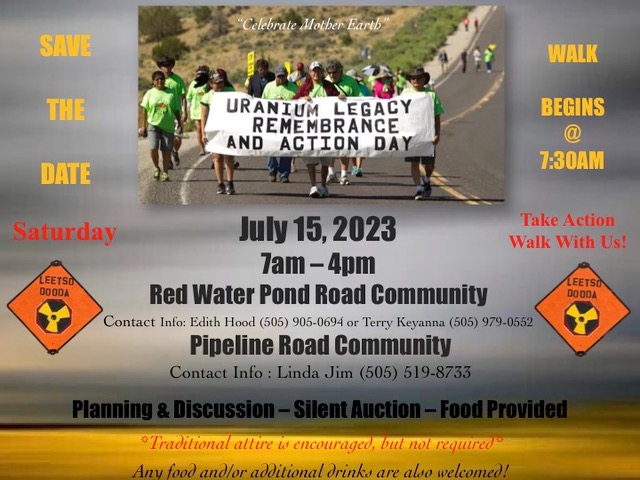
Save the Date: Walk With Us for Uranium Legacy Remembrance and Action Day, Saturday July 15 7am-4pm
Planning & Discussion – Silent Action – Food Provided
Red Water Pond Road Community
Contact Info: Edith Hood (505) 905-0694 or Teny Keyanna (505) 979-0552
Pipeline Road Community
Contact lnfo: Linda Jim (505) 519-8733
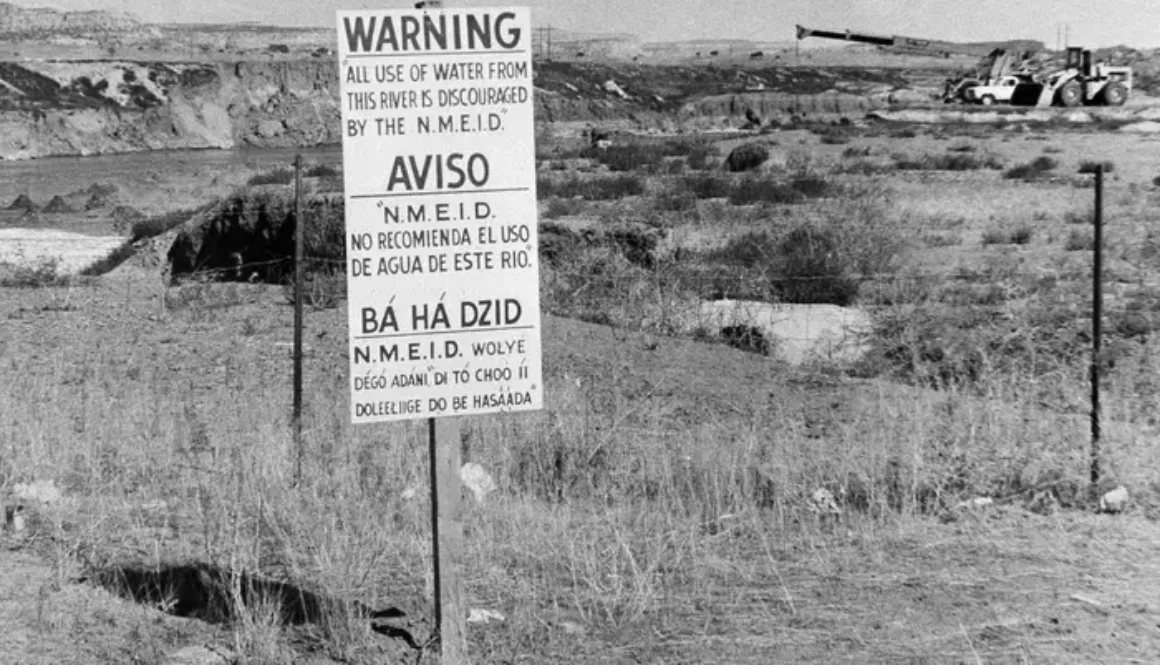
Inside the Navajo Church Rock Nuclear Disaster, the largest radioactive disaster in US history that’s somehow often forgotten
https://www.insider.com/photos-church-rock-the-largest-radioactive-disaster-us-history-2023-6
- The 1979 Church Rock Nuclear Disaster is the largest radioactive accident in US history.
- 94 million gallons of radioactive water and 1,100 tons of uranium waste flooded out of a breached dam into the Rio Puerco.
- The spill happened just four months after the Three Mile Island nuclear incident and released more than three times as much radiation.
In 1979, a dam holding millions of gallons of nuclear waste in Church Rock, New Mexico, collapsed.
In a matter of hours, 94 million gallons of radioactive water and 1,100 tons of uranium waste flooded into a nearby river.
The spill killed crops and cattle, and contaminated the surrounding land and the people who lived off it for decades to come.
It happened just four months after the Three Mile Island nuclear accident. It was the largest accidental release of radioactivity in US history and third worst accident in history, after the Chernobyl catastrophe in 1986 and Fukushima in 2011.
Despite this, perhaps because it happened in a rural, low-income area, or perhaps because it was primarily people from the Navajo Nation who were impacted, it was largely ignored.
Here’s what happened.
The Navajo Nation, which is the largest Native American territory, covers about 27,000 square miles across the boundaries of Colorado, Utah, Arizona and New Mexico. Its people have lived in the region—known for its dusty, arid landscapes— for seven centuries.
Sources: Vice, Vox, Bureau of Land Management
Since the land was fairly inhospitable, the Navajo were mostly left alone in the 20th century. But that peace ended with the beginning of the Cold War and the nuclear arms race. Underneath the dry earth was one of the largest uranium deposits in the world.
For about 40 years between 1944 and 1986, the federal government and private companies mined the area and often used Navajo people to do it.
Over that period, about 30 million tons of uranium were extracted.
Now, according to the EPA, there are about 500 abandoned waste piles, mines and mills across the region.
Sources: Environment and Society, Vox, VC Star, AJPH , Vice
Early on in this period, the government was happy to hire Navajo people to work in the mines, but it failed to warn them about the effects of radiation.
Sources: New York Times
Cattle drank from contaminated runoff, people built their homes out of lumber taken from uranium mines and children played in contaminated streams.
Sources: New York Times
That was bad enough, but in 1968 the United Nuclear Corporation (UNC) began extracting from the country’s largest uranium mine, which was located in a small farming community called Church Rock.
Its extraction process required nuclear waste to be stored in dammed lakes called tailings ponds.
The dams were between 50-75 feet high and made of earth.
In 1977, two years before the accident, UNC already knew about large cracks in its dam.
But even though the officials were aware of them, they continued to overfill the tailing ponds.
A report later released by the Army Corps of Engineers found UNC made three key failures—it failed to use recommended materials during construction, it failed to report the cracks to regulators and it ignored advice from consulting engineers that could have stopped the disaster.
Sources: Environment and Society, Vox, VC Star, AJPH , Vice
It’s not like nuclear accidents hadn’t happened before. On March 28, 1979, a nuclear reactor on Three Mile Island in Pennsylvania had a partial meltdown that exposed 2 million people to nuclear radiation.
No one died, but about 140,000 people had to be evacuated.
CBS News anchor Walter Cronkite called it the “first step in a nuclear nightmare.”
Sources: Environment and Society, Business Insider
Four months later, on July 16, 1979, UNC’s dam failed. Out of a 20-foot wide breach, 94 million gallons of radioactive water and 1,100 tons of uranium waste flooded into the Rio Puerco.
One local named Larry King told Vice, “I remember the terrible odor and the yellowish color of the water.”
The spill contaminated a stretch of river about 80 miles long, passing the homes of about 1,700 people.
Because the area was so dry, locals relied on the river for drinking water as well as for their crops and livestock.
Sources: New York Times, Environment and Society, Vice, Vox, American Indian Law Review, Science History, AJPH
The spill caused crops to wither, contaminated sheep had to be killed and wells had to be closed off permanently. The water’s radioactivity level near the dam reached 7,000 times the safe radiation limit for drinking water.
Blisters and sores reportedly appeared all over the feet of locals who walked in the water that day.
Sources: Vice, Vox, American Indian Law Review, VC Star, New Mexico History
The Church Rock spill was worse than Three Mile Island in terms of radiation. It released more than three times as much radiation. Yet while President Jimmy Carter visited Three Mile Island within days of the failure, Church Rock was basically ignored.
Newspapers described the region as “sparsely populated” and claimed there were no health hazards.
New Mexico’s Governor Bruce King refused to declare that the region was a federal disaster area.
Sources: Vice, History.com, Science History, Vox, AJPH
Despite the local response, it was the third worst accidental release of nuclear radioactivity in the world, after the Chernobyl catastrophe in 1986 and the Fukushima in 2011.
While UNC sent Navajo employees out after the spill to let people know the danger, it wasn’t until a few days later that signs were erected and radio announcements made that warned locals not to drink from the river.
Sources: American Indian Law Review, AJPH
To make matters worse, after the spill no one was compensated, and the UNC only removed about 3,500 tons of sediment from the river—about 1% of the solid waste released in the spill.
Their removal method was to send in workers with shovels and buckets.
Seven months later, a local newspaper reported that six Navajo locals who had been tested for radiation exposure had shown no acute effects.
This was despite the fact diseases from radiation can take years to develop.
The study was also limited to analyzing the effects of inhaling sediment and cattle ingesting it.
It did not examine the impact of drinking contaminated water or eating contaminated vegetables.
By November 1979, the UNC had resumed operation at Church Rock. But instead of improving its practices, it discharged new waste into unlined ponds which led to intensive groundwater contamination.
In 1982, the UNC abandoned its Church Rock operation.
In 1983, due to the groundwater contamination, the operation was placed on the EPA’s National Priorities List.
Yet that same year, federal and state authorities were still claiming the impacts the disaster had on people and the environment were minimal.
This wasn’t the first time authorities had got it wrong about people dying from working in the domestic nuclear industry.
During the Cold War, hundreds of Native American miners died from cancer and lung diseases after working in the industry.
These deaths were scientifically linked to working with uranium, yet for years government agencies claimed no one had died or was harmed from working in the industry.
UNC also continued to dismiss claims of hardship from the Church Rock spill.
In 1983, despite locals noting their cattle kept dying after drinking from the water, Stanley Crout, a spokesperson for UNC, told the New York Times, “We just don’t know of any substance to those claims.”
Crout noted the reason the Navajos were concerned was because they didn’t understand the effect of uranium.
Sources: New York Times, Vox, EPA, Science History, AJPH
In 1990, the government officially apologized to the Navajo people. Two years later, UNC was ordered to invest $16 million to do a better clean up job, but instead the money was paid to its parent company.
Sources: New York Times
In 2007, 28 years after the accident, a local research group called Church Rock Uranium Mining Project found water sources were still contaminated from the spill.
Sources: Vice
Although a comprehensive study wasn’t completed, a number of different studies noted people living in the Navajo nation nearby have had higher rates of birth defects, diseases and cancers.
Sources: Vox
From the 2000s on, the EPA slowly started cleaning up the area, including other mines and waste sites. By 2015, about $100 million was spent on the clean up—and about 200,000 tons of contamination were removed— but the pollution was far worse than the agencies first thought.
EPA Pacific Southwest regional administrator Jared Blumenfeld told the New York Times, “It is shocking — it’s all over the reservation.”
He said, “I think everyone, even the Navajos themselves, have been shocked about the number of mines that were both active and abandoned.”
Sources: New York Times, Science History, AJPH
The repercussions of the spill and the mining are still felt today. As local resident Faith Baldwin told Vice in 2019, “Our generation is afraid of having children.”
She said, “Cancer runs in our family but it shouldn’t. Cancer, diabetes were non-existent in Navajo rez.”
Sources: Vice
Navajo Nation officials, activists feel cut out as company advances uranium mining plans
https://www.the-journal.com/articles/navajo-nation-officials-activists-feel-cut-out-as-company-advances-uranium-mining-plans/
Disposal methods cause concern about future spills, contamination
By Hannah Grover, NM Political Report
Friday, May 26, 2023 8:54 AM Updated Friday, May. 26, 2023 8:54 AM
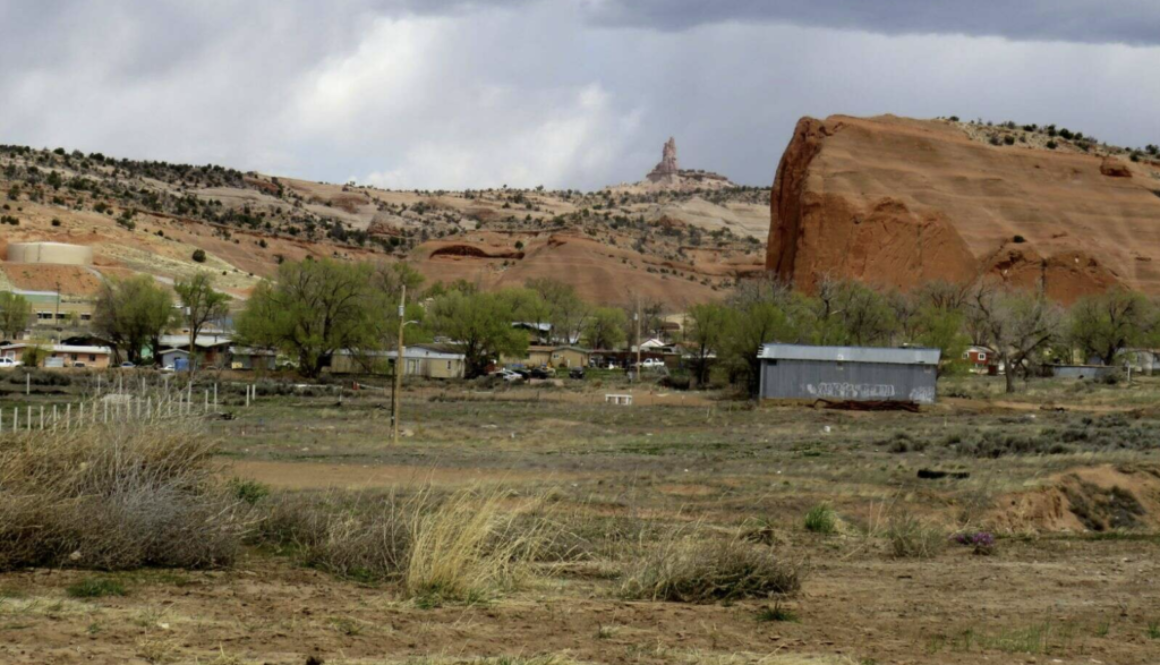
The view from Church Rock Chapter House overlooks a community concerned about future uranium mining and potential negative impacts to the area and the people who live there. (Hannah Grover/NM Political Report)
When a foreign company started exploratory drilling for the possible return of uranium mining near Church Rock, community members say they were not informed in advance.
“It was a complete shock,” Jonathan Perry, the director of Eastern Navajo Diné Against Uranium Mining, said of the process that started this winter.
The eastern Navajo Nation communities have stood largely in opposition to future uranium mining for decades.
“The majority of Diné people have been personally impacted by (uranium),” Leona Morgan, an activist and member of Navajo Nation, said.
The Navajo Nation has a moratorium dating back nearly two decades that prohibits uranium extraction, but the Eastern Agency consists of what is known as checkerboard. That means federal and state lands are intermixed with Navajo, or Diné, lands and allotment lands.
Laramide Resources, a Canada-based company, plans on extracting uranium from an area within the checkerboard that is not tribal land.
The work would occur near the same location where, in 1979, a dam breach released 1,100 tons of uranium waste and 94 million gallons of radioactive water into the Rio Puerco, which the nearby Navajo communities relied upon for water.
Decades later, the spill, along with mine and mill sites in the area, remain unremediated. Earlier this year, the U.S. Nuclear Regulatory Commission issued a record of decision as well as a license amendment that will allow the United Nuclear Corp. – which owned the site where the spill occurred – to dispose of mine waste from the old uranium mine at the old mill site.
Morgan said there are concerns that this disposal method in an unlined pit could lead to a second spill happening, especially as climate change increases the risks of extreme weather events like monsoon floods.
Related: Take uranium contamination off our land, Navajos urge federal nuclear officials
The history of uranium contamination serves as a backdrop as Laramide seeks to begin extraction and the Nation feels as if it has been excluded from the process in part because of the checkerboard of land and mineral jurisdiction.
In response to questions from NM Political Report, Navajo Nation President Buu Nygren highlighted the moratorium imposed by the Nation in 2005 on uranium mining and processing. Uranium mining on the Nation ended in 1986, though about a quarter of the recoverable uranium reserves in the country are located on Navajo Nation lands.
Nygren said the Navajo Nation is highly concerned about new and planned activities for mining, excavating and drilling to get uranium resources out of the ground and to process it from the raw state to a more refined stage.
“We’d like to avoid those activities from happening in our home area again until we get a significant handle on all of the contamination,” he said.
Nygren said there are 524 sites where the Nation is still trying to address past uranium contamination.
The sole remaining uranium mill in the United States is just north of Navajo Nation’s lands in Utah and neighbors a Ute Mountain Ute community.
The Navajo Nation is also fighting a proposal to mine uranium near the Grand Canyon. The Grand Canyon Tribal Coalition, which includes the Navajo Nation, has called for President Joe Biden to use the Antiquities Act to establish a national monument that would block the proposed uranium mine near the Grand Canyon.
History of the project
Laramide Resources acquired the Crownpoint/Church Rock Uranium Project from Hydro Resources Inc. in 2015. HRI was already seeking a license renewal from the U.S. Nuclear Regulatory Commission. That license renewal was granted to Laramide in February 2017.
Related: Navajo group alleges U.S. violated human rights in uranium mine licensing
This winter, Laramide engaged in a drilling operation to determine the feasibility moving forward.
In a March update, Laramide stated that the recent drilling confirmed that “historical drilling results are suitable for resource estimations and agreed with previous studies showing that there is low risk of resource depletion of chemical uranium compared to radiometric uranium in the Church Rock mineralization.”
The update further stated that the drilling will also provide “core for the test work necessary to obtain the New Mexico Aquifer Discharge Permit, the final material permit needed for the project.”
Laramide has not yet applied for the discharge permit.
According to information NMED provided NM Political Report, the agency will perform an administrative and technical review of the application upon receiving it and will determine if the information the company provides is sufficient.
“NMED will then assess the technical feasibility of the activities proposed by the applicant and determine if the applicant has provided enough information to determine if the activities proposed in the application will be protective of human health and the environment,” Matthew Maez, the agency spokesperson, told NM Political Report.
Once a draft permit has been developed, it will be sent out for the public to review. People will then be able to issue comments on the draft permit or request a hearing.
Maez said NMED will work with tribal governments during the permitting process.
Maez said that any mining company wanting to begin or resume uranium extraction on lands that are subject to the state’s regulations must receive the groundwater discharge permit and must provide financial assurances before commencing the operations.
“To the extent resources allow, NMED will assure compliance with permits and state rules to protect groundwater and surface water,” Maez said.
He said that the U.S. Nuclear Regulatory Commission has jurisdiction over uranium milling sites.
‘It’s Navajo Indian Country’
Should an incident occur resulting in contamination of land, air or water, the people who will be impacted are the Diné residents of the Eastern Agency. And it’s not just one community.
The production would occur north of Church Rock in an area that is already highly contaminated from past uranium mining, including the worst uranium spill in the country’s history. The extracted ore would then be transported nearly 50 miles to an area south of Crownpoint where Laramide would process the ore. This would impact communities like Smith Lake, which is at the junction of New Mexico Highway 371 and Navajo Service Route 49.
“Regardless of the land status, it’s Navajo Indian Country,” Perry said.
The Eastern Agency is not the only ones concerned about this.
Nygren said Laramide hasn’t provided assurances it would work with the Navajo Nation, instead choosing to work more with the state and the federal regulatory agencies.
“[Laramide wasn’t] willing to come forward and work with us directly,” Nygren said. “To identify themselves and to state what activities they were going to undertake. Even though the land is not Navajo Nation land, it’s right up against our Navajo Nation lands.”
Nygren said Laramide is aware of the Nation’s concerns and the history of the contamination because the Navajo Nation worked to educate its predecessor, HRI, on those topics.
“The way [Laramide] has decided to approach this project from their interests alone, without recognizing the Navajo Nation’s stance and positions, it’s more concerning than reassuring,” Nygren said.
Laramide did not respond to email and phone requests for comment.
Environment and cultural concerns
Nygren said the Nation’s primary concern is human health and safety.
“We have identified people that are living close to these abandoned uranium mine sites,” he said.
Those people, Nygren said, need to be the top concern and their homes need to be made safer.
“If they have any health conditions as a result of exposure in the past, they need to be provided with adequate health care,” he said.
In the late 2000s, researchers launched a birth cohort study focused on Navajo women. This study’s mission is to identify possible past uranium exposure that could create health issues for children. It has been going on for at least 12 years, Nygren said. “So public health and ongoing efforts to understand health impacts are one of the highest concerns,” he said.
But the Navajo Nation has other concerns as well, including the transportation of contaminants from abandoned uranium mines.
He said contaminants can reach the surface and get in soils at significant concentrations where they can register on detection devices. Much of the past mining was done underground and Nygren said that could put water resources at risk.
“Groundwater is always a very important resource,” Nygren said.
The lack of water access on the Navajo Nation received national attention during the COVID-19 pandemic and chapter houses, including the Church Rock Chapter House, set up hand washing stations outside their buildings to assist community members who didn’t necessarily have access to water.
There are also cultural concerns regarding uranium mining, including the impact on soil and plants.
Nygren highlighted the animals that rely on the landscape and rely on environments around abandoned uranium mines. He said this could have impacts on both wildlife and domesticated animals like horses, sheep and cattle. As they graze for food, they could consume plants that have taken in radioactive materials from water.
“Many of our people still have a subsistence way of life and will take one of their animals from their herds and eat them,” Nygren said. “So through these pathways, there are potential risks and concerns for our people.”
The plants that grow near uranium mines include some that historically have been used for prayers and ceremonies, he said.
“Often the prayers and ceremonies are addressing the mental stresses of living near abandoned uranium mine contamination in addition to any specific health conditions,” Nygren said. “Therefore it is critical that herbal medicines are also free from contaminants.”
Cleaning up contamination is not an easy process.
“It’s not like you can throw the dirt in a washer and it comes out clean,” Morgan said.
Economic opportunities weighed against past contamination
In January, Laramide contracted with Denver-based SLR International Corporation to conduct a preliminary economic assessment based in part on data gathered during this winter’s exploratory drilling.
When the company announced that contract, Laramide’s president and CEO Marc Henderson released a statement saying that the project “has the potential to become a meaningful contributor to future U.S. domestic security of supply.”
“This is an issue of increasing importance in U.S. energy policy considerations and one which appears to have bipartisan domestic support as witnessed by the recent passage of the IRA (Inflation Reduction Act) in which nuclear power featured quite prominently,” Henderson said in the statement.
For the local community, mining could mean new jobs.
Not everyone opposes bringing uranium extraction back. Morgan said there are allottees who may support uranium extraction due to the limited economic opportunities in the region.
One of the reasons why discussions on the checkerboard can be so intense, Morgan said, is because the allottees own the “interest and say so” in the land that has been allotted to them. This is also present in debates over the future of oil and gas extraction to the northeast of the Crownpoint and Church Rock in the Chaco area.
Some of the allottees may turn toward extractive industries as a way to profit off their land.
“Some individuals think they can get rich overnight like the uranium boom in the 50s,” Morgan said.
But, she said, that boom did not create generational wealth.
Nygren said that any discussion of the economic benefits of uranium mining is premature considering the decadal problem of legacy pollution and unremediated sites.
Related: Uranium remediation could create jobs for impacted communities
“Our focus has been on addressing the past impacts of uranium mining from the 20th century. And that focus is on remediation, cleanup, and restoring health to our impacted people and to the communities that are impacted by these mine sites,” he said.
Nygren said the work to address uranium contamination goes back to when the Navajo Nation Environmental Protection Agency was created in the late 1970s.
Despite decades of work, Nygren said “we still haven’t got a true or accurate estimation of what all these impacts have been.”
Those impacts include costs to clean up contaminated sites and to address the impacts of uranium mining on the health of people living on the Navajo Nation.
“So to take a look at potential economic benefits is still premature,” he said “Most of the discussion within the Navajo Nation government and coming to the position to place a moratorium on mining, new mining, and new processing has always been, ‘Let’s get a better handle on the past before we start looking at any kind of potential benefits for renewed uranium mining and processing.’”
Nygren said without any realistic cost estimates about the past impacts of uranium on Navajo Nation, there isn’t a framework to say what the potential economic benefits could be going forward.
“What if somebody says, ‘Well, you can make $5 billion over 20 years if you do get involved in new uranium mining.’ Would that cover the total cost of fixing what was contaminated in the past?” Nygren said. “Also would these potential economic benefits also adequately address the costs to assure a safer future?”
He said even if the price of uranium skyrocketed, he doesn’t think it would be compelling enough to allow future extraction “until we know that these past contaminated areas are adequately restored.”
Energy transition fuels drive for uranium
Perry said that those who oppose the resumed uranium mining are fighting against a misconception amid the energy transition.
He said projects like Laramide’s are “fueled by the misconception that nuclear energy is green energy.”
But uranium mining and milling can have dire health impacts on the communities where those activities occur.
Morgan said activists continue to fight for an expansion of the RECA benefits to include uranium miners who were employed after 1977 and developed health conditions associated with exposure to radioactivity.
Perry said there are 86 unremediated uranium mines in the Eastern Agency region where Laramide hopes to resume mining operations.
“In reality, the communities continue to suffer because of that misconception,” Perry said.
The role that New Mexico, and Navajo Nation, plays in the energy transition and uranium mining is set against a backdrop of legacy contamination both from nuclear and fossil fuels.
“Because of our uranium, it doesn’t matter whether it’s nuclear weapons or nuclear energy, we will always be hurt by the nuclear industry,” Morgan said.
Both the tribe and the state are concerned that future extraction could continue the legacy of radioactive pollution.
“While nuclear energy produces low-carbon energy, Congress must develop long-term solutions for the disposal of nuclear waste that follow a consent-based model,” Maez said. “Further, until the United States and associated mining companies address the legacy issues that continue to impact New Mexicans and tribal members, the nuclear industry has virtually no social license to operate.”
In an email, Maddy Hayden, a spokesperson for Gov. Michelle Lujan Grisham, highlighted that three of New Mexico’s 15 Superfund sites were created by uranium mining. Given that fact, she said the governor’s office is concerned about any proposed mining operations.
“Rural and tribal communities have in the past been taken advantage of by uranium mining companies, which resulted in little to no effort to protect the environment during and after operations,” she said. “That is not acceptable. It’s imperative that mining operations are not only held to a high regulatory standard, but also a high standard for cooperation with affected communities, including tribal nations.”
Hayden said uranium is needed for a variety of purposes beyond just weapons and energy. For example, she highlighted medical imaging. She said uranium is needed just like other metals such as lithium and copper are needed.
“But we shouldn’t be causing pollution while we mine them,” she said. “While nuclear energy has potential as a low-carbon energy solution, until Congress identifies a permanent disposal method for waste, it’s a non-starter as far as we’re concerned.”
NM Political Report is a nonprofit public news outlet providing in-depth and enterprise reporting on the people and politics across New Mexico.
Federal legislation seeks to update mining law
By Hannah Grover
Federal legislation seeks to update mining law

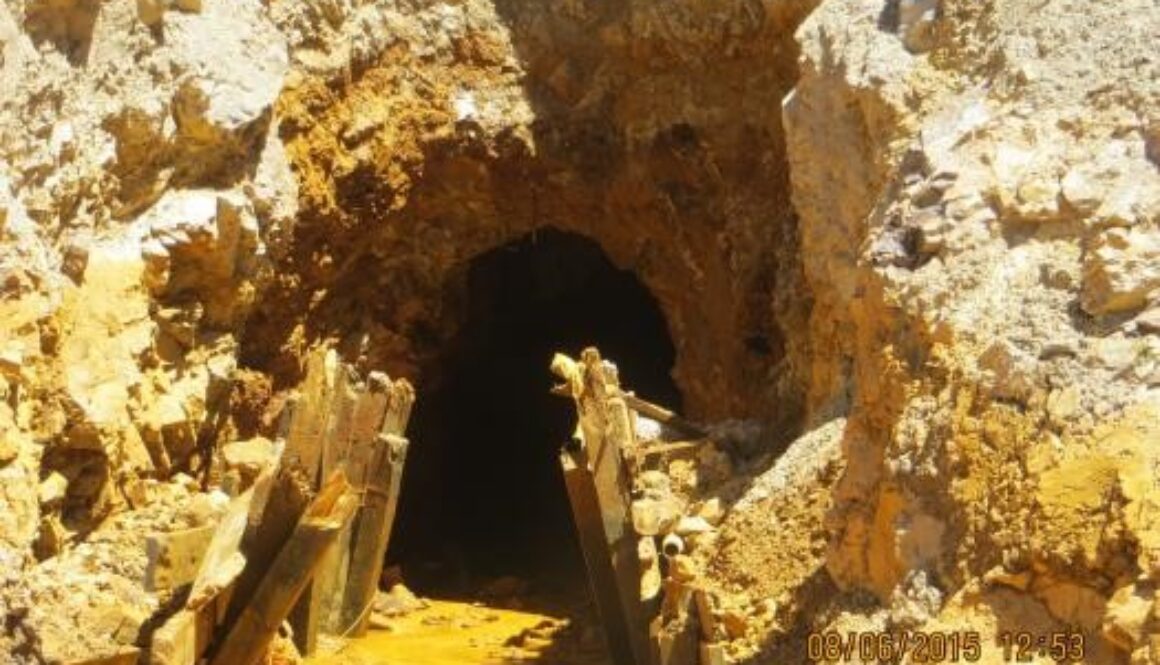
Entrance to the Gold King Mine. Photo via Environmental Protection Agency
U.S. Sen. Martin Heinrich, a New Mexico Democrat, is leading efforts to modernize mining laws as the transition away from fossil fuels increases demand for certain metals and minerals.
Heinrich introduced the Clean Energy Minerals Reform Act on Friday in the Senate while U.S. Rep. Raúl Grijalva, a Democrat from Arizona, introduced the legislation on the House side.
Current mining laws date back to 1872 and have left a slew of unremediated sites across the west, placing watersheds at risk of contamination and people recreating outdoors at risk of collapsing structures.
“We cannot go all in on a clean energy future with a 19th century mining policy on the books. This antiquated law has become a driving force behind centuries of legacy mining pollution that is leaking toxic heavy metals and acid mine drainage into streams and rivers all across the West,” Heinrich said in a press release. “Unlike the way we manage other publicly-owned natural resources like coal and oil, we don’t collect any royalties on hardrock minerals to return fair value to taxpayers. We also don’t have a reclamation fee to help with cleanup work, and we lack a clear process to protect the public lands that aren’t appropriate for mineral development. It’s overdue we change that.”
According to the press release, companies have extracted more than $300 billion worth of metals like gold, silver and copper as well as minerals from public lands without paying any royalties.
The abandoned mines that have been left behind will cost billions of dollars to clean up, which is often an expense borne by taxpayers.
The press release states that 40 percent of headwaters in the western United States have been contaminated by legacy mine sites.
In addition to imposing federal mineral royalties, the bill would create a fund to clean up past contamination and abandoned mine sites. It would also eliminate the patenting of federal lands for mining and would require the review of certain lands within three years to determine if they should be made available for future mining.
“A just and clean energy transition isn’t possible if the mining industry and its destructive practices carry on business as usual. Since even before the 1872 Mining Law, Tribal nations, Black, Brown, rural and frontline communities have fought for their health and future in the face of insufficient environmental protections and no requirements for mining companies to pay to clean up their pollution after they leave town,” Kiara Tringali, senior government relations representative at The Wilderness Society, said in a press release praising the introduced legislation. “We need a renewable energy transition and it cannot be an excuse to perpetuate injustices and corporate favoritism. We’re counting on Congress to pass the Clean Energy Minerals Reform Act to ensure that the minerals we need are extracted responsibly with careful consideration for the wellbeing of our communities, health, water and cultural sites.
23.05.09 NGO Letter to Oppose Mining Regulatory Clarity Act
Earthjustice • The Wilderness Society • Earthworks • League of Conservation Voters • Center for Biological Diversity • Natural Resources Defense Council • Sierra Club • Southern Utah Wilderness Alliance • Defenders of Wildlife • Hispanic Access Foundation • Alaska Clean Water Advocacy • Alaska Community Action on Toxics • Alaska Wilderness League • Anthropocene Alliance • Arizona Faith Network • Arizona Mining Reform Coalition • Arizona Trail Association • Black Hills Clean Water Alliance • Californians for Western Wilderness • Cascade Forest Conservancy • Citizens Awareness Network • Citizens to Protect Smith Valley, NV • Clark County Adventure Riders (NV) • Coalition for Wetlands and Forests • Conservation Northwest • Cook Inletkeeper • Dot Lake Village • Endangered Species Coalition • Friends of Buckingham • Friends of the Kalmiopsis • Friends of the Sonoran Desert • Gila Resources Information Project • Great Basin Resource Watch • Great Bear Foundation • Healthy Environment Alliance of Utah (HEAL Utah) • Idaho Conservation League • Idaho Rivers United • Information Network for Responsible Mining • Kahtoola, Inc • Kalmiopsis Audubon Society • LEAD Agency, Inc. • Living Rivers • Los Padres ForestWatch • Malach Consulting • Mother Kuskokwim Tribal Coalition • Multicultural Alliance for a Safe Environment • Native Movement • Nevada Conservation League • New Mexico Environmental Law Center • Northern Alaska Environmental Center • Northern Front Range Broadband of Great Old Broads for Wilderness • Norton Bay Watershed Council • Okanogan Highlands Alliance • Oregon Natural Desert Association • Patagonia Area Resource Alliance • People of Red Mountain • Physicians for Social Responsibility Pennsylvania • Progressive Leadership Alliance of Nevada • Public Citizen • Quiet Use Coalition • Save the Scenic Santa Ritas Association • Save the South Fork Salmon, Inc. • Silver Valley Community Resource Center • Sky Island Alliance • Soda Mountain Wilderness Council • Standing Trees • The Alaska Center • The Clinch Coalition • Trustees for Alaska • Tucson Audubon Society • Uranium Watch • WaterLegacy • Western Mining Action Network- Indigenous Caucus • Western Shoshone Defense Project • Western Watersheds Project • Wild Arizona • Wisconsin Mining Impact • Xplore Outside
May 09, 2023
Senators & Representatives,
On behalf of our millions of members and supporters, the following 78 conservation, climate, Indigenous and tribal-affiliated organizations call on you to oppose S. 1281 and H.R. 2925, the so-called “Mining Regulatory Clarity Act.”
The Mining Regulatory Clarity Act represents an unprecedented, de facto giveaway of America’s cherished public lands to mining corporations, upending and reversing over one hundred years of public land law precedent. Under the bill, anyone—for a nominal fee—gains permanent rights to occupy land, construct massive waste dumps, and build roads and pipelines across public lands to the detriment of all other values. This would preclude all other types of development and use, including renewable energy projects, recreation, and traditional cultural uses.
The Mining Regulatory Clarity Act is not a return to “status quo” as some proponents have argued. Instead, this legislation undermines the federal government’s long standing authority to safeguard public lands, threatening the protection of irreplaceable cultural, environmental, water, and economic resources. That’s because the bill conveys mining claimants (including international mining conglomerates) with a right to permanently occupy federal public lands. If an alternative use—like an electric transmission line or a renewable energy project—needed to cross “claimed” public lands, mining companies could extract large sums of money from the federal government in exchange for giving up their claim. As an example, if this bill were law in the 1900’s, Grand Canyon National Park wouldn’t exist as it does today. Future Senator Ralph Cameron filed mining claims covering the famous Bright Angel Trail, but they were invalidated due to a lack of a valuable mineral deposit. Had S. 1281/H.R. 2925 been law, Cameron would have had a vested right to undertake a wide variety of exclusionary or destructive activities on these claims and those claims would have superseded the Grand Canyon National Monument’s (later National Park’s) protections. Under S. 1281, all future prospective protected lands could suffer this fate.
This legislation would lead to vast unintended consequences by allowing mining companies, and any individual, to easily weaponize it for their own gain. A person or company wishing to block a solar, wind, or transmission project could simply file a claim in the path of the project by pounding four stakes into the ground and paying a nominal fee and then exercise their new right to occupy the land to block it from moving forward.
Under Section 2(e)(1)(B) of S. 1281/H.R. 2925, mining companies would receive a statutory right to permanently occupy and bury our federal public lands under tons of toxic waste. Modern large scale mines often produce far more toxic waste than the minerals they extract, risking water contamination and other harms. Further, Section 2(e)1(A) grants mining companies automatic rights-of-way for far-flung infrastructure such as new pipelines, transmission lines, and roads across public lands. The change eliminates a central provision of the Federal Land Policy and Management Act (FLPMA) that requires mining companies to receive a permit for such uses, just like everyone else operating on public lands. Section 2(e)(2) would also eliminate FLPMA’s requirement that the mining company pay “fair market value” for using public lands for these facilities.
The Mining Regulatory Clarity Act was authored in reaction to recent court decisions that affirmed and enforced longstanding law. According to proponents of this egregious corporate handout, the need for this bill arises from a court case known as Rosemont, as well as two subsequent federal court rulings, where companies proposed using invalid mining claims to dump enormous quantities of waste generated at the mine site. The problem with that was obvious and courts blocked them: holding an invalid mining claim confers no right to use or occupy the lands covered by the claim unless a valuable mineral is discovered.
The proponents also argue that this legislation is essential to secure our clean energy supply chain. Contrary to industry’s sky-is-falling rhetoric about critical mineral supply shortages, there are a variety of ways to meet the demand for these minerals during our transition to a clean energy economy. This includes—in conjunction with carefully sited mines governed by high environmental standards—deep investment in a circular minerals economy that recycles and reuses the maximum amount of these minerals possible. In addition, mining companies have options to acquire the lands needed for new mines, waste sites, and processing facilities without violating the law or seeking handouts from Congress. In fact, one large copper operation in Arizona, ASARCO’s Ray Mine, recently obtained over 9,000 acres in an exchange to allow for continued mining. There cannot be a just and equitable transition to a carbon-free future, with legislation like this that sacrifices our lands, waters, public health, sacred sites and communities.
The mining law of 1872 is already overly permissive—mining has polluted the headwaters of 40 percent of western watersheds, fiscal assurances for clean up are routinely inadequate, and companies pay no royalties for the minerals they extract from public lands. Reform is needed to safeguard waters, communities, and the environment.
This bill would do the opposite, further tipping the scales away from communities, the environment, and our clean energy future—giving the mining industry the power to dictate how we use our public lands. Instead, Congress should work to balance our nation’s clean energy mineral needs with all other public land uses, such as for renewable energy projects, cultural and historical resources, ranching, recreation, water resources, and wildlife. Our organizations ask you to oppose this legislation in all its forms and reject it as a part of any conversation around energy permitting.
Sincerely,
Alaska Clean Water Advocacy
Alaska Community Action on Toxics
Alaska Wilderness League
Anthropocene Alliance
Arizona Faith Network
Arizona Mining Reform Coalition
Arizona Trail Association
Black Hills Clean Water Alliance
Californians for Western Wilderness
Cascade Forest Conservancy
Center for Biological Diversity
Citizens Awareness Network
Citizens to Protect Smith Valley, NV
Clark County Adventure Riders (NV)
Coalition for Wetlands and Forests
Conservation Northwest
Cook Inletkeeper
Defenders of Wildlife
Dot Lake Village
Earthjustice
Earthworks
Endangered Species Coalition
Friends of Buckingham
Friends of the Kalmiopsis
Friends of the Sonoran Desert
Gila Resources Information Project
Great Basin Resource Watch
Great Bear Foundation
Healthy Environment Alliance of Utah (HEAL Utah)
Hispanic Access Foundation
Idaho Conservation League
Idaho Rivers United
Information Network for Responsible Mining
Kahtoola, Inc
Kalmiopsis Audubon Society
LEAD Agency, Inc.
League of Conservation Voters
Living Rivers
Los Padres ForestWatch
Malach Consulting
Mother Kuskokwim Tribal Coalition
Multicultural Alliance for a Safe Environment
Native Movement
Natural Resources Defense Council
Nevada Conservation League
New Mexico Environmental Law Center
Northern Alaska Environmental Center
Northern Front Range Broadband of Great Old Broads for Wilderness
Norton Bay Watershed Council
Okanogan Highlands Alliance
Oregon Natural Desert Association
Patagonia Area Resource Alliance
People of Red Mountain
Physicians for Social Responsibility Pennsylvania
Progressive Leadership Alliance of Nevada
Public Citizen
Quiet Use Coalition
Save the Scenic Santa Ritas Association
Save the South Fork Salmon, Inc.
Sierra Club
Silver Valley Community Resource Center
Sky Island Alliance
Soda Mountain Wilderness Council
Southern Utah Wilderness Alliance
Standing Trees
The Alaska Center
The Clinch Coalition
The Wilderness Society
Trustees for Alaska
Tucson Audubon Society
Uranium Watch
WaterLegacy
Western Mining Action Network- Indigenous Caucus
Western Shoshone Defense Project
Western Watersheds Project
Wild Arizona
Wisconsin Mining Impact
Xplore Outside
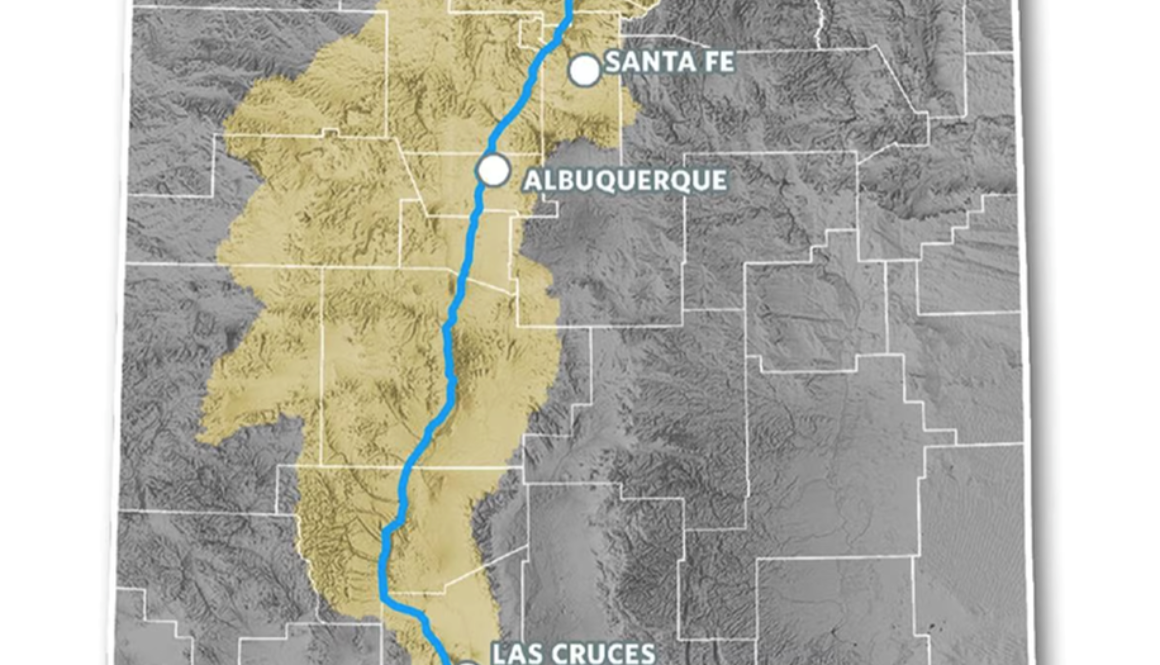
Life with Less Water
Amid a withering drought, New Mexico leaders struggle to plan for life with less water
https://www.sfreporter.com/news/coverstories/2023/04/26/life-with-less-water/
:quality(70)/cloudfront-us-east-1.images.arcpublishing.com/sfr/JHY7I7QNAVBV5KLYFUDAX4WDNU.jpg)
By Elizabeth Miller and New Mexico In Depth
April 26, 2023 at 12:00 am MDT
This story was produced by New Mexico In Depth.
Though the Rio Grande runs through the heart of New Mexico’s biggest city, you can easily miss it. Even from places where you’d expect to see water—designated parking areas near the river or paths along which you carry a boat to cast off from the nearest bank—it’s often invisible behind a screen of cottonwoods. Through much of the city, it hides behind businesses, warehouses and strip malls.
From the riverbank or on the river itself, these curtains create a rare reprieve, a place in an urban area that can be mistaken for a pocket of wild. City noise infrequently penetrates the cottonwoods that beat back the heat and hum with insects and birdsong on summer days. The river often runs a murky, reddish beige that matches its muddy banks.
:quality(70)/cloudfront-us-east-1.images.arcpublishing.com/sfr/RM6NMMCHMREF3DKWVIBKZITZDU.jpg)
But invisibility also means the river is more easily forgotten. That’s worrying for a river as water managers and stakeholders plan for the next five decades of water use in New Mexico—a period that will witness tough choices as a dire and historic drought continues and the river is unable to give everyone what they want or need.
Norm Gaume, a water resources engineer who once served as director of the New Mexico Interstate Stream Commission and as a water manager for the City of Albuquerque, has watched and participated in water planning in the state for decades. He agreed to take me down the river on the first warm spring day last year to talk about the future of the Rio Grande from the river itself. As soon as we launched downstream in his canoe, we began passing examples of ill-considered planning around the river: houses built in flood plains and scattered jetty jacks once planted on the riverbanks to channelize the historically sprawling riverbed and now primed to rip open a boat.
In the stretch where our trip finished, the river was so low that we had to wade, instead of float, back to our vehicles. It drove home Gaume’s core point: “All the desires for this poor little river exceed what it is.”
That situation is getting worse, and the consequences have us, as he said, “borrowing from the future to pay the river back today.”
New Mexico’s future will almost certainly be hotter and drier, with profound implications for our water and people who use it for homes, industries, farms and recreation. Failing to plan holistically leaves the state running from one crisis to the next, whether that’s farmers weathering another dry season or biologists racing to save endangered fish in a vanishing waterway, and facing seemingly impossible choices and improbable solutions, while time runs out.
New Mexico doesn’t have a good track record on planning when it comes to water. And now, as it nears the finish of drafting a 50-year water plan, some say they’ve continued to fall short: dedicating few staff and too little funds, not involving the right people and communities, and not imagining a future that encompasses the full spectrum of river uses, including the very existence of some species.
“This is not one of those issues that you can say, ‘Well, if we take a step in the right direction, in 20 years, we’ll have made headway,’” said Gina Della Russo, an ecologist who has worked along the Rio Grande for more than three decades. “We don’t have 20 years. We didn’t have 20 years 20 years ago.”
Climate change forces new approach to water planning
The Rio Grande has never been an easy river to live alongside. Through its 1,900-mile course, which begins in Colorado’s San Juan Mountains and ends in the Gulf of Mexico, running through broad valleys and tight gorges along the way, it’s known as dynamic and variable.
Historically, spring snowmelt flooded its banks. The river frequently changed course through its floodplain. Species that grew up alongside it, from the Rio Grande silvery minnow to cottonwood trees, adapted to that variety. Now, they depend on it. Silvery minnows spawn in spring runoff, and cottonwood’s white drifts of seeds sprout only after that rush of water leaves muddy ground.
But settlers saw the river’s erratic flows, side channels, backwaters, sweeping floodplains and shifting banks as a hostile neighbor. As the communities of Albuquerque, Las Cruces, El Paso and Ciudad Juarez, plus more than 200,000 acres of irrigated agriculture, arose alongside the river, humans harnessed it to produce more predictable flows. Levees and jetty jacks, asterisk-like stars of metal, set the river into a specific channel, while dams steadied its flow.
:quality(70)/cloudfront-us-east-1.images.arcpublishing.com/sfr/I5WVCDPNEBAQRBVSHQ5UV6IVII.jpg)
Now, a changing climate jeopardizes the river’s uses. Rising temperatures turn snow to rain. Spring runoff is starting earlier; already, it’s out of sync with when fish spawn and cottonwoods cast seeds. New Mexico’s history of swinging from wetter to drier periods about twice per century perpetuates faith that rain will return, but when, exactly, it is impossible to say. The state is 22 years into drought, and forecasts anticipate hotter and longer dry periods to come as climate change moves the Southwest into unprecedented ground where what we learned from the past may not apply well to the future.
“You can’t talk about water policy and investments without understanding the scale and scope of change that’s happening,” said US Rep. Melanie Stansbury, who studied and worked in water policy and management for years before heading to Congress to represent New Mexico. “Sure, we can make micro-investments in different solutions that we tried in the 20th century and in the last few decades, but we really have to take a hard look at the science, figure out how we’re going to manage this system over the next century, given climate impacts, a completely different hydrologic regime and a completely different need for ways in which we’re going to meet the existing and growing demands.”
“It’s just crucial that people understand this is not a one-time drought,” Stansbury said. “This is the change that climate change has brought to these systems and we have to act now, because literally the future of our communities depends on it.”
New Mexico has been barred from storing water upstream since June 2020, in large part because water held in a reservoir upstream that would have been sent to Texas was instead used to irrigate Middle Rio Grande farmers’ fields through a painfully dry summer, and it now owes significant water to Texas. That water obligation is set by the Rio Grande Compact, a multi-state agreement that determines how to divvy up the river and that has landed the two states in recent conflict.
Without that stored water to add to flows all summer, said Page Pegram, Rio Grande Basin water chief for New Mexico’s Interstate Stream Commission, the river will dry out, as it did in Albuquerque for the first time in 40 years last July. And that’s actually the natural state of the river, she said. “Flow has been relatively low, snowpack has been relatively low, but really what we saw this summer and early fall, before the rains really hit, was really the natural flow of the Rio Grande.”
The prohibition on water storage upstream won’t be rescinded until the water stored in Elephant Butte and Caballo reservoirs comes above 400,000 acre feet. It’s currently around 150,000 acre feet.
“We can’t assume that we’re going to find more water anywhere, we have to assume that we’ve got to shrink the pie,” Pegram said. “From the state’s perspective, we just need to figure out how all different sectors can share in the shortage that we’re seeing in the middle Rio Grande, and that includes environmental, agriculture, municipalities—everybody.”
New Mexico is not alone. ”This whole region is grappling with water bankruptcy,” said Ali Mirchi, a professor at Oklahoma State University who co-authored a recent paper on the drying Middle Rio Grande.
Even cities that lean on groundwater aquifers to supply municipal taps aren’t safe from the drought-induced water crisis. Albuquerque relies on the Santa Fe Group Aquifer as well as the San Juan-Chama Drinking Water Project, which diverts water from the San Juan River to the Rio Grande to bolster supplies. That $400 million pipeline was built in 2008 to reduce reliance on an aquifer the city’s water utility admits is overtaxed. Research in the early 1990s showed a reservoir once thought to be virtually limitless was being pumped twice as fast as nature could replenish it.
:quality(70)/cloudfront-us-east-1.images.arcpublishing.com/sfr/2Y4HGD5L4NCABIU54T23ZTBYGA.jpg)
Viewing rivers on the landscape’s surface and the aquifers, or groundwater, below it as separate systems is a mistake, Mirchi said: “River water is our checking account. Groundwater is our savings account. So we’re depleting our savings.”
Worse still, when New Mexico drives up the amount of water it owes to Texas under the Rio Grande Compact, he added, that amounts to “maxing out the water credit cards.”
Striving to plan
In 2005, then-Gov. Bill Richardson recognized the most significant threat from climate change was to the state’s water sources. He tasked the Office of the State Engineer with drafting a report examining the changing snowpack, water availability and timing, increased water use by plants and people because of longer and hotter summers, and more frequent floods and droughts.
Anyone who has read “Climate Change in New Mexico Over the Next 50 Years: Impacts on Water Resources,” the scientific report published in March 2022 that will be foundational to the state’s forthcoming 50-year water plan, will hear an echo of that Richardson-era report. New Mexico faces the same challenges today. All that’s changed in 18 years is that more research has better characterized the consequences.
After Gov. Michelle Lujan Grisham tasked the Interstate Stream Commission with preparing a 50-year water plan, commission Director Rolf Schmidt-Petersen asked Nelia Dunbar, a volcanologist and director of the New Mexico Bureau of Geology and Mineral Resources, to organize drafting a scientific report, called the “Leap Ahead Analysis Assessment,” to provide a foundation for creating the 50-year plan.
Dunbar assembled a team of authors, led by a climate scientist and a hydrologist, and the team spent hours in virtual meetings, brainstorming the reports’ components and discussing the ripple effects of forecast changes.
“We need to recognize that we are going to be dealing with a scarcer resource, and we wanted to provide some parameters about just how much scarcer that resource is going to be,” Dunbar said.
The 50-year plan is expected to soon be publicly released. But Mike Hamman, who leads the Office of the State Engineer, the state division tasked with drafting the plan, has said the effort faces “inertial issues.” He called out his agency’s limited capacity. Others have voiced concerns that the office is understaffed and underfunded, and facing so much turnover that too little expertise and too few staff remain to implement any new programs a plan might call for.
The Leap Ahead analysis also excluded traditional ecological knowledge and expertise, said Julia Bernal, director of the Pueblo Action Alliance. The climate has changed over millennia, and Native communities have adapted to and survived those fluctuations.
“To not include them here is also doing a disservice to future climate mitigation plans,” she said. “This concept of ecosystems not including communities has also been very problematic because we tend to categorize human communities as separate from the natural environment and that’s just not the case.”
Alejandría Lyons, coordinator for New Mexico No False Solutions coalition, said the process for convening stakeholder groups to support drafting the water plan put everyone in different rooms, with the business community, nonprofits, indigenous communities, and farmers meeting separately. Lyons, who has a background working to increase access to the river among communities of color, worries that the approach cost New Mexicans a chance for open dialogue: “I think that it’s great that we were revisiting the 50-year water plan, but the way in which we’re doing it, we are, again, siloing our communities, and so the same people are receiving the same information, and it becomes this kind of echo chamber.”
In the end, she said, that may produce a plan ill-equipped to proactively address the crises on the horizon: “We’ll see the kind of water management like we have in the last 10 years,” she said, “where agencies are just picking up the pieces where they can.”
Lack of funding hobbles water planning
As he dipped a paddle into the water on our trip downriver, Gaume called the previous iteration of a state water plan a “shelf report”— a ream of paper printed with ideas and predictions about the state’s water future but with no actionable or enforceable elements. Lujan Grisham, who called for a state water plan in 2018, and the Office of the State Engineer requested $750,000 for this 50-year plan, but state lawmakers declined that request in 2020. The OSE pursued planning anyway, with just $350,000.
“The agency decided it was important enough that they would take it out of their hide, so to speak,” Gaume said.
This year, the Legislature appropriated $250,000 in recurring money for the 50-year water plan, plus a one-time $500,000 allocation for the plan.
But the limited funding for this round convinces Gaume that New Mexico remains a state that “doesn’t believe in water planning.” Of the new 50-year water plan, he said: “Really all it will be is a plan to plan.”
:quality(70)/cloudfront-us-east-1.images.arcpublishing.com/sfr/5Q7FUI7RTFGMBDIWJZQEAI2EIA.jpg)
Short funding and little capacity—New Mexico’s Interstate Stream Commission has two staff working on water planning; Colorado, for comparison, has 13—mean the state’s plan can at best offer broad strokes, and leave working out the details to water planners working on more localized levels. Senate Bill 337, which passed on the second to last day of the most recent legislative session, tries to map a path forward for that regional-level planning, as funding is available. The Office of the State Engineer estimated that it would need an additional full-time employee for the tasks the bill mapped out; the bill’s fiscal impact report points out that state agencies regulating and enforcing water policy in the state have faced staffing issues, and the additional responsibilities assigned in this bill do nothing to improve that problem.
A heron skims ahead, a red-tailed hawk barrels into the thickets, and a porcupine sits in a cottonwood, a dark knot where branches join. The khaki-colored water leaves indiscernible shapes and shadows below the surface, dark rocks and pale sandbars the canoe skids off or sinks into. Some paddle strokes catch more mud than water. We pass a few people along the banks: a woman with two blonde kids in pants so wet they sag, an older man in a blue polo who asks how far we’re going, five firefighters on fuels-reduction work, three young men with fishing poles.
As stakeholders vie for water where the demands already exceed what the river provides, the river so prone to running invisibly in the background has been left out entirely.
The Leap Ahead report, when first released, did not include a chapter on rivers and managing ecological health. There are, however, chapters on agriculture and industry. Conservation groups brought this to the ISC staff’s attention in late 2021.
“If you don’t have a scientific foundation for those needs, then how do you expect to be able to form good policy?” said Tricia Snyder, with WildEarth Guardians, which has been watchdogging the Rio Grande for decades and has filed repeated lawsuits for more ecologically sensitive management of the river. “If you are investigating the impacts on certain water uses and not others, then the state is already making decisions about which of those water uses will be prioritized in the future.”
There wasn’t time to add a chapter on rivers to the original Leap Ahead report, Dunbar said, but in December, the existing Leap Ahead report was replaced with one that includes a chapter on how river flows will change and how that will affect the physical condition of rivers.
“What we did not do, which I know the NGOs wanted us to do, was address endangered species, and recreation,” Dunbar said. “They wanted us to really look at rivers in a holistic way, and my point there was, that is not the point of this report.”
The point was to look at how the natural world was responding to climate change. But opening the scientific report to questions like those around endangered species or riparian vegetation restoration would require opening “the pandora’s box of water rights, and that was not something we wanted to do,” Dunbar said.
“I’ve poured countless hours of my life into this project and we had to have boundaries on this project,” Dunbar added. “I spent every weekend for many, many months. This was not part of my day job, it was something I did on top of my day job.”
The draft of the 50-year water plan has been with the governor’s office for months, awaiting review before public release.
Whatever the future brings, Della Russo said, it’s likely to come with tough decisions, and losses.
“But if those losses are balanced with longer-term resilience or stability in the system, then just help us understand how this is balanced,” she said. “We know pressures are just going to build on water in this system. So help us understand how the Rio Grande, as a living thing, has an opportunity to survive all these changes.”
‘We are all forgotten’: Residents await long-delayed cleanup of uranium waste near Cameron
Arlyssa D. Becenti, Arizona Republic
March 18, 2023
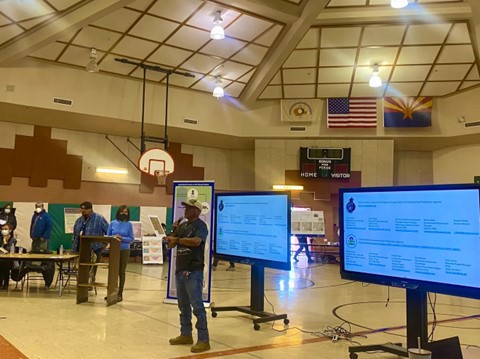
CAMERON — Beverly Ann Huskon and her cousins, Bob Robbins and Natalie Huskie, sat in the bleachers at Dzil Libei Elementary School in Cameron to hear U.S. Environmental Protection Agency and Navajo Nation EPA officials discuss the options the community has to deal with waste from an abandoned uranium mine.
The mine is known as the Charles Huskon No. 12 site, named after the prospector who identified areas in Cameron where uranium could be extracted. The three cousins are descendants of Huskon and they wanted to hear more about what would happen to this site named after their grandfather.
“That’s why I came here to see what kind of ideas they have or what they might be talking about to help the people,” said Huskie. “I don’t know how many people are affected by it. I just hope it’s taken care of. I would want it to be taken away to another area.”
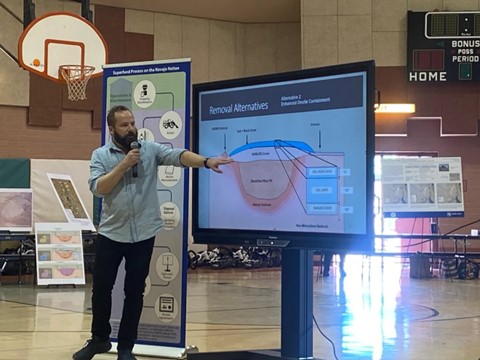
Three options were presented: no action, enhance the onsite containment of the waste, or load it up and take it nearly 600 miles away. The third option, they were told, would require about 3,560 trucks.
The Charles Huskon No. 12 site is located 1.8 miles northwest of the Cameron Chapter House and less than a mile west of U.S. Highway 89. In late 1953, the Atomic Energy Commission explored the site, and between 1954 and 1961, Rare Metals Corporation mined it and then hauled it away in trucks off-site for milling.
In 2013, the Environmental Protection Agency signed what’s called an administrative order of consent with El Paso Natural Gas, which is now responsible for the site, to asses 19 mines. The site covers 13 acres, including 2.6 acres reclaimed by Navajo Abandoned Mine Lands Reclamation Department.
In the 1990s, the department had pushed the mine waste back into the pit and covered it with clean dirt, also covering several areas of exposed bedrock that emitted natural radiation. The site was fenced off and the pit was capped and poses no risk to the community, according to the EPA.
“This particular mine site, all the mine waste is safely contained in the mine pit and has a clean cover over it, so there is no migration or risk from the Charles Huskon 12 mine site to nearby residents,” said Colin Larrick, U.S. EPA remedial project manager.
The preferred option is thorough on-site containment
The site is part of the EPA’s efforts to clean up abandoned uranium mines on the Navajo Nation. The agency has identified responsible parties at many of the sites and they are required to either clean up the site or reimburse the government for EPA-led cleanup work. Larrick said there will always be an option of no action but failing to act will, in time, create a danger.
“Navajo Abandoned Mine did a really good job using engineering design and scientific process to get all of the mine waste material back into the mine pit where it started,” Larrick said of the site. “And they placed a clean cover over the site. That clean cover is a temporary cover. It’s made of fine-grain clay material that doesn’t include organic matter or sandy material that’s good to support plant life and prevent erosion. Over time this temporary cover will erode and the waste material in the pit will be moved by wind and water.”
The second option, enhancing the onsite containment, will involve revegetating the existing cap with native plants and would cost $1.1 million. It’s what the EPA has recommended.
There will also be long-term land-use controls and maintenance, according to the EPA. The time frame for maintenance to be completed will be four and a half months, and it will involve placing mined rock back in the pit. All construction will happen on-site and may require land-use controls, like restriction of homesites.
The third option, moving the waste off-site, would cost $9 million and require 3,560 trucks to pass through the community. That option would take nine months, and it would require more planning and work to take the waste off-site.
“To investigate the site to figure out which area needs to be cleaned up, El Paso Natural Gas surveyed the area all around the mine,” Larrick said. Drainages, where land or water may have moved mined material, were examined and, he said, “there was no migration of material identified.”
Feds agreed to clean up sites decades later
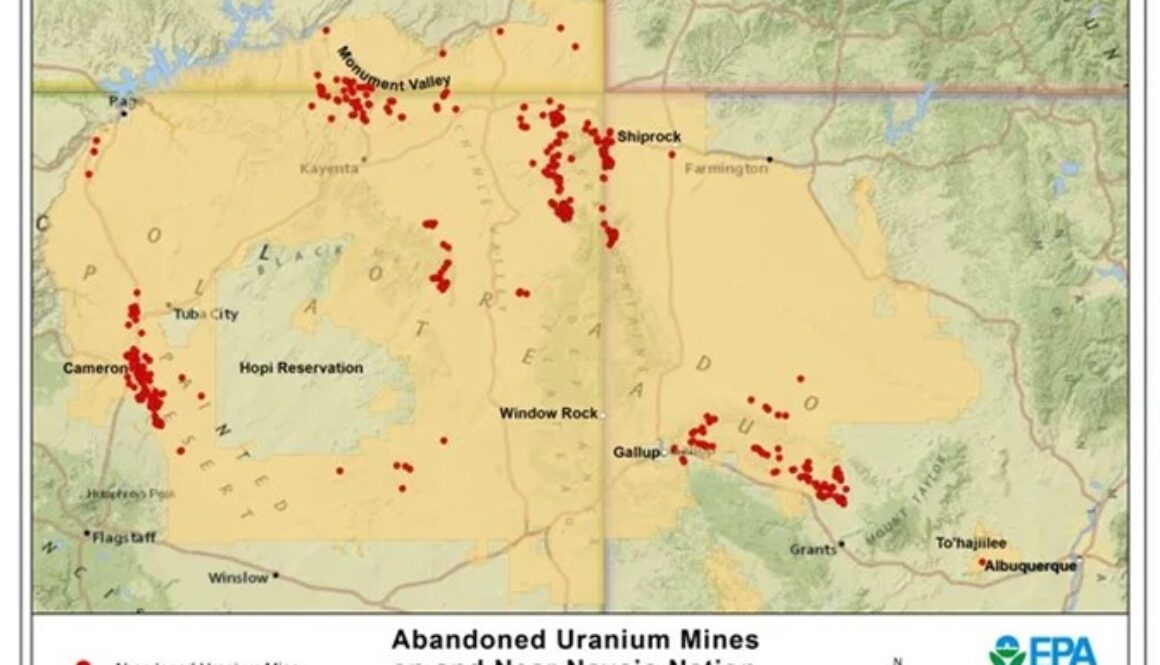
The Atomic Energy Commission announced in 1948 that it would guarantee a price for and purchase all uranium ore mined in the United States. Uranium was discovered in Cove, on the Navajo Nation, and then elsewhere on the reservation. Four centers of mining and milling operated near Shiprock, New Mexico, in Monument Valley, Utah, at Church Rock, New Mexico, and near Kayenta in northern Arizona.
Decades later, the Navajo Nation negotiated with the United States to address the commission’s role in developing historical uranium mining on Navajo land. Those talks led to two legal settlements between the U.S. and the Navajo Nation, the Phase 1 Settlement in 2015 and the Phase 2 Settlement in 2016.
The Phase 1 Settlement provided funds to assess 16 “priority” mines that had elevated radiation levels and were near homes or had the potential for water contamination. The Phase 2 Settlement provided funds to assess an additional 30 mines, conduct two water studies and clean up the 16 Phase 1 priority mines located on the Navajo Nation.
The Navajo Nation has selected Navajo trustees to manage the trust funds and do the work under the oversight of the U.S. EPA and the Navajo Nation EPA. Currently, the U.S. has provided $13.2 million for the Phase 1 Settlement and $21.5 million for the Phase 2 Settlement.
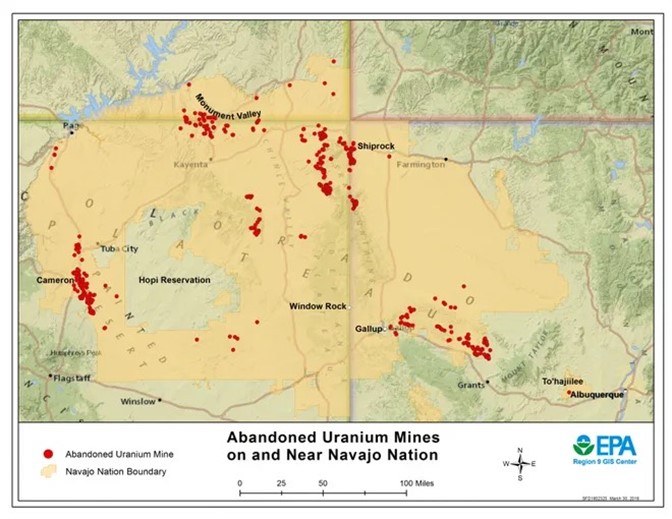
The EPA has identified 523 abandoned uranium mines on the Navajo Nation, and of these, 111 are in the western region, where Cameron is located. Even with the mines identified by the EPA, there are an estimated 1,000 or more abandoned uranium mine shafts on Navajo Nation.
“It is scary, we had an open mine that we called a ‘swimming pool,’” said Huskon. “It was an open pit with water, and a lot of people of that generation, when we were kids growing up, used to swim in it. Now it’s closed, but a lot are still open. Elders still herd their livestock in the area. I’m sure our water is contaminated by uranium.”
By the late 1930s, it was already known that uranium mining was associated with high rates of lung cancer, but when uranium was discovered and mined on the Navajo Nation in the 1940s, that information was unknown to Navajo miners. Navajo was the dominant language spoken and the reservation was considered isolated.
“When uranium mining began, the predominant modes of transportation for Navajo people were by horse and wagon or by foot on the reservation, the Navajo language had no word for radiation, few Navajo People spoke English, and few had formal education,” according to “The History of Uranium Mining and the Navajo People,” by Doug Brugge and Rob Goble.
“Thus, the Navajo population was isolated from the general flow of knowledge about radiation and its hazards by geography, language, and literacy level.”
With few cautions, miners brought debris home
Huskie’s dad and brother, Bob Huskie and Bobby Huskie Jr., were both uranium miners, and she remembers when her dad would bring his clothes home covered in dirt and debris from the mine for her mom to wash, unaware of this seemingly innocent act’s health risks to the family.
“My dad did work in the mine and he came back and left his clothes around the house,” said Huskie. “And back then, they hand washed everything, that’s why I think my mom was affected by it.”
Robbins said there was really no safety class or anything to inform miners about the dangers, so it was easy to think there was nothing wrong when miners came home with debris on their clothes. In some cases, miners built structures or homes using contaminated rocks and boulders they brought home from work.
“Back in those days they didn’t have safety classes for workers,” said Robbins. “So all that stuff was on their clothes when they came home, and part of that went into the food they ate.”
The remnants of the past still can be seen in the open mine pits. Huskie said there are still pieces of uranium right behind her home and in an open area near her house, which she said authorities have told her they will address. That has yet to happen.
Strong, high winds on the Navajo Nation, especially in the springtime, aren’t unusual. Winds can gust to more than 50 mph in some areas. For people living in places such as Cameron, the wind can stir up the waste and debris left by abandoned uranium mines and blow into faces, homes, cars, water, livestock, just about anywhere and everywhere.
“They flagged the area,” said Huskie. “But it seems like kids go over there and play, and they take the flags. We try to inform the kids to stay away from the area. People come out, ask us questions on how they can help us. A lot of that is questions, it’s never anything finalized where something can be done.”
“We have really bad wind that comes through and we inhale,” said Huskie. “There is no wind breaker where we live. It’s really bad.”
There are about 15,700 cubic yards of mine waste, 11,000 cubic yards from within the former pits and 4,700 cubic yards of cap material. Other areas within the Western Abandoned Uranium Mine Region include Coalmine Canyon, Bodaway-Gap and Leupp.
The EPA will collect input on the recommended alternative during the public comment period from March 4 – April 4. Comments can be submitted to larrick.colin@epa.gov or by calling (833) 950-5020.
“I just hope it’s taken care of. Even if I live near it, I don’t ever want to move,” said Huskie. “I hope the cleanup is successful. I don’t want it to where they say they’ll clean it up but another administration comes in and it’s just forgotten again. We are all forgotten.”
Abandoned sites: Navajo residents say they won’t let the government forget about poisoned uranium mines
Arlyssa Becenti covers Indigenous affairs for The Arizona Republic and azcentral.com. Send ideas and tips to arlyssa.becenti@arizonarepublic.com.

Mining on Navajo Nation
To view a copy of the Diné Natural Resources Protection Act of 2005, click here: Navajo Ban
A Legacy of Destruction and No Accountability
The nuclear industry has left a devastating legacy of pollution, illness and death.
Uranium mining began in earnest on Navajo land during the Grants Uranium Boom from the 1950s – 1980s. The NM State Mining and Minerals Division lists 259 uranium production mines and 400 uranium exploration sites with a concentration in the Grants Belt.
When most of these ‘legacy’ mines were operating the Clean Water Act hadn’t been passed and the New Mexico Environment Department didn’t exist. Of the 259 uranium production mines, 137 have no record of any kind of cleanup work.
Navajo families continue to live with the radioactive pollution and increased health risks from past uranium mining and milling, including the United Nuclear Corporation (UNC) uranium mill tailings spill into the Puerco River, in the Church Rock area in 1979. This was the largest release of radioactive waste in U.S. history. URI/HRI which acquired this site from UNC in 1993 has still not committed to a full cleanup of the Old Church Rock Mine and the spill.
Today, HRI/URI claims that in-situ mining is safe. But communities like Kingsville TX, disagree. URI has been unable to restore the water quality contaminated by the in-situ mining there.
In-situ leaching releases large amounts of radon, and produces waste slurries and waste water during recovery of the uranium from the liquid. Dangerous radioactive heavy metals are mobilized in this process. It is technologically impossible to restore natural groundwater conditions after leaching operations have been completed.
Navajo Ban
The Navajo Nation Government unanimously passed a Uranium Mining Ban on tribal lands in April of 2005. Despite this ban, mining corporations like Hydro Resources Inc. (HRI) and Uranium Resources Inc. (URI) have relentlessly pursued permits for new mines, including mines on native sacred sites in New Mexico.
There is NO NEED for new uranium mining. The value of uranium has been artificially bolstered by false promises of “nuclear power renaissance”. The reality is that current nuclear reactors are in their final years of operation and have adequate fuel. No nuclear plants have been licensed, constructed or are even under construction in the US. The Obama Administration would like to change that and this is one step in the process of expanding the nuclear industry – both power and weapons. There are proposals for 22 new uranium mines, billions for weapons expansion and a number of nuclear power plants have been proposed. This is the wrong direction.
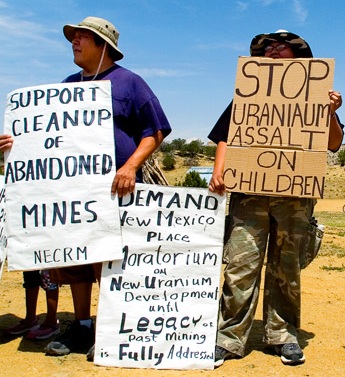
On December 2, 2006 the IWUS Declaration Final of the Indigenous World Uranium Summit was passed at Window Rock, Navajo Nation, USA

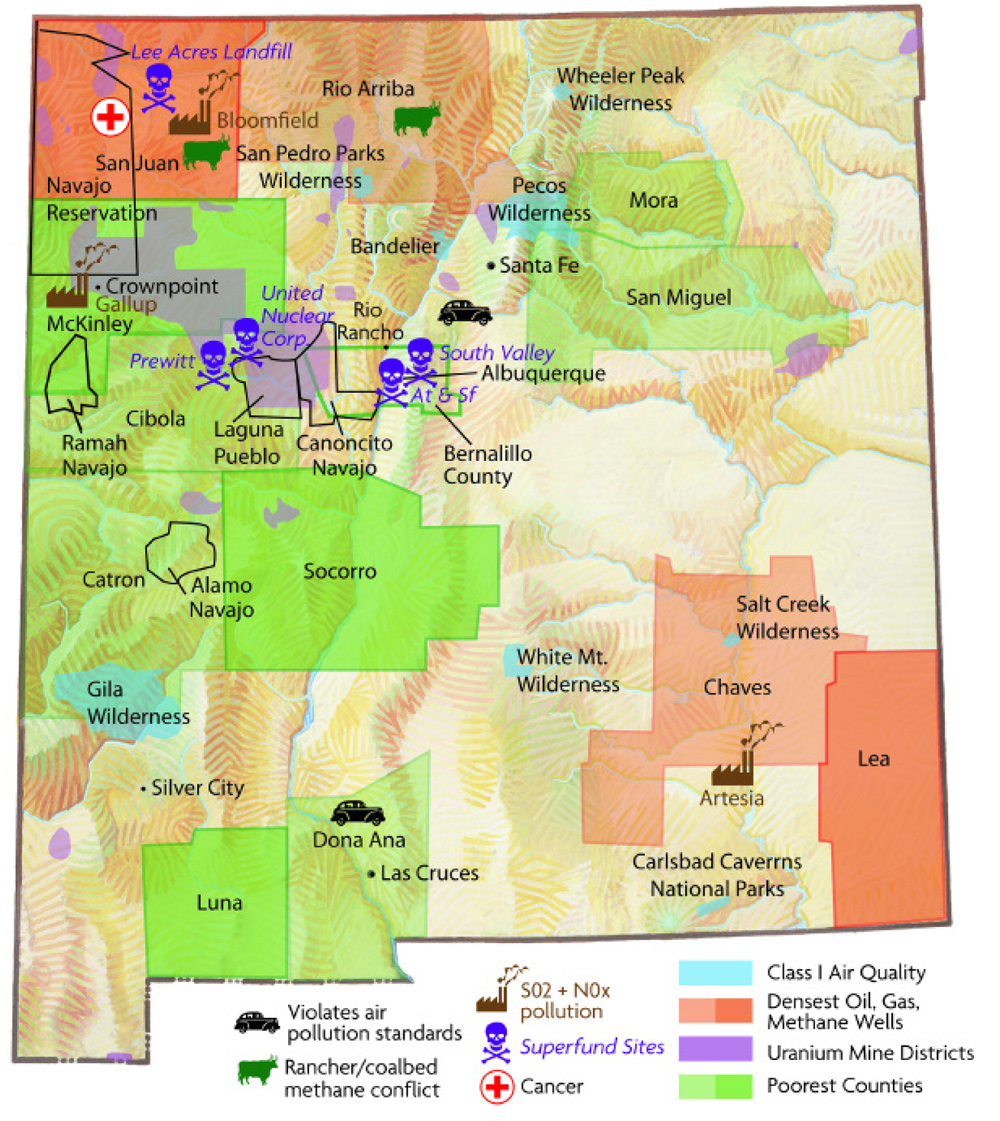
Dreaming New Mexico
NEW MEXICO ENVIRONMENTAL JUSTICE FACTS
- Of 250 abandoned Uranium mines only about 130 have any record of clean up.
- Most New Mexicans spend four percent of their income on utility bills. Because New Mexico is the lowest income earner in the nation, about one in five families spends 20% of its income for electricity or gas.
- Over 10,000 New Mexicans, mostly Native American, have no electricity.
- About 40,000 New Mexican homes cannot afford weatherization.
- Navajo miners and civilians have suffered from uranium mining. The Navajo Nation has banned any future uranium mining and fights mining on adjacent lands.
- Galisteo Basin and northern New mexican counties have been threatened by predatory oil and gas contracts that can leave land owners with degraded land and possible health threats.
- Two coal-fired power plants are among the dirtiest in the nation for merucury and greenhouse gas emissions. Coal and gas rich San Juan county also has the highest cancer rates.
- Sulfur dioxide, nitrogen oxides, heavy metals, and radiactive particles from coal are worst in Bernalillo and San Juan Counties.
- Five energy-related superfund sites remain sources of harm (see map shown above).