Dear Chairman Westerman, Ranking Member Grijalva, and Members of the Natural Resources Committee:
As your committee considers changes to the energy and mine permitting processes, on behalf of the undersigned, we write to ask you to prioritize efforts that would balance public health, community input, and the protection of watersheds, wildlife habitat and cultural and historic resources on America’s public lands and wildlife. Similarly, we respectfully urge your committee to strongly oppose efforts that would exacerbate deficiencies in the existing mining law and result in an unnecessary increase in mining on federal public lands and puts at risk irreplaceable protected lands, special places, endangered and sensitive wildlife, tribal sacred sites, and culturally significant sites in the guise of a clean energy transition.
Improvements to the Mine Permitting Process
We acknowledge that growing demand for certain materials may require new hardrock mines, including some on federal public lands. However, there are better ways to source minerals than allowing entities to stake claims prior to the discovery of a mineral deposit or imposing arbitrary environmental review timelines. Necessary changes include those considered last Congress in the Clean Energy Minerals Reform Act of 2022. Converting to a leasing system for hardrock minerals—just like the one that oil and gas companies use today–would help provide certainty to the permitting process and result in more timely and socially acceptable decisions.
Congress has already invested significant time and resources into permitting reform for mining. The Inflation Reduction Act (IRA) included $1 billion to support timely and effective environmental reviews across federal agencies, which should lead to better, more equitable outcomes, and help avoid litigation. Additionally, the Fiscal 2023 budget will help fund public lands management agencies to perform more thorough mining reviews.
These resources for mine permitting build upon those in the Infrastructure Investment in Jobs Act (IIJA). IIJA made permanent the Fixing America’s Surface Transportation Act Permitting Council (Permitting Council), which, in January 2021, added hardrock mining as a covered sector. In November 2022, the Administration announced the Permitting Council will devote $5 million in support of more meaningful consultations with federally recognized tribes in hardrock mine permitting.
IIJA also required the Interior Department to identify process improvements to hardrock mine permitting. A coalition of tribes, indigenous-led organizations, and conservation groups have also petitioned Interior for rules that, if finalized, would result in more timely decisions for hardrock mine permits without sacrificing necessary public input. In response to both, the administration convened the mining reform Interagency Working Group which should recommend mining rule improvements, consistent with the petition. These updates would also help lead to a fair hardrock mine permitting process, delivering more certainty to both claimants and impacted communities.
Mine Permitting Must Be Modernized, Centering on Historically Impacted Communities
Current mining law has allowed for the pollution of America’s environment and waterways, placing additional unjust burdens on communities who have already borne the brunt of our nation’s toxic mining legacy. Already, America is littered with hundreds of thousands of abandoned mines that the Environmental Protection Agency (EPA) estimates have polluted 40% of the headwaters of western U.S. watersheds and will cost taxpayers more than $50 billion to clean up. Under current law, taxpayers are potentially liable for billions more in cleanup costs at currently operating mines—including treatment of water in perpetuity, risking the health of already threatened Western watersheds—because there is no legal requirement for mining companies to remediate lands and waters.
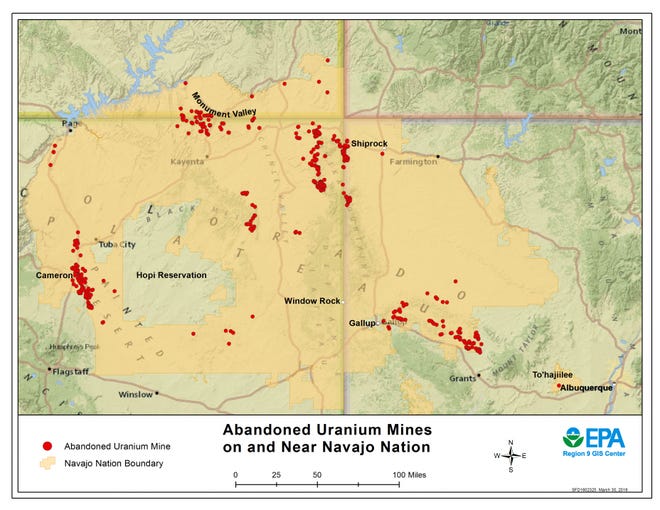
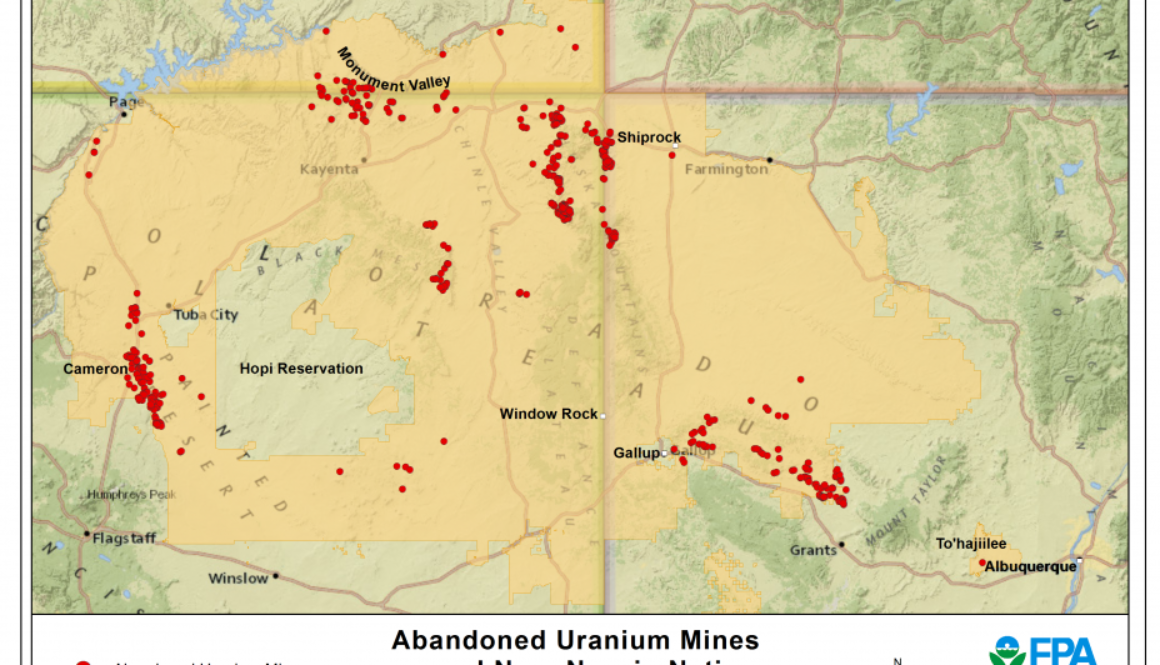
Historical examples of mining companies being given unfettered access to minerals with little to no environmental safeguards have had severely negative consequences—a prime example is found in Navajo Nation’s experience with uranium mining, milling, and toxic pollution. Navajo Nation is situated directly in America’s uranium mining belt, and in the 1950’s and 1960’s fervent uranium development left residents with myriad health risks due to radiation exposure through polluted water and land. Today over 500 of these mines remain unremediated across the Navajo Nation, where they continue to impact residents’ health. Navajo Nation residents are 67 times more likely to live without running water than other residents across the country—and many water sources on the Navajo Nation are contaminated as a result of uranium mining and milling operations. In 2016, researchers with Northern Arizona University discovered high levels of uranium contamination in the water supply of Sanders, Arizona, a small town just outside of the Navajo Nation whose residents are mostly Navajo. It was later discovered that the state had known of the contamination since 2003, but regulators failed to notify the residents of Sanders until after NAU researchers presented their results to the community. The Navajo Nation is not alone. Past and ongoing impacts of uranium operations on Native communities are extensive.
Any Changes to Mine Permitting Must Explicitly Include Protections for America’s Special Places
Expanding mineral activities on federal public lands without modernizing our mining laws could threaten some of our nation’s most treasured areas. Previous mine permitting proposals have sought to scale back protections for millions of acres of tribal sacred sites, culturally significant places, and iconic natural places. While mining is not permitted within the boundaries of National Parks, mining activities pollute the air and water that crosses the boundaries of protected lands. Insufficiently regulated mining in the name of clean energy development promotes a false choice by risking key lands that we need to conserve for our own health and wellbeing. We urge the committee to reject any legislation that puts important American lands, waters, and wildlife at risk of pollution and degradation.
Conclusion
We respectfully urge Members of the House Natural Resources Committee to oppose efforts that would exacerbate deficiencies in the existing mining law and result in an unnecessary increase in mining on federal public lands and puts at risk irreplaceable protected lands, special places, tribal sacred sites, wildlife, and culturally significant sites in the guise of a clean energy transition. There are common-sense solutions to improve mine permitting and promote responsible mining that Congress should consider, including the community-consent driven leasing system in the Clean Energy Minerals Reform Act of 2022. Additional resources, updated rules, and thoughtful IIJA and IRA implementation will also drive mine permitting efficiency.
Thank you for your consideration.
Sincerely,
The Wilderness Society Earthworks Earthjustice Sierra Club National Parks Conservation Association Defenders of Wildlife Center for Biological Diversity League of Conservation Voters Natural Resources Defense Council Conservation Lands Foundation Friends of the Earth Alaska Wilderness League Grand Canyon Trust Southern Utah Wilderness Alliance Oregon Natural Desert Association Friends of the Sonoran Desert Northeastern Minnesotans for Wilderness Arizona Faith Network New Mexico & El Paso Interfaith Power and Light Los Padres ForestWatch Sisters of Mercy of the Americas Justice Team Northern Alaska Environmental Center Arizona Trail Association Conservation Northwest Wilderness Workshop Citizens to Protect Smith Valley (NV) Progressive Leadership Alliance of Nevada Uranium Watch Living Rivers Western Watersheds Project Save the Scenic Santa Ritas Hispanic Federation Idaho Conservation League Kamloops Moms For Clean Air Weber Sustainability Consulting Black Hills Clean Water Alliance Sheep Mountain Alliance Wild Arizona Idaho Rivers United Brooks Range Council Multicultural Alliance for a Safe Environment Okanogan Highlands Alliance Red Water Pond Road Community Association MEIC Arizona Mining Reform Coalition American Friends Service Committee Office of Peace, Justice and Integrity of Creation, Sisters of Charity of New York RedWaterPond Road Community Tucson Audubon Society BlueWater Valley Downstream Alliance. River Alliance of Wisconsin Friends of the Kalmiopsis Kalmiopsis Audubon Society Information Network for Responsible Mining Cook Inletkeeper Endangered Species Coalition Rivers Without Borders Laguna Acoma Coalition For A Safe Environment
CC: Secretary of State, Antony Blinken Special Presidential Envoy for Compact Negotiations Joseph Yun Ambassador of the Republic of the Marshall Islands to the United States, Gerald Zackios
We are writing to respectfully urge the White House and the Department of State to prioritize issues of nuclear justice in the ongoing negotiations between the United States and the Republic of the Marshall Islands (RMI) on an updated Compact of Free Association (COFA).
As you know, between 1946 and 1958, the United States government conducted high-yield nuclear weapons test explosions in the atmosphere and underwater in the Marshall Islands, which produced profound and long-lasting adverse health, environmental, and cultural impacts.
As the 2012 report by the United Nations Special Rapporteur on the impact of the U.S. nuclear testing program on human rights in the RMI concluded:
“The nuclear testing resulted in both immediate and continuing effects on the human rights of the Marshallese…radiation from the testing resulted in fatalities and in acute and longterm health complications. The effects of radiation have been exacerbated by nearirreversible environmental contamination, leading to the loss of livelihoods and lands…many people continue to experience indefinite displacement.”
The scale of nuclear testing was immense. The 67 U.S. atmospheric nuclear weapons tests—23 at Bikini Atoll and 44 at Enewetak Atoll—spewed radiation over the entirety of the Marshall Islands and produced a total explosive power of 108.5 megatons (TNT equivalent). That was about 100 times the total yield of all atmospheric tests conducted at the Nevada Test Site.
These dangerous nuclear detonations produced incalculable harm to the land and people of the Marshall Islands. Whole islands were vaporized by these tests. Radioactive fallout affected all of the islands, and lingering radioactive contamination has made some islands uninhabitable. But to this day, the only individuals considered by the United States as impacted by U.S. nuclear testing are those specified in Section 177 of the original Compact: the people of Rongelap, Utrik, Bikini, and Enewetak atolls, including their descendants.
The U.S. nuclear tests have led to serious illnesses such as radiation poisoning, elevated cancer rates, birth defects, and contamination of food and water sources that continues to this day. The nuclear test explosions seriously disrupted cultural traditions and ways of life. Many Marshallese were dislocated and exiled from their homes; many are still unwilling or unable to return, especially given that the RMI does not have the capacity to independently determine the risks and to monitor them. A massive nuclear waste site, the Runit Dome, is leaking and is threatened by rising sea levels and the possibility of stronger storms due to climate change.
The U.S. government clearly has an ongoing moral obligation to help address the adverse impacts of nuclear testing in the Marshall Islands. We do not believe that any new Compact of Free Association can be considered fair or equitable without fully addressing these issues in a way that is acceptable to the Marshallese people.
While we defer to the Marshallese people and leaders involved in the negotiations of the Compact to determine the specific provisions relating to their longstanding claims for nuclear justice, we want to add our voice to the calls from many quarters—from Marshallese people, to the RMI National Nuclear Commission, to the halls of Congress—for:
A formal apology from the U.S. government to the people of the Marshall Islands for the profound and adverse health, environmental and social consequences of the United States’ nuclear testing program in the Marshall Islands;
Meeting the compensation claims of the Nuclear Claims Tribunal in a serious and fair manner;
Working collaboratively with appropriate parties in the Marshall Islands to expeditiously address environmental monitoring and remediation requirements across the whole country, and to collaboratively develop, implement and provide the necessary financial support for long-term environmental remediation programs and activities;
Expanding access to health care and improving health care capacity especially as it relates to treatment related to illnesses associated with radiation exposure;
Prompt declassification of all documents related to U.S. nuclear testing in the region, cleanup activities, and decisions relating to the relocation of displaced Marshallese peoples, and providing full and complete transparency and accessibility to all relevant post-detonation environmental and health assessment studies and data;
Sufficient and dedicated financial and technical support for building independent, national capacity in the RMI to monitor, assess, and address environmental and health needs so that the Marshallese people have the ability to make and implement better informed decisions concerning their health and environment in the years to come.
We were pleased to see that following the Pacific Islands Summit in September 2022, the United States declared that it remains “committed to addressing the Republic of the Marshall Islands’ ongoing environmental, public health concerns, and other welfare concerns.”
In addition to the deadly legacy of U.S. atmospheric nuclear testing during the Cold War, the people of the Marshall Islands are on the frontlines of the unfolding global climate disaster. Now is the time for the United States to step up and meet its responsibilities by delivering on these important steps for Marshallese people through the new Compact of Free Association.
Thank you for your consideration.
NATIONAL AND INTERNATIONAL ORGANIZATIONS
David Hawks, Acting Executive Director Alliance of Multicultural Physicians
Nadya Dutchin, Executive Director American Humanist Association
Daryl G. Kimball, Executive Director Arms Control Association
Shatabhisha Shetty, Executive Director Asia Pacific Leadership Network
Peter Wilk, MD, Administrative Chair Back from the Brink
Cindy Folkers, Radiation and Health Hazard Specialist Beyond Nuclear
Shea Leibow, National Organizer CODEPINK
Bo Jacobs, President CORE Hanford
Estella Owoimaha-Church, Executive Director Empowering Pacific Islander Communities
Wenonah Hauter, Founder and Executive Director Food & Water Watch
Andrew Albertson, Executive Director Foreign Policy for America
Allen Hester, Legislative Representative for Nuclear Disarmament and Pentagon Spending Friends Committee on National Legislation
Mary Olson, Founder Gender and Radiation Impact Project
Rev. Dr. Karen Georgia Thompson, Co-Executive Global Ministries of the Christian Church (Disciples of Christ)
Mari Faines, Partner for Mobilization Global Zero
Norma Torres, Executive Director Greenpeace
Arjun Makhijani, President Institute for Energy and Environmental Research
Rev. Dr. Liz Theoharis, Director Kairos Center for Religions, Rights and Social Justice
Alan Owen, Founder Legacy of the Atomic Bomb, Recognition for Atomic Test Survivors (LABRATS)
John Burroughs, Senior Analyst Lawyers Committee on Nuclear Policy
Matthew Davis, Senior Director of Government Affairs League of Conservation Voters
Susan Gunn, Director Maryknoll Office for Global Concerns
Keith Kiefer, NAAV National Commander National Association of Atomic Veterans, Inc.
Bemnet Alemayehu, Senior Staff Scientist Natural Resources Defense Council
Michael Beer, Director Nonviolence International
Ivana Nikolic Hughes, President Nuclear Age Peace Foundation
Libbe HaLevy, Producer and Host Nuclear Hotseat Podcast
Diane D’Arrigo, Radioactive Waste Project Director Nuclear Information and Resource Service
Johnny Zokovitch, Executive Director Pax Christi USA
Kevin Martin, President Peace Action
Emilie McGlone, Director Peace Boat US
Robert Gould, MD, Chair Peace Caucus in affiliation with the American Public Health Association
Jeff Carter, Executive Director Physicians for Social Responsibility
Emma Belcher, President Ploughshares Fund
Robert K. Musil, Ph.D., M.P.H., President and CEO
Rachel Carson Council Christian N. Ciobanu, Coordinator and Co-Founder Reverse The Trend: Save Our People, Save Our Planet
Norman Solomon, National Director RootsAction.org
Tim Dewane, JPIC Director School Sisters of Notre Dame, Central Pacific Province
Leslie G. Fields, National Director, Policy Advocacy and Legal Sierra Club
Paul Magno, Program Director The Isaiah Project
Tara Drozdenko, Director, Global Security Program Union of Concerned Scientists
Rev. Michael Neuroth, Policy Advocate for International Issues United Church of Christ, Justice and Local Church Ministries
George Friday, National Coordinator United for Peace and Justice
Gerry Condon, President Veterans For Peace Golden Rule Project
Faith Gay, Government Relations Associate Win Without War
Cynthia Lazaroff, Founder Women Transforming Our Nuclear Legacy
Darien De Lu, President, WILPF US Women’s International League for Peace and Freedom US
David Swanson, Executive Director World BEYOND War
ARIZONA
Matthew Capalby, Spokesman Downwinders of Mohave County Arizona
Jack and Felice Cohen-Joppa, Coordinators the Nuclear Resister
Barbara H. Warren, MD, MPH, Executive Director Physicians for Social Responsibility-Arizona
ARKANSAS
Melisa Laelan, Founder and Executive Director Arkansas Coalition of Marshallese
Benetick Kabua Maddison, Executive Director Marshallese Educational Initiative
CALIFORNIA
Mary Beth Brangan, Co-Founder and Co-Director Ecological Options Network
Matt Harper, Associate Director Los Angeles Catholic Worker
Denise Duffield, Associate Director Physicians for Social Responsibility-Los Angeles
Catherine Crockett, Board President Monterey Peace and Justice Center
Robert M. Gould, MD, President Physicians for Social Responsibility-San Francisco Bay
Dennis Nelson, Director Support and Education for Radiation Victims (SERV)
Marylia Kelley, Executive Director Tri-Valley Communities Against a Radioactive Environment (CAREs)
Jacqueline Cabasso, Executive Director Western States Legal Foundation
GEORGIA
Glenn Carroll, Coordinator Nuclear Watch South
HAWAII
Kip Goodwin, Founding Member Kaua`i Alliance for Peace and Social Justice
James V. Albertini, President Malu ‘Aina Center for Non-Violent Education & Action Action
Mele Stokesberry, President Maui Peace Action
Colonel (Ret) Ann Wright, Chapter Coordinator Veterans For Peace Chapter 113-Hawaii
ILLINOIS
David Borris, President Chicago Area Peace Action
MAINE
Sydney Sewall, MD, President of Board PSR Maine
MARYLAND
Max Obuszewski, Founder Baltimore Nonviolence Center
MASSACHUSETTS
Joseph Gerson, PhD, President Campaign for Peace, Disarmament and Common Security
Anna Linakis, Executive Director Physicians for Social Responsibility-Greater Boston
MINNESOTA
Dave Logsdon, President, Mike McDonald, Secretary Twin Cities VFP, Veterans For Peace Twin Cities Chapter 27
NEVADA
Brian Terrell, Outreach Coordinator Nevada Desert Experience
NEW HAMPSHIRE
Will Hopkins, Executive Director NH Peace Action
NEW JERSEY
The Rev. Robert Moore, Executive Director Coalition for Peace Action
NEW MEXICO
Joni Arends, Co-Founder Concerned Citizens for Nuclear Safety
Petuuche Gilbert, Vice President Laguna Acoma Coalition for a Safe Environment
Susan Gordon, Coordinator Multicultural Alliance for a Safe Environment
Jay Coghlan, Executive Director Nuclear Watch New Mexico
Teracita Keyanna, Community Member/Executive Alternate Red Water Pond Road Community Association
Don Hancock, Nuclear Waste Program Director Southwest Research and Information Center
Jean Stevens, Director Taos Environmental Film Festival
Gregory Corning, President Veterans For Peace Joan Duffy (Santa Fe, NM) Chapter
NEW YORK
Mari Inoue, Co-Founder Manhattan Project for a Nuclear-Free World
Emily Rubino, Executive Director Peace Action New York State
Ellen Ferranti, MD, Secretary Physicians for Social Responsibility-New York
OHIO
Tanya Maus, Director Peace Resource Center at Wilmington College
Vina Colley, President Portsmouth/Piketon Residents for Environmental Safety and Security (PRESS)
OREGON
Betsy Toll, Board Chair Living Earth Gatherings
Fredrick Schafer, State Commander Oregon Association of Atomic Veterans
Jesse Gasper, Executive Director Oregon Marshallese Community Association
Kelly Campbell, Executive Director Physicians for Social Responsibility-Oregon
Debra Higbee-Sudyka, Conservation Committee Chair Sierra Club Oregon Chapter
Daniel Shea, President Veterans For Peace Chapter 72
PENNSYLVANIA
Tonyehn Verkitus, Executive Director Physicians for Social Responsibility-Pennsylvania
SOUTH CAROLINA
Tom Clements, Director Savannah River Site Watch
TENNESSEE
Ralph Hutchison, Coordinator Oak Ridge Environmental Peace Alliance
Coordinator Pax Christi Memphis
UTAH
Kristen Rogers-Iversen, President Gandhi Alliance for Peace
Deb Sawyer, Coordinator Utah Campaign to Abolish Nuclear Weapons
WASHINGTON
Leonard Eiger, Communications Coordinator Ground Zero Center for Nonviolent Action
Shirley Shimada, Member, Board of Directors From Hiroshima to Hope
Tracy W. Powell, Founder No More Bombs
Glen Anderson, Founder and Chairperson Olympia Coalition to Abolish Nuclear Weapons
Liz Moore, Executive Director Peace and Justice Action League of Spokane
Bill Dole, Policy Committee Member Rachel Corrie Foundation for Peace and Justice
Mary Hanson, Chair Seattle Fellowship of Reconciliation
Max Savishinsky, Executive Director Physicians for Social Responsibility-Washington
Aline Prata, Executive Director Whatcom Peace & Justice Center
Hollis Higgins, Secretary Veterans For Peace Spokane Chapter #35
WISCONSIN
Hannah Mortensen, Executive Director Physicians for Social Responsibility-Wisconsin
Kelly Lundeen, John LaForge and Lindsay Potter, Co-Directors Nukewatch
Leonard Eiger, Communications Coordinator Ground Zero Center for Nonviolent Action
Shirley Shimada, Member, Board of Directors From Hiroshima to Hope
Tracy W. Powell, Founder No More Bombs
Glen Anderson, Founder and Chairperson Olympia Coalition to Abolish Nuclear Weapons
Liz Moore, Executive Director Peace and Justice Action League of Spokane
Bill Dole, Policy Committee Member Rachel Corrie Foundation for Peace and Justice
Mary Hanson, Chair Seattle Fellowship of Reconciliation
Max Savishinsky, Executive Director Physicians for Social Responsibility-Washington
Aline Prata, Executive Director Whatcom Peace & Justice Center
Hollis Higgins, Secretary Veterans For Peace Spokane Chapter #35
Time and again, mining company Homestake and government agencies promised to clean up waste from decades of uranium processing. It didn’t happen. Now they’re trying a new tactic: buying out homeowners to avoid finishing the job.
The “death map” tells the story of decades of sickness in the small northwest New Mexico communities of Murray Acres and Broadview Acres. Turquoise arrows point to homes where residents had thyroid disease, dark blue arrows mark cases of breast cancer, and yellow arrows mean cancer claimed a life.
Neighbors built the map a decade ago after watching relatives and friends fall ill and die. Dominating the top right corner of the map, less than half a mile from the cluster of colorful arrows, sits what residents believe is the cause of their sickness: 22.2 million tons of uranium waste left over from milling ore to supply power plants and nuclear bombs.
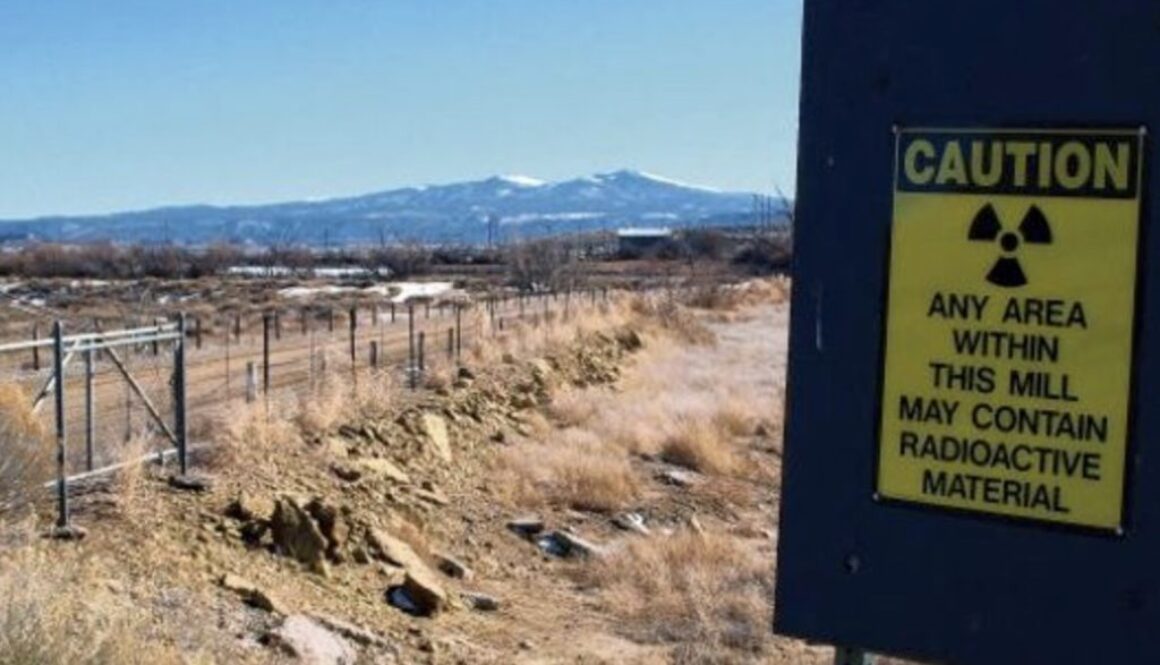
Beginning in 1958, a uranium mill owned by Homestake Mining Company of California processed and refined ore mined nearby. The waste it left behind leaked uranium and selenium into groundwater and released the cancer-causing gas radon into the air. State and federal regulators knew the mill was polluting groundwater almost immediately after it started operating, but years passed before they informed residents and demanded fixes.
The contamination continued to spread even after the mill closed in 1990.
The failures at Homestake are emblematic of the toxic legacy of the American uranium industry, one that has been well-documented from its boom during the Cold War until falling uranium prices and concerns over the dangers of nuclear power decimated the industry in the 1980s. Uranium mining and milling left a trail of contamination and suffering, from miners who died of lung cancer while the federal government kept the risks secret to the largest radioactive spill in the country’s history.
But for four decades, the management of more than 250 million tons of radioactive uranium mill waste has been largely overlooked, continuing to pose a public health threat.
ProPublica found that regulators have failed to hold companies to account when they missed cleanup targets and accepted incorrect forecasts that pollution wouldn’t spread. The federal government will eventually assume responsibility for the more than 50 defunct mills that generated this waste.
At Homestake, which was among the largest mills, the company is bulldozing a community in order to walk away. Interviews with dozens of residents, along with radon testing and thousands of pages of company and government records, reveal a community sacrificed to build the nation’s nuclear arsenal and atomic energy industry.
Time and again, Homestake and government agencies promised to clean up the area. Time and again, they missed their deadlines while further spreading pollution in the communities. In the 1980s, Homestake promised residents groundwater would be cleaned within a decade, locals told the Environmental Protection Agency and ProPublica. After missing that target, the company told regulators it would complete the job around 2006, then by 2013.
In 2014, an EPA report confirmed the site posed an unacceptable cancer risk and identified radon as the greatest threat to residents’ health. Still, the cleanup target date continued shifting, to 2017, then 2022.
Rather than finish the cleanup, Homestake’s current owner, the Toronto-based mining giant Barrick Gold, is now preparing to ask the Nuclear Regulatory Commission, the independent federal agency that oversees the cleanup of uranium mills, for permission to demolish its groundwater treatment systems and hand the site and remaining waste over to the U.S. Department of Energy to monitor and maintain forever.
Before it can transfer the site to the Department of Energy, Homestake must prove that the contamination, which exceeds federal safety levels, won’t pose a risk to nearby residents or taint the drinking water of communities downstream.
Part of Homestake’s strategy: buy out nearby residents and demolish their homes. Local real estate agents and residents say the company’s offers do not account for the region’s skyrocketing housing costs, pushing some who accept them back into debt in order to buy a new home. Those who do sell are required to sign agreements to refrain from disparaging Homestake and absolve the company of liability, even though illnesses caused by exposure to radioactive waste can take decades to manifest.
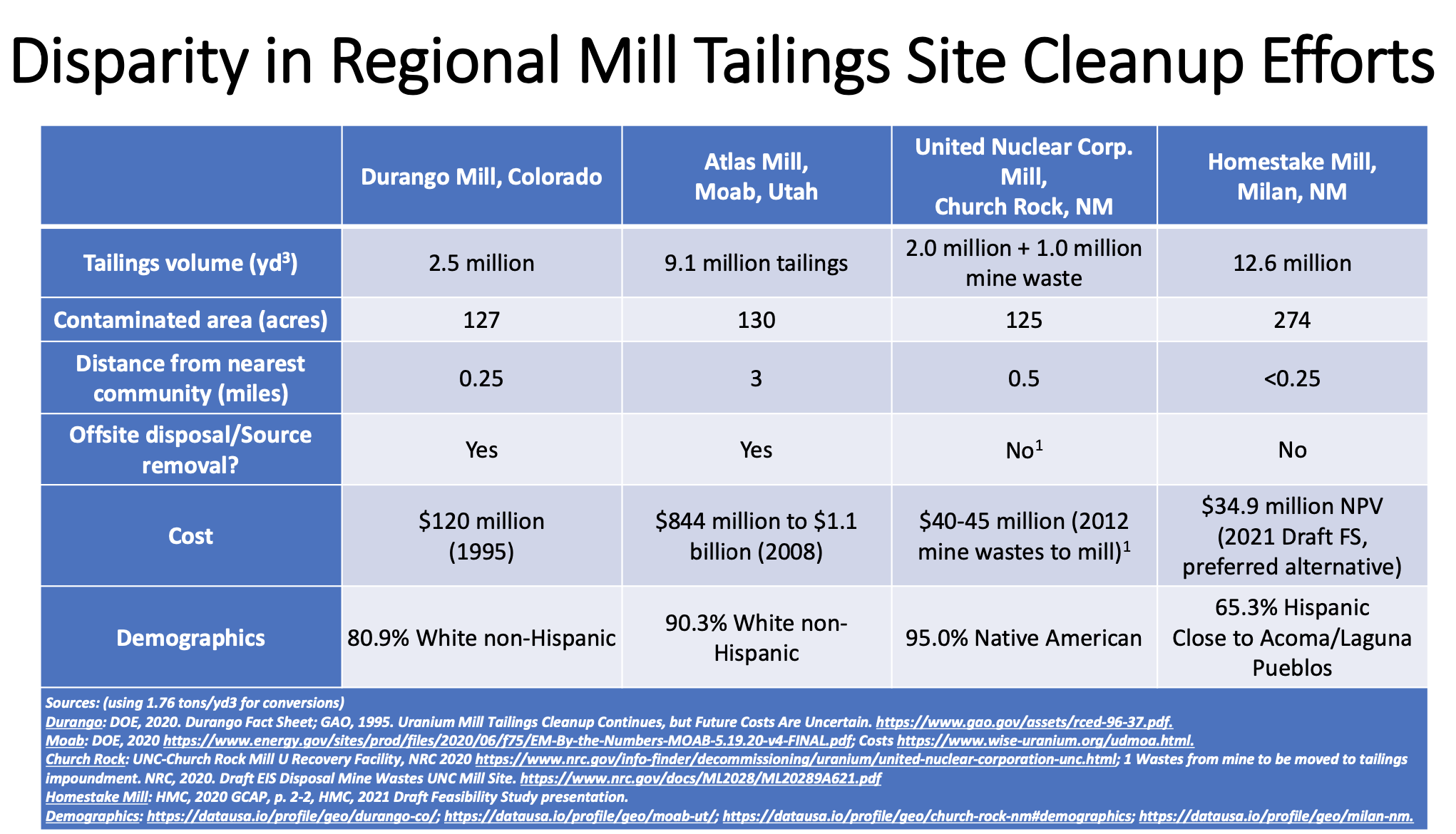
Property records reveal the company had, by the end of 2021, purchased 574 parcels covering 14,425 acres around the mill site. This April, Homestake staff indicated they had 123 properties left to buy. One resident said the area was quickly becoming a “ghost town.”
Even after the community is gone, more than 15,000 people who live nearby, many of them Indigenous, will continue to rely on water threatened by Homestake’s pollution.
The company said it has produced models showing that its waste won’t imperil the region’s water if it walks away. The NRC says it will only grant a groundwater cleanup exemption if that’s the case.
But while Homestake and other mining companies have polluted the region, it’s been the NRC and various other agencies that stood by as it happened. ProPublica found the NRC has issued exemptions from groundwater cleanup standards to uranium mills around the country, only to see pollution continue to spread. This has occurred as climate change hammers the West, making water ever scarcer.
“Groundwater moves. Groundwater doesn’t care about regulations,” said Earle Dixon, a hydrogeologist who reviewed the government’s oversight of uranium cleanup and pollution around Homestake for the New Mexico Environment Department and the EPA. Dixon and other researchers predict contamination at Homestake will likely spread if cleanup ends.
The company has denied that its waste caused residents’ illnesses, and judges ruled in Homestake’s favor in a case residents filed in 2004 alleging the site caused cancer. Doctors testified that the pollution was a substantial factor contributing to residents’ cancers, but tying particular cases to a single source requires communitywide blood, urine and other testing, which hadn’t been done.
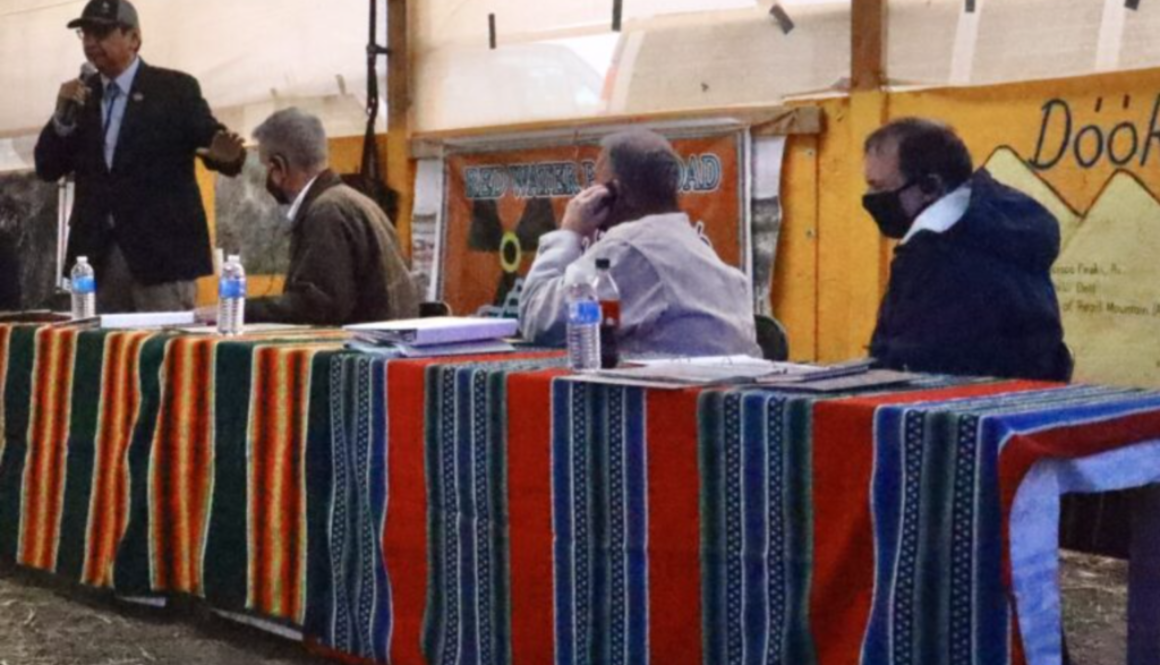
GALLUP – Following the U.S. Nuclear Regulatory Commission’s Earth Day meeting at a shade house on Red Water Pond Road amid a brutal wind storm, the NRC held a formal meeting at the Hilton to discuss how regulators plan to address uranium contamination on the Navajo Nation.
“Some of us are still taking the sand out of our ears and our hair. That’s just what you live with here in the Southwest – a lot of wind,” Navajo Nation PresidentJonathan Nez said during opening remarks. “If there are over 500 uranium mines, just imagine what we’re breathing in with the local community.”
Commissioner Jeff Baran said he began working on the contamination issues 15 years ago in 2007 when U.S. Rep. Henry Waxman led the House Committee on Oversight and Government Reform in a hearing to understand the scope of the Navajo problem and what needed to be done in the interim.
“The challenge is daunting. The widespread uranium contamination that has been around the Navajo Nation is a shameful tragedy,” Baran said. “What happened was wrong and the federal government bears most of the blame.”
Feds to blame
“In spite of its trust responsibility, the federal government allowed millions of tons of uranium ore to be mined and milled on the Navajo Nation to supply the yellowcake used to build the nuclear weapons stockpile during the Cold War,” Baran said. “Workers and communities were not protected or even warned of the dangers.”
In September 2018, United Nuclear Corp./General Electric, submitted a request to the NRC for a license amendment that would pave the way for the relocation of 1 million cubic yards – 1.4 million tons – of radioactive waste from the Northeast Churchrock Mine to UNC’s former uranium mill.
Michael Montgomery, director of the Superfund Division at EPA Region 9, said it seemed fitting that everyone gathered there on Earth Day take a minute to acknowledge the damage and the legacy of uranium mining and its disproportionate impact on the Navajo.
“The remedy is designed to take the mine waste to the mill site and contain it in a state-of-the-art containment facility. Restoring this site to unrestricted use would safely contain the waste and provide for long-term federal stewardship close to the Navajo trust land,” Montgomery said.
The highest levels of contamination, about 3% of the volume, will go farther away to a licensed disposal facility. An evapotranspiration cover, which will limit the infiltration of water, will be placed on top of the mine waste cell.
Downstream, downwind
Red Water Pond Road residences are “downstream and downwind” of the Northeast Churchrock Mine waste pile, he said.
The existing cover will serve as the bottom liner for the mine waste and prevent co-mingling of the more radioactive mill waste. The remedy also will include improvements to stormwater diversion structures and keep water away from the mine waste. The mill tailings from below the mine waste and the groundwater are separated from the bottom of the tailings impoundment by more than 40 feet.
Effective remedy?
Montgomery said EPA recognizes that despite their best efforts, “there’s still some concerns about the design,” but added that EPA can still demonstrate that it is the most protective and effective remedy that we can implement using our statutory tools.”
Baran said the Northeast Churchrock Mine waste is a tough issue and has been for over a decade. “I know that the Navajo Nation and Navajo communities have major concerns with disposal across the street at the mill site. My sense is that a couple of big issues are driving the proposed remedy at the mill site: cost and the potential hazards of transportation. Mr. Montgomery, is that right?”
Montgomery agreed that those are two of the main reasons, but that there are follow-on considerations about the availability of those facilities and about capacity for the available facilities.
Baran said there are over 500 abandoned uranium mines and the Ten-Year Plan calls for starting cleanup at 110 of them. “That’s a lot of mine waste. That’s a lot of sites. Do we have a sense of where all of that mine waste is going to go?” he asked. “How could we do this 500 times, trying to figure out a one-stop solution for every mine?”
The U.S. Nuclear Regulatory Commission met with residents from the Red Water Pond Road Community on April 22. The community is north of Church Rock.
FARMINGTON — A decision that was expected this month about whether to remove uranium mine waste from an area near a Church Rock community or store it onsite near the community has been delayed for now by the U.S. Nuclear Regulatory Commission.
Area residents have called on federal agencies to have United Nuclear Corporation transport the waste to disposal facilities outside the area.
The NRC and its and staff will continue evaluating a request from United Nuclear Corporation to amend its cleanup plan to transport contaminated soil from its uranium mines and dispose the waste at its mill site. The entire activity would take place next to the Red Water Pond Road Community, an area north of Church Rock.
The design of the cleanup was completed in 2018 and approved by the U.S. Environmental Protection Agency for submission to the Nuclear Regulatory Commission, which must approve the request before work can begin, according to information about the Northeast Church Rock Mine posted on the EPA website.
Eric Jantz, attorney with the New Mexico Environmental Law Center, speaks to the U.S. Nuclear Regulatory Commission on April 22 about uranium contamination in the Red Water Pond Road Community, an area north of Church Rock.
Community wants uranium waste removed
Eric Jantz is an attorney with the New Mexico Environmental Law Center and represents residents of the Red Water Pond Road Community, the people who live next to the mines and mill site proposed as a storage area for uranium waste.
“RWPRC hopes the commission’s action will spur the U.S. EPA Region 9 to reconsider its decision to move mine waste from the Northeast Church Rock site to the United Nuclear mill, which it forced upon the community,” Jantz said in a statement.
“EPA should engage the RWPRC and the Navajo Nation at the earliest stages of decision‐making. This would not only avoid lengthy and costly delays in the future, it would also fulfill the United States’ obligations under international human rights law,” he said.
Throughout the session, commissioners were provided first‐hand accounts from residents about the impacts of uranium contamination on the Navajo Nation. They also expressed opposition to the proposal and advocated for removing the waste from the area.
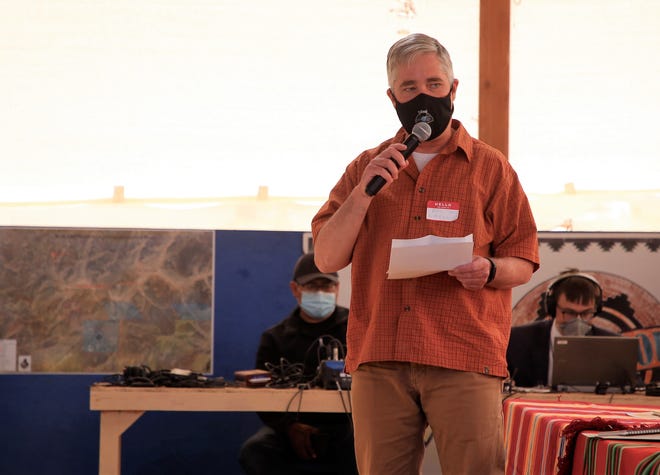
Edith Hood, president of the Red Water Pond Road Community Association, provides opening remarks at the start of the April 22 meeting with the U.S. Nuclear Regulatory Commission.
“Our village is not on a main road. No one sees where we live. That is why they have not cleaned up the uranium waste. Hopefully, they will change course and take the materials away from our homes,” Edith Hood, president of the Red Water Pond Road Community Association, said about the commission’s delay.
Navajo Nation President Jonathan Nez told commissioners that uranium mining on the tribal land was the result of the federal government seeking the material for nuclear weapons.
He underscored that the federal government has the responsibility to remove mine waste from the Red Water Pond Road area and from abandoned mines across the tribal land.
“The Nuclear Regulatory Commission’s decision to hold off on issuing the final EIS is a strong indication that the voices of our people were heard when the commissioners visited the Red Water Pond Road Community,” Nez said on June 17 in a statement to the Daily Times.
He continued, “the commissioners heard a lot of heartfelt testimony and personal accounts from our elders and young people of the physical and mental health impacts brought on by the federal government’s previous uranium mining activities. We appreciate the commission’s decision to hold off and we continue to urge the NRC to move the uranium waste far from our homelands.”
Noel Lyn Smith covers the Navajo Nation for The Daily Times. She can be reached at 505-564-4636 or by email at nsmith@daily-times.com.
By Marjorie Childress, New Mexico In Depth, April 23, 2022
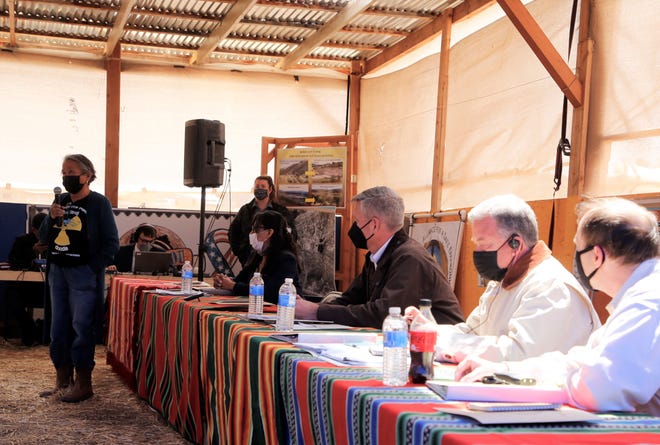
Navajo Nation President Jonathan Nez makes final remarks at the afternoon listening session at the Red Water Pond Road shade house on Friday. Seated at the table are U.S. Nuclear Regulatory Commissioners Christopher Hanson, David Wright and Jeff Baran.
The gale-force winds that swept across New Mexico on Friday, driving fires and evacuations, gave Diné residents in a small western New Mexico community an opportunity to demonstrate first hand the danger they live with every day.
Nuclear Regulatory Commission (NRC) members were in the Red Water Pond Road community, about 20 minutes northeast of Gallup, to hear local input on a controversial plan to clean up a nearby abandoned uranium mine. It was the first visit anyone could recall by NRC commissioners to the Navajo Nation, where the agency regulates four uranium mills. Chairman Christopher Hanson called the visit historic, and the significance was visible with Navajo Nation President Jonathan Nez and other Navajo officials in attendance.
As commissioners listened to 20 or so people give testimony over several hours Friday afternoon, high winds battered the plastic sheeting hung on the sides of the Cha’a’oh, or shade house, making it hard for some in the audience of many dozens to hear all that was said. “This is like this everyday,” community member Annie Benally told commissioners, mentioning the dust being whipped around outside by the wind. “They say it’s clean, it’s ok. But we have more piles back there and you see it blowing this way.”
Friday’s listening session was held at the Red Water Pond Road Cha’a’oh, or shade house, an open structure used for community gatherings. Plastic sheeting was hung around the sides to protect people from the wind. (Image: Marjorie Childress/New Mexico In Depth)
Benally was referring to piles of contaminated radioactive soil and debris at two adjacent abandoned uranium mines. One mine is near enough to the shade house that its gate is visible. The U.S. Environmental Protection Agency wants to move some of that waste to a mill site regulated by the NRC, where contaminated groundwater is still being cleaned up. To drive north of Church Rock to the Red Water Pond Road community is to appreciate how close that mill site is to the surrounding community. It sits one mile south of the shade house, on private land but right next to a highway driven every day by local residents.
After Friday afternoon’s listening session, the federal commissioners conducted a public meeting in Gallup in the evening where they heard from EPA officials. The NRC is expected to decide in June whether or not to permit the EPA to move the mine debris to the mill.
The swirling dust outside was a consistent theme during the Friday afternoon session as residents described a generational struggle with significant health risks from uranium contamination.
“I’m glad we don’t have air sampling going, because that might scare some people,” said Dariel Yazzie, head of the Navajo Nation EPA Superfund program. Yazzie connected the swirling dust outside to historic uranium exposure experienced by residents. Prior to running water being made available to them, people used to haul water in open containers, he said. “Guess what? You’re sitting there with a little bit of dust on you. Everything had dust on it. Where does that dust come from? Right behind us.”
Residents described growing up playing in contaminated landscapes, drinking water from mine sites, not told that it was dangerous. Commissioners heard about the worry parents feel about whether their children are safe playing outside. Others implored commissioners to help speed up the cleanup process, which has taken decades, as health impacts like cancer and lung disease, which have stretched across generations, continue.
“This is not right, it brings anger,” said Benally about decades living with the contamination. “I’m 64 years old now, when they first came I was only 12. How long are we going to stay here, and plead and cry.” She urged commissioners to save the dust on them so that when they’re back home they’ll remember.
The multiple hours of testimony concluded with remarks by Nez, who put a point on the message residents were sending: the mining waste should be moved completely outside of their community.
“This is what the Navajo people live with, just imagine 500 open uranium mines on a windy day,” Nez said. “…the Navajo people in this area have lived with this for a very long time, so we plead with you, I plead with you, let’s get this waste, and get it way far away from the Navajo Nation.”
The EPA cleanup plan wouldn’t move the contamination far, though, just to the nearby mill site. At the public meeting Friday evening, NRC commissioner Jeff Baran asked San Francisco-based EPA Region 9 Superfund and Emergency Management Director Michael Montgomery whether there are other disposal locations outside Indian country but still reasonably close.
Montgomery said current law only allows the EPA to go so far. It can’t site or create facilities for disposal, or ask a private party to do it either, he said. The agency is working to identify locations on federal land for other mine cleanups, Montgomery said, but for the Church Rock area there are no easy solutions for taking the waste out of Indian country. Should the NRC not approve the current plan, the agency would be at an “impasse” that would take years to move beyond, he said.
Montgomery suggested that Navajo aspirations to remove all uranium mine waste from their land would be difficult to achieve by the EPA alone. “If the solution for all the mines is to take all the waste off of tribal land, it’s going to require a dialogue that’s possibly outside our authority,” he said.
Montgomery’s answers seemed to confound Baran. “Would EPA proceed with the mill site option if the community it is meant to benefit opposes it?” he asked.
“There are a lot of perspectives within the community,” Montgomery said. “You can’t always get everyone to agree.”
Nez challenged those remarks later in the meeting after Baran asked him if he wanted to respond to any of Montgomery’s comments.
“I’ve heard a hundred percent of my Navajo relatives there say they didn’t want the waste. So I’m just wondering who are these individuals who can’t agree?” he asked.
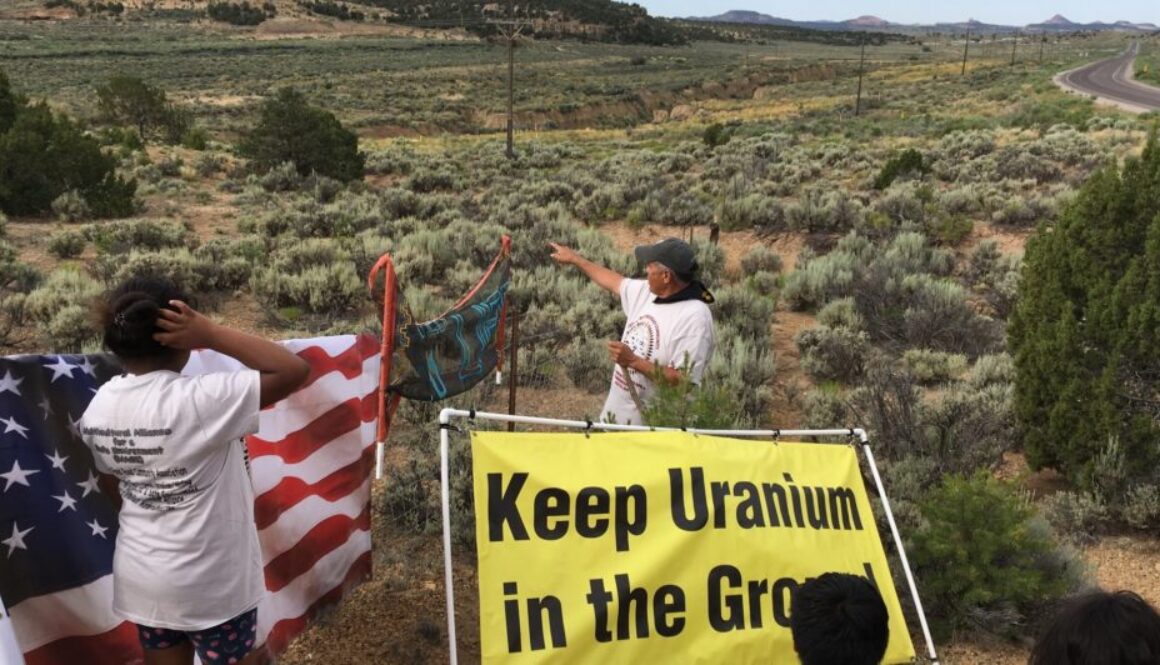
The Nuclear Regulatory Commission (NRC) is visiting the Red Water Pond Road Community (RWPRC) on Friday, April 22 at 2 pm, then hosting a public meeting in Gallup at 6:30 pm.
Please join and show support for RWPRC and advocate for uranium mine cleanup that is protective of the community, sacred waters and future generations.
WHAT CAN YOU DO?
At 1 pm – Meet at the junction of Highway 566 and Frontage Rd, Highway 118, near Red Rocks State Park. We will have signs for you to hold along the road to the Red Water Pond Road Community. Bring your own signs, too!
At 2:30 pm – Join with RWPRC in their village to listen to the NRC Commissioners and hear testimony from the community. The Navajo Nation EPA will be broadcasting the meeting via a public address/sound system. MASKS ARE REQUIRED.
At 6:30 pm – NRC will hold a public meeting at the Hilton Garden Inn, 1530 W Maloney Ave, Gallup. Two panels – ‘Ten-Year Plan to Address Impacts of Uranium Contamination on the Navajo Nation’ and ‘Lessons Learned from the Remediation of Former Uranium Mill Sites.’
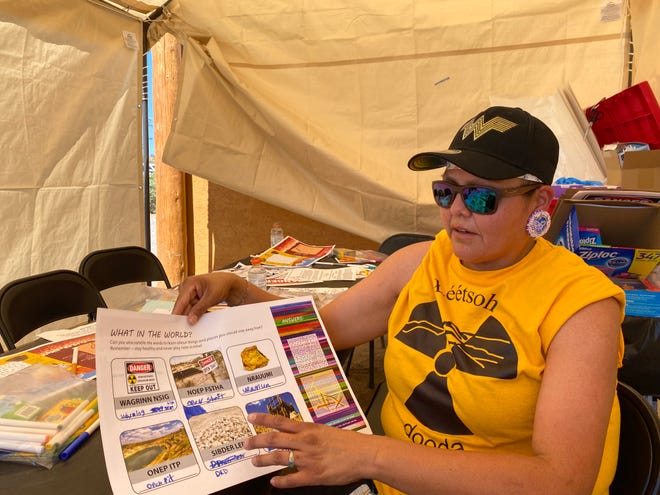
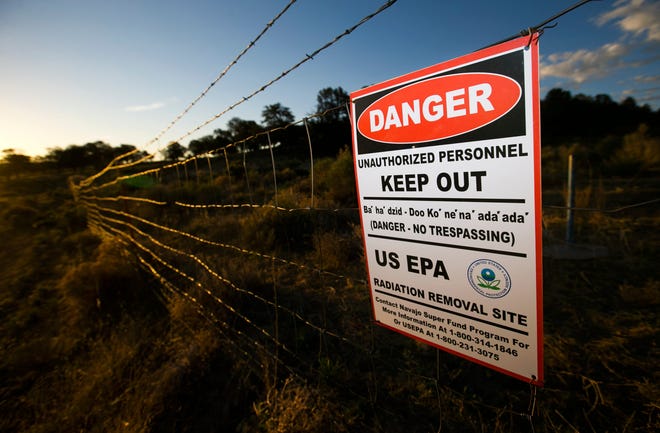
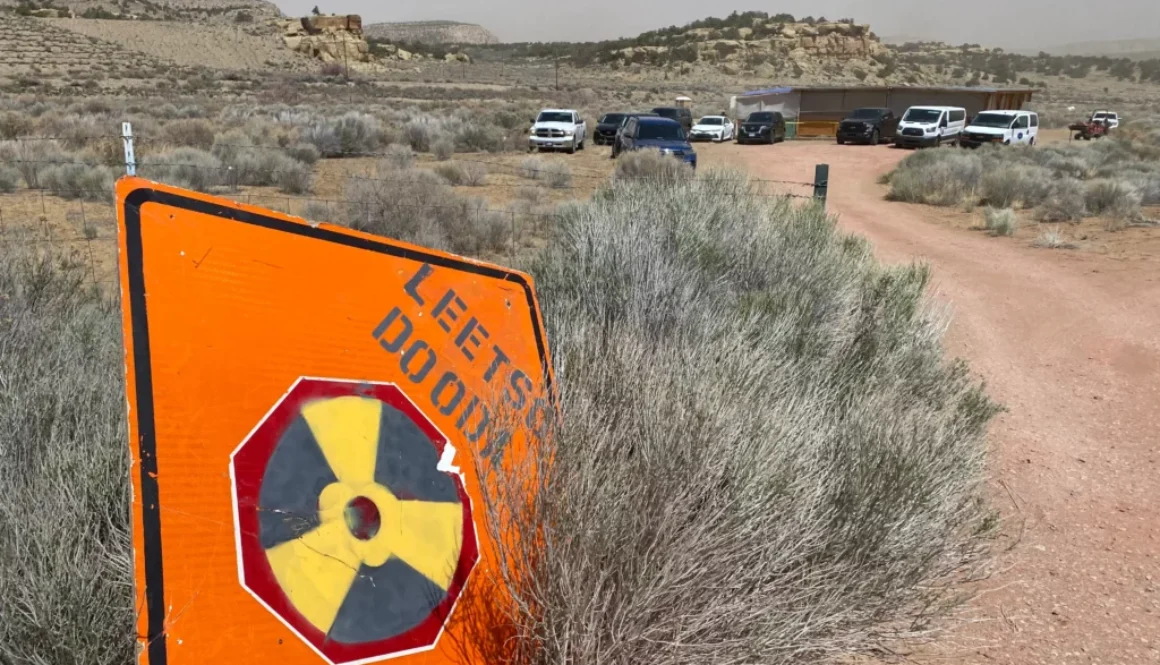
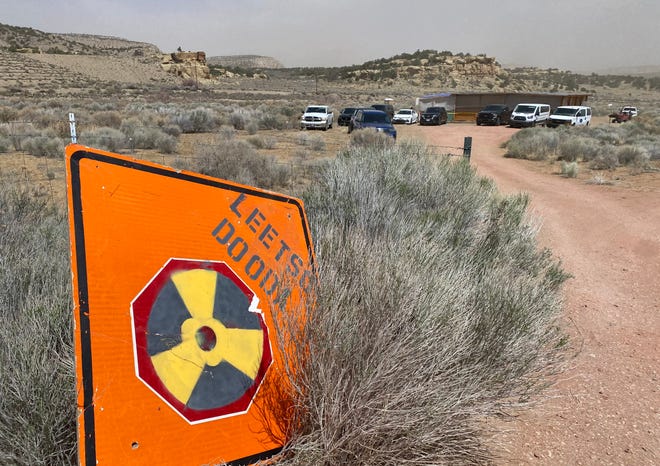
“Leetso Dooda”, which means “no uranium” in the Diné language, is a rallying cry in Navajo communities where abandoned uranium mines and mills dot the landscape. (Images provided by Bryant Furlow of a mill site in the Ambrosia lake mining district and Kalen Goodluck of signs near Church Rock, New Mexico)
Now head of the Navajo Nation’s Superfund program, Yazzie grew up near Monument Valley, Arizona, where the Vanadium Corporation of America started uranium operations in the 1940s.
His childhood home sat a stone’s throw from piles of waste from uranium milling, known as tailings. His grandfather, Luke Yazzie, helped locate the first uranium deposits mined on the Navajo Nation. His father was a uranium miner, then worked for Peabody Coal mine.
Yazzie, Diné, heard the family stories about the U.S. Environmental Protection Agency scanning his family’s home for radiation in 1974, when he was 4 years old, finding several high contamination readings.
“Nothing was done,” he said. Not until 32 years later, in 2006, when a new scan was done, leading to eventual demolition in 2009 of the home where he grew up.
His father now suffers from kidney failure and complications with his heart and lungs, ailments that can stem from uranium exposure, research shows. He received financial support through the federal Radiation Exposure Compensation Act, which provides lump sum payments to former uranium workers, but it doesn’t make up for the fact that he struggles with illness.
And it’s not just his dad. Yazzie has survived cancer, and now lives with the prospect that it could come back one day.
“We often hear about environmental justice, social injustice,” Yazzie said. “Flat-out racism is what the local perception is about these long-standing issues, almost 80 years in some areas. Lack of cleanup, lack of funding, lack of emphasis to prioritize cleanup.”
Dariel Yazzie, Diné, heads the Superfund program within the Navajo Nation Environmental Protection Agency, which includes overseeing uranium cleanup. His childhood home was eventually demolished after revealing high levels of contamination. (Photo by Marjorie Childress/New Mexico In Depth)
But yesterday’s injustices could mean jobs for the future.
Abandoned uranium mines are found in all corners of the Southwest. In New Mexico, about 1,100 sites where mining, milling or exploratory drilling occurred lie abandoned, mostly in the Grants Mineral Belt, which stretches more than 90 miles from Laguna Pueblo almost to Gallup. Hundreds more dot the greater Navajo Nation, in Arizona, Utah and Colorado.
An online interactive map maintained by New Mexico’s Mining and Minerals department pinpoints abandoned uranium sites in the Grants Mineral Belt, which was a booming uranium region until the mid-1980s. The area stretched from Laguna Pueblo almost to Gallup in New Mexico’s northwest checkerboard region. (New Mexico Mining and Minerals/Google Earth)A vast landscape in the Grants mineral belt, called the Ambrosia Lake mining district, is contaminated from past uranium mining and milling. (Photo by Bryant Furlow/New Mexico In Depth)
With big money flowing in the coming decade from settlements with large corporations and the U.S. government for contamination, cleanup of hundreds of abandoned mines will finally begin after decades of neglect.
And that means jobs for tribal citizens and businesses, providing an economic balm for areas that need work. One estimate concludes that about 1,000 jobs could be created over the next 10 years for every $1 billion dollars spent on cleanup, with an average salary of nearly $55,000 per year.
The New Mexico Legislature appears convinced. Lawmakers passed a bill earlier this year to develop a strategic plan for uranium cleanup and to focus economic development on reclamation.
“There are plenty of jobs that can be created cleaning up … abandoned uranium mining sites all across the area,” said Susan Gordon, coordinator of the Multicultural Alliance for a Safe Environment, a coalition of activist groups located in uranium-impacted communities.
But cleanup contracts issued recently by the Environmental Protection Agency have gone to out-of-state companies.
And reclamation brings its own troubles. Some cleanup involves little more than moving contamination from one site to another. The first major cleanup proposed, in Church Rock, New Mexico, exposes the shortcomings of bypassing local communities in the planning process.
Largest radioactive catastrophe in the U.S.
Most of the uranium mining and milling on and around the Navajo Nation occurred before environmental regulations were in place to safeguard human health. When the industry shut down in the 1980s, companies closed shop, leaving hundreds of abandoned uranium mines, extensive surface and groundwater contamination, Radon gas releases and vast amounts of radioactive soil and mining debris.
The U.S. government essentially created the industry in the late 1940s when the newly established Atomic Energy Commission announced it would purchase all uranium mined in the U.S. at a guaranteed price, which it did until 1966. The commission was established after World War II to transfer the nuclear energy assets of the secretive Manhattan Project to civilian control.
By 1967, New Mexico mines were producing half of the total U.S. uranium.
The dangers were significant. On July 16, 1979, the dam of a holding pond at the United Nuclear Corporation uranium mill in Church Rock failed, spilling 94 million gallons of watery, radioactive sludge into the Rio Puerco, running through the local community to Gallup and on to Sanders, Arizona. It is still the largest radioactive catastrophe in the United States.
Larry King, Diné, president of the Navajo Church Rock Chapter, remembers well the day of the spill. King worked at the UNC mine not far from the mill as an underground surveyor, beginning a few months after graduating high school in 1975 until the mine closed in 1983. He heard about the spill from miners coming in for their day shift.
“There was a huge gaping hole,” he said, about the breach at the dam.
The dam failed a few months after the meltdown of the Three Mile Island nuclear reactor near Middleton, Pennsylvania. Three Mile Island led to minimal public health impacts but generated enormous national press coverage and galvanized opposition to the nuclear fuel industry. Much larger and consequential to public health, the Church Rock spill received little attention.
Larry King, Diné, on Feb. 27, 2022, at the United Nuclear Corporation mine and ill site in northern Church Rock, New Mexico, which operated from 1967 to 1982. King worked at the mine for years and was there on the day in 1979 when a dam breach caused a massive radioactive spill. An old building abandoned by the company sits at the mill site today. King approached a fence near the dam breach, and said he had never walked this close to the building before. (Photos by Kalen Goodluck for New Mexico In Depth)
The morning of the spill, the sound of rushing water puzzled people, because it was a clear day.
“I’ve heard from community members who live along the Rio Puerco wash, that’s where the mill waste flowed through, that it sounded like thunder,” King said.
Eventually they learned it was mill waste, he said, but not before people had let their livestock out and they themselves had crisscrossed the wash. Sheep died, crops withered, and at least one woman said it burned her feet. There were similar reports up and down the wash, he said.
The focus on the catastrophe obscured the fact that water had always trickled into the Rio Puerco from the uranium mining upstream, King said.
“Contaminated water did not only flow through the Rio Puerco that one day, on July 16, it was going on for years, 24/7,” he said.
His father’s livestock grazing area ran alongside the Rio Puerco, and his dad extended their fenceline into the wash to make it easier to water the cattle. He played in the water, too.
“There used to be a smell, a real terrible smell, yellow slime along the side… the water always flowed,” he said.
At that young age he thought it was a natural stream. But later, he said, he found out it was contaminated mine water that didn’t stop running until the mining company shut off pumps in the 1990s.
The industry collapsed shortly after the Church Rock spill because of cheaper uranium prices outside the United States. There were 6,800 people employed in 1979. That figure dropped to 2,613 in 1982, before the industry largely shut down completely over the next several years.
Indigenous voices not heard
Perry H. Charley has investigated the scope of uranium contamination for decades.
Recently retired from Diné College where he founded the Diné Environmental Institute Research and Outreach Program, Charley said official counts on Navajo land underestimate the number of abandoned mines — including exploratory mines, drilled shafts and buildings — resulting from the Atomic Energy Commission’s uranium program.
“They left it as it is; they just walked off,” said Charley, Diné, an expert on the health and environmental impacts of uranium contamination. “You have tons of radioactive material scattered all over the Southwest.”
Now, 40 years after the industry shut down, the UNC Church Rock mine that King worked at remains contaminated with debris, but that could change soon.
It’s the only one of 523 abandoned mines on or within a mile of the Navajo Nation nearing the beginning of cleanup, according to the EPA.
But that cleanup plan is controversial. The proposal, developed by the U.S. EPA office in San Francisco, calls for simply moving approximately one million cubic yards of contaminated uranium soil, rocks and other debris across a nearby highway to the reclaimed mill site where the dam breach in 1979 occurred. It’s on private land, but so close it’s still near the local Navajo community. A remaining amount of contaminated mine waste would still need to be cleaned up, through a separate EPA process.
The plan doesn’t reflect the wishes of the Navajo Nation and local residents that the waste be removed entirely. The community will still sit practically next door to the contamination.
“The position has always been off-site disposal. And taking it across the street, literally across the street, does not work for the Navajo people,” said Valinda Shirley, executive director of the Navajo Nation EPA, to state lawmakers at a hearing on uranium last September.
The mill site is regulated by the Nuclear Regulatory Commission, the successor to the Atomic Energy Commission, so the EPA’s plan triggered the need for the agency’s approval. The NRC issued an environmental impact statement for public comment in 2020, and is expected to finalize its decision this summer.
But public education and opportunities for input from the local community about the environmental impact statement were insufficient, Yazzie said.
Direct person-to-person outreach to people living near the site was needed, he said, because many people don’t have phones or reliable internet. Instead the NRC held one in-person meeting in Gallup, and several more online meetings, he said.
“They should have knocked on every door, with the whole plan, bring copies,” he said, “and be fluent in Navajo to go over the entire packet. That never happened. The limited amount of information they shared, over the radio, over internet platforms, they were speaking oftentimes too technical, in English, that some didn’t understand. So, is this an environmental justice issue? Or is this a racism issue?”
The lack of community voices and input is concerning, Yazzie said, because the northeast Church Rock mine cleanup will set the stage for how community members are included in future cleanups.
The Church Rock proposal comes despite the EPA’s 10-year plan requiring that traditional ecological knowledge and Diné Fundamental Law, a set of principles that guide Navajo decision-making, inform its remediation decisions.
The Native view of cleanup is based on ecological restoration, Charley said, but Indigenous perspectives are often missing from non-Native approaches to cleanup, which can lead to reclamation projects failing.
“Modern Western science risk assessment leaves out so much from the Diné viewpoint,” he said. “It leaves out sacredness, livingness, the soul of the earth.”
From the perspective of the Diné people, the traditional belief is that illness and the imperfections of life are an imbalance, and the underlying toxins, such as radioactive waste, are disrespectful to the environment, or Mother Earth, he said.
Holistic healing, he said, is maintained by a “delicate interconnectedness” between the physical, emotional, psychological and spiritual existence of human beings.
To bridge non-Native and traditional approaches to reclamation, it’s important to include traditional Navajos and scientists, like him, who live in impacted communities, Charley said.
Failing to incorporate Native ecological knowledge at the beginning of the process can mean certain communities are overlooked for cleanup because the full impact of toxic exposure they experience is missed. A medicine man, for example, might gather plants for their medicinal properties or for traditional ceremonies from a contaminated area 30 miles away that wasn’t prioritized for cleanup. Taking the plants back home would spread contaminants, a risk that could be missed by non-Native scientists, Charley said.
The result is a high certainty that rural communities that are sparsely populated won’t be prioritized for cleanup when they should be, he said.
New generation of workers
Kirby Morris, Diné, stands in the Red Rock State Park in Church Rock, New Mexico, on Feb. 27, 2022, with Dr. Abhishek RoyChowdhury, right, an assistant professor of environmental science at Navajo Technical University. Morris is studying mine reclamation under a program operated by RoyChodhury, and hopes to be able to use her knowledge with uranium cleanup. (Photo Kalen Goodluck for New Mexico In Depth)
Yazzie said the reclamation field needs a new generation of Indigenous workers to help ensure proper remediation in the decades ahead. It needs people not only trained in reclamation but who understand local perspectives and can communicate effectively with community members.
People like Kirby Morris.
Every week, Morris, Diné, drives 35 miles east from her home in Coyote Canyon to Navajo Technical University in Crownpoint where she studies environmental science and learns to clean up abandoned, hardrock mines.
As a child, Morris would visit her grandmother in Coyote Canyon, on the Navajo Nation in northwest New Mexico, and climb to the top of the mesa behind her grandmother’s house.
“They always said there’s abandoned mines back there,” she said. “You can just see it — a doorway that’s closed up into the hillside.”
After looking at maps of abandoned mines, Morris, now 39, realizes the mine she saw had been used to unearth uranium decades ago.
“We shouldn’t even be near it, but it’s so close, you know,” she said, “just on top of the mesa from the communities down there.”
Morris works on a Navajo Technical University team trying to transform soil from an abandoned coal mine near Socorro so that it can grow plants and vegetation. The idea is to come up with the right “recipe” that can then be used back at the mine to grow ground cover.
Morris and the other Navajo students working on the project could one day employ what they’re learning in uranium remediation jobs.
At the root of her work is a desire to teach her four children about the environment and protecting it for them and Navajo communities.
“I do see it as a career,” she said. “This is something that is, you know, needed here not only on the Navajo Nation but the state of New Mexico as well. It would be a benefit for all of us.”
Dr. Abhishek RoyChowdhury, an assistant professor of environmental science and natural resources at NTU, leads the soil cleanup project for the Socorro coal mine and is working to prepare future environmental scientists from Navajo communities for the reclamation field.
Along with colleagues, he’s building a radiation health physics associate science program that will train students to handle radioactive waste, a specialized process regulated by the government.
“We believe if we can train our local workforce, they will be the main force to solve this issue,” said Roychowdhury, who is non-Native. “If we can provide the education, if we can provide the training, we can build a future workforce who can work for the Navajo Nation, who can work for these external companies who are always looking to hire local people.”
Looking ahead
New attention to environmental cleanup comes after a string of bad economic news for the region, which is made up of a checkerboard of Navajo, federal, state and private lands.
In 2020, big employers near the city of Gallup – a Marathon oil refinery and the Escalante coal-fired power plant in Prewitt – shut down. Three hundred people lost their jobs.
In metropolitan Farmington, another city near the Navajo Nation, the closing earlier this year of the San Juan Generating Station will worsen a steady decline in the labor force. On the horizon looms the expected 2031 closure of another large employer, the Four Corners Power Plant in Fruitland.
Corporate interests and New Mexico elected officials, including Democratic Gov. Michelle Lujan Grisham, hope to tap the region’s vast natural gas reserves to create a new hydrogen fuel industry and replace lost jobs.
Another job-creation idea sailed through the New Mexico Legislature earlier this year: cleanup of abandoned uranium mines. Lawmakers hope mine reclamation can help workers and businesses access jobs if the state helps to coordinate training and fosters relationships.
The idea began to take shape during a 2018 struggle over a uranium mining permit at Mount Taylor, which pitted a need for jobs against desecration of a sacred site of the Navajo Nation and many of the state’s pueblo tribes.
It then bloomed into an influential economic study by the Bureau of Business and Economic Research at the University of New Mexico. In a legislative presentation last year, bureau researcher Rose Rohrer estimated cleanup projects could create 1,000 jobs for every $1 billion spent on cleanup over 10 years, with an average salary of $54,633 per year. Jobs would include general labor, trucking, environmental science, architecture and engineering.
New Mexico lawmakers ran with the idea, passing a law that directs state agencies to develop a strategic plan for mine cleanup, and create or promote programs for worker training and business development. It also created a revolving fund specifically for uranium remediation with hopes for future funding from the state and federal governments and the private sector.
And it created uranium reclamation positions in the state’s Mining and Minerals agency and Environment Department. That gives the agencies additional resources to address legacy uranium mining and mill site contamination through holistic strategic planning, Environment Department spokesman Matthew Maez said.
The effort complements the Environmental Protection Agency’s 10-year plan for uranium remediation on Navajo land, which includes a workforce development component intended to ensure cleanup money flows to Navajo companies and workers.
So far, however, cleanup contracts the EPA has awarded have gone to non-Navajo-owned companies. The EPA doesn’t give preference to Navajo companies in awarding contracts, according to EPA Press Officer Joshua Anderson, but each contract includes an employment plan and training requirements, and companies must file an annual report about how they created “meaningful job opportunities” for Navajo businesses and the Navajo Nation.
In an $85 million contract with Tetra Tech, Inc. in 2017 to assess uranium contamination, the EPA built in criteria to encourage the company to procure services and supplies from Navajo companies, and to partner with NTU to train Navajo students, like Morris, in career paths related to assessment and cleanup. The plan also calls for industry job fairs and advertising to get the word out about contract opportunities.
Cleaning up abandoned mines costs a lot of money. Regulations, laws, and safety issues must be considered when planning for uranium remediation. Millions of tons of radioactive soil will likely be moved to designated repository sites, and workers will need specialized training for handling chemicals or radioactive material and to master guidelines they must follow while on the job.
The economic study singled out time-consuming, costly training as a barrier to small companies breaking into the uranium remediation industry.
Funding for reclamation has been a long time coming, though it got a recent boost through large, corporate settlements and new funding that U.S. Sen. Martin Heinrich, D-New Mexico, attached to last year’s federal infrastructure bill.
But the expected explosion of jobs could be snatched up by out-of-state companies and out-of-state workers as more reclamation money flows into the state, Rohrer said.
“These are lifetime issues,” Rohrer said, “and they can bring jobs and opportunities for lifetimes.”